‘Better if he was dead’: Kenyan mother’s search for son year after protests

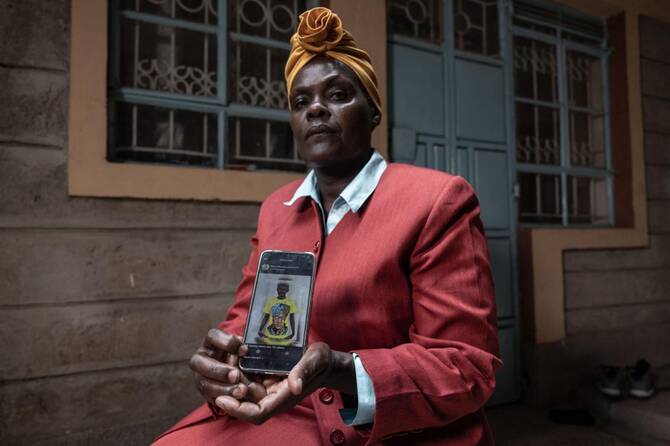
Susan Wangari has lost count of the morgues, hospitals and police stations she has visited in search of her son, who went missing at the height of Kenya's mass protests last June. (AFP)
Short Url
Updated 09 June 2025
Follow

‘Better if he was dead’: Kenyan mother’s search for son year after protests

  • Susan Wangari has lost count of the morgues, hospitals and police stations she has visited in search of her son, who went missing at the height of Kenya’s mass protests last June

NAIROBI: Susan Wangari has lost count of the morgues, hospitals and police stations she has visited in search of her son, who went missing at the height of Kenya’s mass protests last June.
She last saw Emmanuel Mukuria, 24, on the morning of June 25, 2024, the day that thousands of Kenyan youths thronged the streets of Nairobi and stormed parliament in protest at planned tax rises and corruption.
“It would be better if my son were dead; at least I could visit his grave,” she told AFP.
Rights groups say at least 60 people were killed during the protests in June and July, and more than 80 abducted by the security forces since then, with dozens still missing.
Mukuria’s friends say he was arrested during the protests in the city center, where he worked as a minibus tout.
“We do not have peace in this house,” his mother, 50, told AFP during a visit to her single-room home in the Kasarani slum area.
“I sleep lightly at night in case he comes knocking at my window like he always did,” she said.
“Every time we hear that bodies have been found somewhere, we are anxious to know whose they are.”
Two men told her they shared a cell with Mukuria, but they are too afraid to speak publicly about their ordeal.
One was only released in February, giving her hope that her son is still alive in captivity.
“They told me they were beaten and questioned about the protests. They were being asked who paid them to participate,” Wangari said.
Last month, President William Ruto, in a clear admission that security forces had engaged in kidnappings, said all those abducted during the protests had been “returned to their families.”
Rights groups say dozens are still missing and police have shown little progress in investigating the disappearances despite Ruto claiming an “accountability mechanism” was put in place.
Questioned by AFP, the president’s office said the police were “handling the brief,” while a police spokesman referred AFP back to the president’s office.
The police spokesman said they had no information on Mukuria’s case. An officer-in-charge at the station where Wangari reported him missing said the matter was still under investigation.
Many other families are still dealing with the aftermath of the violence.
Rex Masai, 29, was the first to die during the protests, shot and killed in the city center on June 20.
The inquest into his death is still dragging on.
“We are hoping for the best but we are not near the truth,” Masai’s mother Gillian Munyao told AFP at her home, where a photo of her dreadlocked son hangs on the wall.
She found her son lying lifeless in a pool of blood at a clinic where he was taken that day.
The state prosecutor has said a lack of witnesses has delayed progress in the case.
One potential witness was scared off for fear he might be “forcibly disappeared” by the police, Munyao said.
Hussein Khalid, head of rights group Vocal Africa, blamed a “lack of cooperation by the authorities.”
“When you get evidence, the unfortunate bit is you have to take it to the police themselves,” he said.
He lost count of the number of funerals he attended after the protests, estimating between 20 and 30.
“Was it necessary to unleash this kind of brute force against young, innocent Kenyans?” he said.
Politicians have shown little interest in accountability or learning from the unrest.
“People were killed, we sympathized, we moved on,” Bashir Abdullahi, a member of the ruling coalition, told parliament during a debate on the protests last month.
But for victim’s families, the search for justice “means a lot,” said Masai’s father, Chrispin Odawa.
“The wound will never heal,” he said.


Russia-ally Touadera seeks third term in Central African Republic

Updated 1 sec ago
Follow

Russia-ally Touadera seeks third term in Central African Republic

BANGUI: Central African Republic President Faustin-Archange Touadera is seeking a third term in an election on Sunday, campaigning on security gains after signing deals with rebel groups and enlisting support from Russian mercenaries and Rwandan ​forces.
He faces six opposition candidates including Anicet-Georges Dologuele, a former prime minister and runner-up in the 2020 election, but is likely to win in part due to his control over state institutions, analysts say.
Such a result would likely further the interests of Russia, which has traded security assistance for access to resources including gold and diamonds. Touadera is also offering access to the country’s lithium and uranium reserves to anyone interested.
The 68-year-old mathematician took power in 2016 after the worst crisis in the chronically unstable country’s history, when three years of intercommunal strife forced a fifth of the population to flee their homes, either internally or abroad.
Touadera has signed peace deals this year with several rebel groups, while ‌others have been ‌weakened in the face of Russian mercenaries and troops from Rwanda deployed to ‌shore ⁠up Touadera’s ​government as ‌well as UN peacekeepers.
“During the 10 years that we have been working together, you yourselves have seen that peace is beginning to return, starting from all our borders and reaching the capital,” Touadera told a rally at a stadium in the capital Bangui this month.
His opponents, meanwhile, have denounced a constitutional referendum in 2023 that scrapped the presidential term limit, saying it was proof Touadera wants to be president for life.
They have also accused him of failing to make significant progress toward lifting the 5.5 million population out of poverty.
“The administrative infrastructure has been destroyed and, as you know, the roads are in a ⁠very poor state of repair,” Dologuele told a recent press conference.
“In short, the Central African economy is in ruins.”
SECURITY THREATS REMAIN DESPITE PEACE DEALS
The presidential ‌contest is taking place alongside legislative, regional and municipal elections, with provisional results ‍expected to be announced by January 5.
If no ‍candidate gets more than 50 percent of the vote, a presidential runoff will take place on February 15, while legislative ‍runoffs will take place on April 5.
A smooth voting process could reinforce Touadera’s claim that stability is returning, which was buttressed last year with the UN Security Council’s lifting of an arms embargo and the lifting of a separate embargo on diamond exports.
“The fact that these measures were lifted, it shows that we’re gradually getting back to normal. Or at least that’s the narrative,” said Romain ​Esmenjaud, associate researcher at the Institut Francais de Geopolitique.
The peace deals are credited with a decline in violence in some areas and an expected boost in economic growth projections to 3 percent this ⁠year, according to the International Monetary Fund. US President Donald Trump’s administration has said the UN should hand security back to the government soon.
But serious security threats remain. Rebels have not fully disarmed, reintegration is incomplete, and incursions by combatants from neighboring Sudan fuel insecurity in the east.
Pangea-Risk, a consultancy, wrote in a note to clients that the risk of unrest after the election was high as opponents were likely to challenge Touadera’s expected victory.
“The election will take place in an atmosphere marked by heightened grievances over political marginalization, increasing repression, and allegations of electoral fraud,” said chief executive Robert Besseling.
Dologuele alleged fraud after he was recorded as winning 21.6 percent of the vote in 2020, when rebel groups still threatened the capital and prevented voting at 800 polling stations across the country, or 14 percent of the total. A court upheld Touadera’s win.
Paul-Crescent Beninga, a political analyst, said voters will be closely scrutinizing the voting and counting processes.
“If they do not go well, it gives those ‌who promote violence an excuse to mobilize violence and sow panic among the population of the Central African Republic. So that is why we must ensure that the elections take place in relatively acceptable conditions,” he said.