

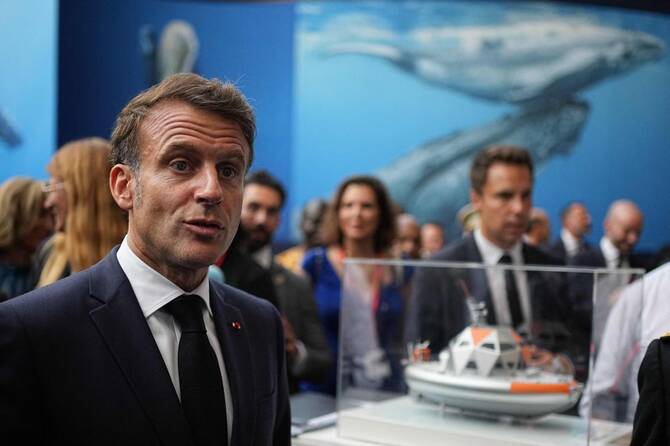

NICE:The third UN Ocean Conference opens Monday as pressure mounts for nations to turn decades of promises into real protection for the sea.
The summit comes as just 2.7 percent of the ocean is effectively protected from destructive extractive activities, according to the nonprofit Marine Conservation Institute. That’s far below the target agreed under the “30x30” pledge to conserve 30 percent of land and sea by 2030.
Atop this year’s agenda is ratification of the High Seas Treaty. Adopted in 2023, the treaty would for the first time allow nations to establish marine protected areas in international waters, which cover nearly two-thirds of the ocean and are largely ungoverned.
“It’s the Wild West out there with countries just fishing anywhere without any sort of regulation, and that needs to change,” said Mauro Randone, regional projects manager at the World Wildlife Fund’s Mediterranean Marine Initiative. “The high seas belong to everyone and no one practically at the same time, and countries are finally committing to establish some rules.”
The ocean is critical in stabilizing Earth’s climate and sustaining life. It generates 50 percent of the oxygen we breathe, absorbs around 30 percent of carbon dioxide emissions and captures more than 90 percent of the excess heat caused by those emissions. Without a healthy ocean, experts warn, climate goals will remain out of reach.
The treaty will only come into force once 60 countries ratify it. As of Monday, just 32 countries had. Advocates hope UNOC can build enough momentum to cross the threshold, which would allow for the first official Oceans Conference of Parties.
“Two-thirds of the ocean is areas beyond national jurisdiction — that’s half our planet,” said Minna Epps, director of global ocean policy the International Union for Conservation of Nature. “We cannot possibly protect 30 percent of the ocean if it doesn’t include the high seas.”
South Korea, France and the European Union have championed the treaty, but most large ocean nations have yet to ratify it, including the rest of the G20. Thousands of attendees are expected in Nice — from delegates and heads of state to scientists and industry leaders. The United States has yet to confirm a formal delegation.
Moving from protections on paper to something real
Beyond new commitments, the conference highlights the growing gap between marine protection declarations and real-world conservation.
France, the conference co-host, claims to have surpassed the 30 percent target for marine protection. But environmental groups say only 3 percent of French waters are fully protected from harmful activities like bottom trawling and industrial fishing.
In 2024 alone, more than 100 bottom-trawling vessels were recorded spending over 17,000 hours fishing within France’s six marine nature parks, according to ocean advocacy group Oceana.
“The government declares these as protected areas, but this is a lie,” said Enric Sala, founder of National Geographic Pristine Seas marine reserve project. “Most of it is political box-ticking. It’s all paper parks.”
That criticism is echoed across the continent. A new World Wildlife Fund report found that although more than 11 percent of Europe’s marine area is designated for protection, just 2 percent of EU waters have management plans in place.
Fabien Boileau, director of marine protected areas at France’s Office for Biodiversity, acknowledged the presence of bottom trawling in French protected areas, but said it was part of a phased strategy.
“In France, we made the choice to designate large marine protected areas with relatively low levels of regulation at first, betting that stronger protections would be developed over time through local governance,” he said. “Today, we’re gradually increasing the number of zones with stricter protections within those areas.”
France’s Port-Cros: A model for conservation
While many marine protected areas struggle with enforcement, others show what real protection can achieve. Off the southern coast of France, Port-Cros National Park is one of the oldest marine reserves in the Mediterranean. There, strict anchoring bans have allowed vast seagrass meadows to grow undisturbed. Massive groupers patrol rocky outcrops, brightly colored nudibranchs munch on algae, and schools of large corbs glide through the shallows, undisturbed by fishing lines.
“Thanks to the protections that have been in place since 1963, we can observe species that are much larger than elsewhere in the Mediterranean and at a much higher density than in other areas,” said Hubert Flavigny, manager of Mio Palmo dive center in Hyeres, France.
Still, such examples remain exceptions.
Advocates say industrial fishing lobbies continue to resist stricter protections, despite evidence that well-managed reserves boost long-term fisheries through the “spillover effect,” whereby marine life flourishes in nearby waters.
“Protection is not the problem — overfishing is the problem,” said Sala. “The worst enemy of the fishing industry is themselves.”
Frustrated by government inaction, environmental groups have taken enforcement into their own hands. In May, Greenpeace dropped 15 limestone boulders into France’s Golfe du Lion, aiming to physically block bottom trawling in a marine area that has long been designated for protection. The protected zone was established in 2008 to preserve deep-sea ecosystems, yet 12 trawlers continue to operate there, despite scientific warnings of ecological collapse, according to activist group MedReAct. The Golfe is now one of the most overfished areas in the Mediterranean.
What will UNOC deliver?
The conference will feature 10 panels on topics such as blue finance, sustainable fisheries and plastic pollution. Deep sea mining is expected to feature in broader discussions, while small island states are likely to use the platform to advocate for increased climate adaptation funding. The outcome of these discussions will form the basis of the Nice Ocean Action Plan — a declaration of voluntary commitments to be adopted by consensus and presented at the United Nations in New York this July.
“There cannot be a healthy planet without a healthy ocean,” said Peter Thomson, UN special envoy for the ocean. “It’s urgent business for us all.”


