



Battal Sector, Azad Kashmir: On a dusty, uneven patch of ground beside the Poonch River, the rhythmic thud of a volleyball hitting palms and sand rose above the late afternoon quiet.
It’s a familiar sound in the border village of Jhawara, located in the Poonch district of Azad Kashmir, the part of the disputed Himalayan region of Kashmir that is governed by Pakistan. But until recently, it had fallen silent under the roar of artillery and gunfire.
Just weeks ago, the area bore the brunt of intense cross-border shelling between India and Pakistan. The Line of Control (LoC), a jagged and heavily militarized de facto boundary slicing through the disputed region, once again became a flashpoint for conflict, forcing families into hiding and pausing everyday joys like this daily volleyball match.
Now, with a tenuous ceasefire in place since May 10 — brokered with help from Washington — the boys are back on the field.
For them, the return to play is more than a pastime. It’s an act of defiance, remembrance, and quiet hope.
“There has been firing here before but now it doesn’t feel scary,” said Hamid Fareed, 18, as he waited to serve. “There is a ceasefire in place now, which is why we play with peace of mind. Before, when there used to be firing, we didn’t play here.”
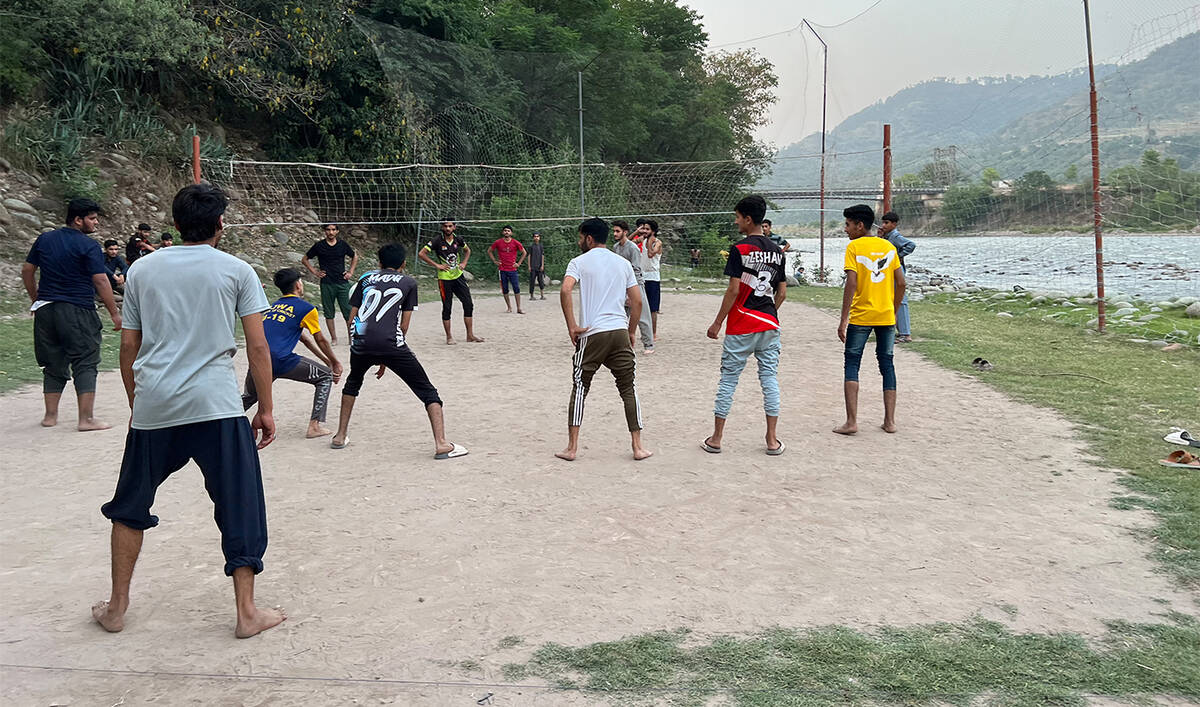
People are playing volleyball in the border village of Jhawara, located in the Poonch district of Azad Kashmir, on May 23, 2025. (AN photo)
The Battal sector, situated at one of the most sensitive stretches of the LoC, was at the heart of last month’s escalation, with the shelling so heavy residents were forced to evacuate, and even the simple joy of a volleyball match became too dangerous to risk.
Among those displaced were the families of the boys who now fill the field each evening from 4pm until the sunset maghrib prayer. Many had sought shelter with relatives in safer villages farther from the border during the latest fighting. Others, like Fareed, stayed behind but refrained from venturing out unnecessarily.
The violence still didn’t spare the players. Anwar Taskeen, a 17-year-old student and regular at the matches, was killed in shelling on his home just hours before the ceasefire was announced.
“Our brother who got martyred [on May 10, 2025] used to play volleyball with us,” said Muhammad Nawaz, one of Anwar’s closest friends. “He used to come every day.”
“When they [Indian forces] fire, they target civilians and army posts as well,” he added.

The picture shows Anwar Taskeen, a 17-year-old student who was killed in shelling on his home just hours before India-Pakistan ceasefire. (AN photo)
SYMBOL OF NORMALCY
Now that calm has returned, at least for the moment, the boys are determined to reclaim the ground and the normalcy it represents. Most days, they split into two teams of six, playing until darkness falls. Laughter, shouts, and the squeak of rubber slippers on hard soil fill the air.
But the volleyball field isn’t just a space for play. It’s also a space of memory.
Taskeen’s absence lingers. So too does the knowledge that peace here is often fleeting.
“There are beautiful places on that side, people should get to enjoy them. And people from there should be able to come here,” said Abdul Hannan, another student who recently completed his intermediate studies.
“Many people there [Indian-administered], in Jammu and Kashmir, play as well,” Hannan added. “We watch their videos to gain skills. They are playing better than us. We also get motivated by watching them.”
The boys recalled that some former players who used to compete on this very field had now moved abroad in search of better opportunities. From afar, many continued to support the volleyball tradition, pooling together funds to help maintain the ground.
Their latest contribution helped install a protective net, now in place for six to seven years, which keeps the ball from rolling into the river and drifting downstream toward the Indian side.
“WE JUST WANT PEACE”
The Poonch River marks both a border and a lifeline for the region. On hot days, the boys often dive into its cool waters to beat the heat, even as Indian army posts watch from across the bank.
That same river has seen far more than games but carried the sounds of shelling, the cries of displaced families, and now, the echoes of a volleyball match played in the name of peace.
During Ramadan and other special occasions, the field hosts semi-annual tournaments. Teams travel from neighboring towns and villages to compete, a reminder that even in a conflict zone, community and competition endure.
“When there is peace, we can play. That’s all we want,” Fareed saiid.
India and Pakistan have long shared a contentious relationship over Kashmir, with flare-ups along the LoC occurring frequently despite periodic agreements. The current ceasefire too is fragile, its future uncertain. But on this side of the Poonch River, young players are daring to imagine something more permanent — not through diplomacy, but through volleyball, through shared videos, playful rivalries, and quiet tributes to friends lost. And through simple, hopeful wishes — that one day, the people of Kashmir might cross the border not as enemies, but as guests.
“We just want peace,” Hannan repeated softly. “That’s all we’ve ever wanted.”


