“Mission accomplished. Private Military Company Wagner returns home,” the group announced
Mali, along with neighbors Burkina Faso and Niger, has for more than a decade battled an insurgency fought by armed groups
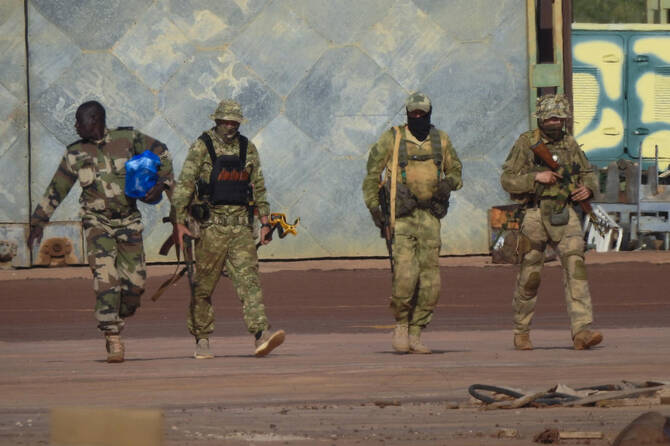
DAKAR: The Russia-backed Wagner Group said Friday it is leaving Mali after more than three and a half years of fighting Islamic extremists and insurgents in the country.
Despite Wagner’s announcement, Russia will continue to have a mercenary presence in the West African country. The Africa Corps, Russia’s state-controlled paramilitary force, said on its Telegram channel Friday that Wagner’s departure would not introduce any changes and the Russian contingent will remain in Mali.
“Mission accomplished. Private Military Company Wagner returns home,” the group announced via its channel on the messaging app Telegram. It said it had brought all regional capitals under control of the Malian army, pushed out armed militants and killed their commanders.
Mali, along with neighbors Burkina Faso and Niger, has for more than a decade battled an insurgency fought by armed groups, including some allied with Al-Qaeda and the Daesh group.
As Western influence in the region has waned, Russia has sought to step into the vacuum, sweeping in with offers of assistance. Moscow initially expanded its military cooperation with African nations by using the Wagner Group of mercenaries. But since the group’s leader, Yevgeny Prigozhin, was killed in a plane crash in 2023, after mounting a brief armed rebellion in Russia that challenged the rule of President Vladimir Putin, Moscow has been developing the Africa Corps as a rival force to Wagner.
Africa Corps is under direct command of the Russian defense ministry.
According to US officials, there are around 2,000 mercenaries in Mali. It is unclear how many are with Wagner and how many are part of the Africa Corps.
Beverly Ochieng, a security analyst specializing in the Sahel for Control Risks consultancy, said the Russian defense ministry had been negotiating with Mali to take on more Africa Corps fighters and for Wagner mercenaries to join Russia’s state-controlled paramilitary force.
“Since the death of Prigozhin, Russia has had this whole plan to then make the Wagner Group fall under the command of the Ministry of Defense. One of the steps they made was to revamp or introduce the Africa Corps, which is the way in which the Russian paramilitaries would retain a presence in areas where the Wagner group has been operating,” Ochieng said.
Wagner has been present in Mali since late 2021 following a military coup, replacing French troops and international peacekeepers to help fight the militants. But the Malian army and Russian mercenaries struggled to curb violence in the country and have both been accused of targeting civilians.
Last month, United Nations experts urged Malian authorities to investigate reports of alleged summary executions and forced disappearances by Wagner mercenaries and the army.
In December, Human Rights Watch accused Malian armed forces and the Wagner Group of deliberately killing at least 32 civilians over an 8-month span.
The announcement of Wagner’s withdrawal comes as the Malian army and the Russian mercenaries suffered heavy losses during attacks by the Al-Qaeda linked group JNIM in recent weeks.
Last week, JNIM fighters killed dozens of soldiers in an attack on a military base in central Mali.
Rida Lyammouri, a Sahel expert at the Morocco-based Policy Center for the New South, said the major losses might have caused the possible end of Wagner’s mission.
“The lack of an official and mutual announcement from both the Malian authorities and Wagner indicate possible internal dispute which led to this sudden decision. Simultaneously, this could point to a new framework for Russian presence in the country,” he said.
Replacing Wagner with Africa Corps troops would likely shift Russia’s focus in Mali from fighting alongside the Malian army to training, said Ulf Laessing, head of the Sahel program at the Konrad Adenauer Foundation.
“Africa Corps has a lighter footprint and focuses more on training, providing equipment and doing protection services. They fight less than the ‘Rambo-type’ Wagner mercenaries,” Laessing said.


![]()

Wagner Group leaving Mali after heavy losses but Russia’s Africa Corps to remain
Wagner Group leaving Mali after heavy losses but Russia’s Africa Corps to remain
Latest updates


© 2026 SAUDI RESEARCH & PUBLISHING COMPANY, All Rights Reserved And subject to Terms of Use Agreement.