

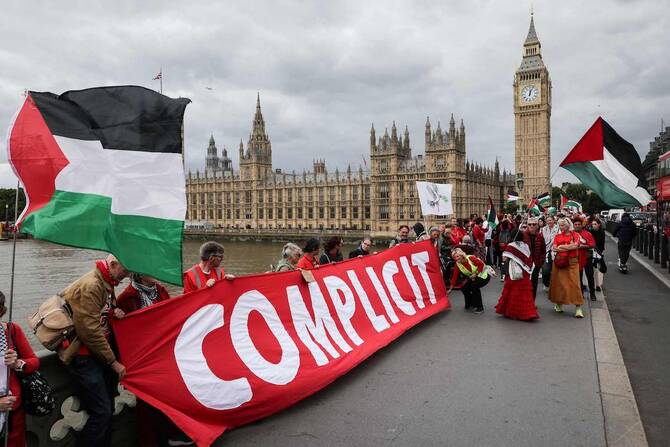

LONDON: Muslim political representatives who belong to UK Prime Minister Keir Starmer’s Labour Party are overwhelmingly unhappy with the British government’s approach to the war in Gaza, a survey reveals.
The study by the Labour Muslim Network found that 82 percent of the Muslim MPs, councillors and mayors that were polled described Starmer’s handling of the conflict as “fairly bad” or “very bad.”
Three‐quarters supported the suspension of all UK arms exports to Israel, and nearly all of the respondents backed immediate, official recognition by the UK of the State of Palestine. More than 80 percent favored sanctions on Israel.
The results of the survey will add to the pressure on Starmer over the issue, with large sections of his party increasingly voicing anger over the UK’s lack of action against Israel over the war in Gaza.
In recent weeks the prime minister has stepped up his criticism of the Israeli military campaign in the territory, which has killed more than 54,000 people since October 2023. The UK last month joined France and Canada in calling on Israel to end the fighting and resume deliveries of humanitarian aid. All three countries threatened “concrete measures” if Israel failed to halt the slaughter. Britain also paused negotiations with Israeli authorities for a free-trade agreement.
In September 2024, the UK suspended 30 of 350 export licenses to Israel for weapons used in military operations in Gaza, after a review of Israeli compliance with international humanitarian law.
However, many members on the left wing of the Labour Party want much stronger action, including an end to all arms sales and tougher sanctions. There have also been growing demands for the UK to join the majority of UN member states in officially recognizing the Palestinian sate.
The issue of the war in Gaza featured heavily during campaigning for the UK parliamentary elections last year, and independent candidates running on pro-Palestinian platforms took five seats from Labour.
There are 25 Muslim MPs in the UK Parliament, 19 of whom belong to the Labour Party. The survey was sent to 477 party members who are elected representatives, and 221 responded.
In addition to the dissatisfaction with Labour’s policy on Gaza, many voiced concern about discrimination within their own party.
Two-thirds said they were not treated equally to other Labour representatives, and more than a half said they did not believe the party takes Islamophobia seriously enough.
In its report on the survey results, the Labour Muslim Network said the figures “tell the story of a growing chasm between the Labour Party and its Muslim representatives.”
It added: “The party must urgently address the structural issues identified in this report or face the moral and political consequences to come.”
A Labour spokesperson told The Guardian newspaper: “The Labour Party is proud of the diversity of our party, including the increase in the number of Muslim MPs in the parliamentary Labour party and having the first Muslim lord chancellor in Shabana Mahmood, and the first Muslim mayor of London in Sadiq Khan.
“We take any complaints of discrimination, including Islamophobia, seriously.”


