Playwright Caryl Churchill pulls out of theater project over Barclays’ ties to Israel

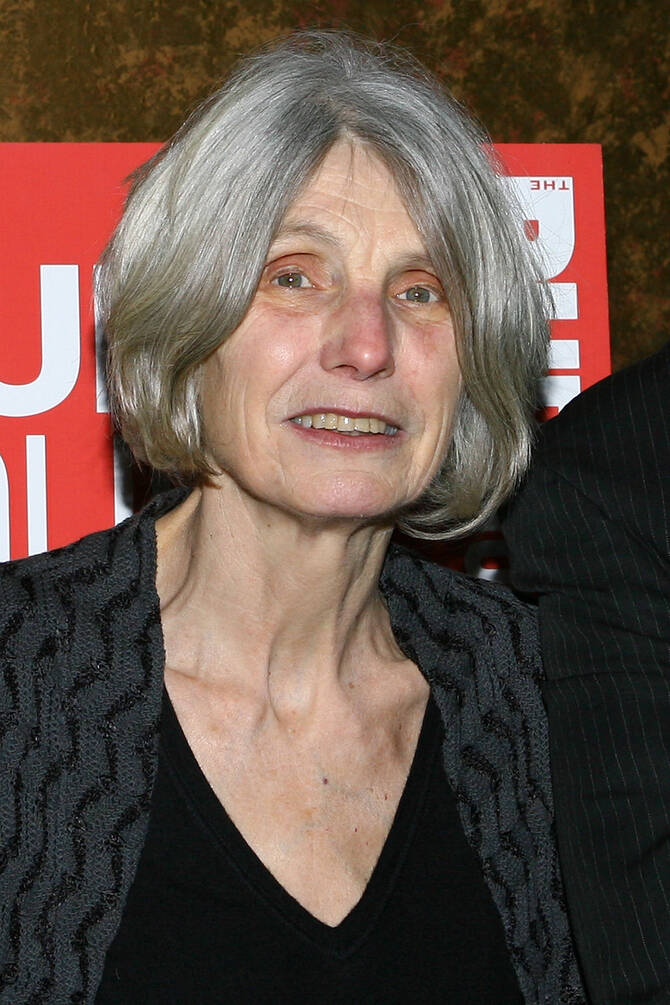
Acclaimed playwright Caryl Churchill (pictured) has withdrawn from a project with a London theater over its sponsorship by Barclays and the bank’s links to companies supplying arms to Israel. (AFP/File Photo)
Short Url
Updated 05 June 2025
Follow

Playwright Caryl Churchill pulls out of theater project over Barclays’ ties to Israel

  • Churchill, who is a long-time advocate for Palestinian rights, called on the Donmar Warehouse to cut ties with Barclays

LONDON: Acclaimed playwright Caryl Churchill has withdrawn from a project with a London theater over its sponsorship by Barclays and the bank’s links to companies supplying arms to Israel.

In a statement, Churchill, who is a long-time advocate for Palestinian rights, called on the Donmar Warehouse to cut ties with Barclays, The Guardian reported.

“Theaters used to say they couldn’t manage without tobacco sponsorship, but they do. Now it’s time they stopped helping advertise banks that support what Israel is doing to Palestinians,” she said.

The project had not yet been publicly announced but would have marked Churchill’s return to the Donmar for the first time since “Far Away” in 2020.

Her move has been backed by more than 300 artists and arts workers, including actors Harriet Walter, Juliet Stevenson, Alfred Enoch, Samuel West and Tim Crouch, who signed an open letter in support.

Barclays has faced increasing pressure from arts and activist groups over its provision of financial services to defense companies operating in Israel.

In 2023, the group Culture Workers Against Genocide published a letter condemning Barclays’ sponsorship of Sadler’s Wells, with signatories including Maxine Peake, an actress.

Last year, the Bands Boycott Barclays campaign led to the bank being dropped as a sponsor by several UK music festivals, including Latitude and The Great Escape.

Barclays declined to comment on Churchill’s withdrawal but said on its website: “While we provide financial services to these companies, we are not making investments for Barclays and Barclays is not a ‘shareholder’ or ‘investor’ in that sense in relation to these companies.”

Barclays CEO C.S. Venkatakrishnan defended the bank’s position in a 2023 Guardian article, writing: “These companies are supported by our democratically elected governments for their role in protecting the UK and allies in Europe. We will not undermine our own national security by de-banking them.”

Responding to Churchill’s decision, Culture Workers Against Genocide said: “Arts institutions have an ethical duty not to contribute to oppression and injustice. By continuing to accept sponsorship from Barclays, Donmar Warehouse is helping to launder the bank’s reputation as it profits from Israel’s genocide in Palestine.”

The Donmar, which lost its £500,000 ($679,355) annual government grant in 2022, has increasingly relied on private support, including corporate sponsorships. It has been approached for comment.

Churchill was previously stripped of a European lifetime achievement award in 2022 following criticism of her play “Seven Jewish Children” and her public pro-Palestinian stance.


Lebanese filmmaker turns archival footage into a love letter to Beirut

Updated 28 February 2026
Follow

Lebanese filmmaker turns archival footage into a love letter to Beirut

LONDON: Lebanese filmmaker Lana Daher’s debut feature “Do You Love Me” is a love letter of sorts to Beirut, composed entirely of archival material spanning seven decades across film, television, home videos and photography.

The film premiered at the 82nd Venice International Film Festival in September and has since traveled to several regional and international festivals.

Pink Smoke (2020) by Ben Hubbard. (Supplied)

With minimal dialogue, the film relies heavily on image and sound to reconstruct Lebanon’s fragmented history.

“By resisting voiceover and autobiography, I feel like I had to trust the image and the shared emotional landscape of these archives to carry the meaning,” Daher said.

A Suspended Life (Ghazal el-Banat) (1985) by Jocelyne Saab. (Supplied)

She explained that in a city like Beirut “where trauma is rarely private,” the socio-political context becomes the atmosphere of the film, with personal memory expanding into a collective experience — “a shared terrain of emotional history.”

Daher said: “By using the accumulated visual representations of Beirut, I was, in a way, rewriting my own representation of home through images that already existed."

Whispers (1980) by Maroun Bagdadi. (Supplied)

Daher, with editor Qutaiba Barhamji, steered clear of long sequences, preferring individual shots that allowed them to “reassemble meaning” while maintaining the integrity of their own work and respecting the original material, she explained.

The film does not feature a voice-over, an intentional decision that influenced the use of sound, music, and silence.

The Boombox (1995) by Fouad Elkoury. (Supplied)

“By resisting the urge to fill every space with dialogue or score, we created room for discomfort,” Daher said, adding that silence allows the audience to sit with the image and enter its emotional space rather than being guided too explicitly.

 The film was a labor of love, challenging Daher personally and professionally.

“When you draw from personal memory, you’re not just directing scenes, you’re revisiting parts of yourself and your childhood,” she said. “There’s vulnerability in that.”