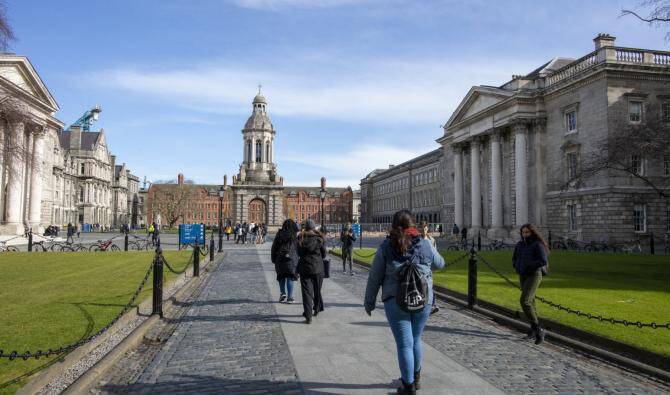
DUBLIN: Ireland’s prestigious Trinity College Dublin said on Wednesday that it would cut all links with Israel in protest at “ongoing violations of international and humanitarian law.”
The university’s board informed students by email that it had accepted the recommendations of a taskforce to sever “institutional links with the State of Israel, Israeli universities and companies headquartered in Israel.”
The recommendations would be “enacted for the duration of the ongoing violations of international and humanitarian law,” said the email sent by the board’s chairman Paul Farrell, and seen by AFP.
The taskforce was set up after part of the university’s campus in central Dublin was blockaded by students for five days last year in protest at Israel’s actions in Gaza.
Among the taskforce’s recommendations approved by the board were pledges to divest “from all companies headquartered in Israel” and to “enter into no future supply contracts with Israeli firms” and “no new commercial relationships with Israeli entities.”
The university also said that it would “enter into no further mobility agreements with Israeli universities.”
Trinity has two current Erasmus+ exchange agreements with Israeli universities: Bar Ilan University, an agreement that ends in July 2026, and the Hebrew University of Jerusalem, which ends in July 2025, the university told AFP in an email.
The board also said that the university “should not submit for approval or agree to participate in any new institutional research agreements involving Israeli participation.”
It “should seek to align itself with like-minded universities and bodies in an effort to influence EU policy concerning Israel’s participation in such collaborations,” it added.
Ireland has been among the most outspoken critics of Israel’s response to the October 7, 2023 attacks on southern Israel by Hamas militants that sparked the war in Gaza.
Polls since the start of the war have shown overwhelming pro-Palestinian sympathy in Ireland.
In May 2024, Dublin joined several other European countries in recognizing Palestine as a “sovereign and independent state.”
It then joined South Africa in bringing a case before the International Court of Justice in The Hague accusing Israel of committing genocide in Gaza — charges angrily denied by Israeli leaders.
In December, Israel’s Foreign Minister Gideon Saar ordered the closure of the country’s embassy in Dublin, blaming Ireland’s “extreme anti-Israel policies.”
The University of Geneva also announced Wednesday that it has ended its partnership with the Hebrew University of Jerusalem following student protests, saying it no longer reflected the institution’s “strategic priorities.”


Prestigious Irish university to cut links with Israel over Gaza war
https://arab.news/cxnwz
Prestigious Irish university to cut links with Israel over Gaza war

- Trinity College Dublin will sever institutional links with the Israeli state, universities and companies headquartered there
- University said the action was a protest against 'violations of international and humanitarian law'


UK upper house approves social media ban for under-16s
LONDON: Britain’s upper house of parliament voted Wednesday in favor of banning under?16s from using social media, raising pressure on the government to match a similar ban passed in Australia.
Prime Minister Keir Starmer said Monday he was not ruling out any options and pledged action to protect children, but his government wants to wait for the results of a consultation due this summer before legislating.
Calls have risen across the opposition and within the governing Labour party for the UK to follow Australia, where under-16s have been barred from social media applications since December 10.
The amendment from opposition Conservative lawmaker John Nash passed with 261 votes to 150 in the House of Lords, co?sponsored by a Labour and a Liberal Democrat peer.
“Tonight, peers put our children’s future first,” Nash said. “This vote begins the process of stopping the catastrophic harm that social media is inflicting on a generation.”
Before the vote, Downing Street said the government would not accept the amendment, which now goes to the Labour-controlled lower House of Commons. More than 60 Labour MPs have urged Starmer to back a ban.
Public figures including actor Hugh Grant urged the government to back the proposal, saying parents alone cannot counter social media harms.
Some child-protection groups warn a ban would create a false sense of security.
A YouGov poll in December found 74 percent of Britons supported a ban. The Online Safety Act requires secure age?verification for harmful content.


