

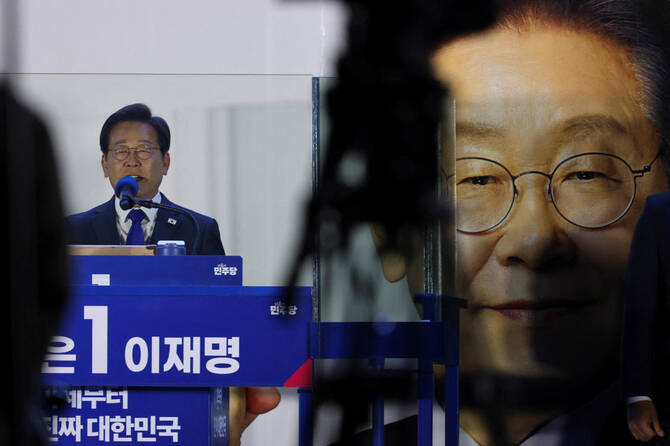

SEOUL: Winning a tense election that capped off months of political turmoil, new South Korean President Lee Jae-myung described his victory as the start of the country’s return to normalcy following the crisis sparked by then-conservative leader Yoon Suk Yeol’s imposition of martial law in December.
But the outspoken liberal, who assumed office immediately on Wednesday without a transition period, takes the helm during a highly challenging time for the country, which has struggled mightily to revive a faltering economy battered by months of political paralysis and compounded by US President Donald Trump’s tariff hikes.
Lee also inherits from Yoon the escalating threat of North Korea’s nuclear ambitions, now further complicated by Pyongyang’s deepening alignment with Moscow over Russian President Vladimir Putin’s war on Ukraine.
Here’s a look at the key challenges facing Lee’s government:
Addressing a slow economy and Trump’s tariffs
In his inauguration speech, Lee identified the economy as his top priority, vowing to immediately launch an emergency task force to wage a “head-on battle” against the looming threat of recession and to boost government spending to jumpstart economic activity.
South Korean economic institutions have repeatedly sounded the alarm in recent months over the state of the economy, citing sluggish business investment, weak consumer spending, a deteriorating job market and a trade environment worsened by Trump’s tariffs and other America-first policies.
Despite the country’s strikingly high household debt, the central bank last week lowered borrowing costs in a desperate bid to inject more money into the economy and slashed its 2025 growth forecast to 0.8 percent, which would be the weakest since a 0.7 percent contraction during the COVID-19 crisis in 2020.
Lee won’t have much time to negotiate with Washington before July 9, when Trump’s 90-day pause in global reciprocal tariffs is set to expire, potentially exposing South Korean products to 25 percent tax rates.
Although a US federal court recently ruled that Trump lacks authority to impose his planned tariffs, the White House has appealed, leaving the outcome uncertain. Trump has also pushed for product-specific tariffs on key sectors like autos and semiconductors, which make up a major share of South Korean exports. Trump could also seek a broader deal requiring Seoul to pay significantly more for the 28,000 US troops stationed in South Korea to deter North Korean threats.
While Seoul’s previous government had aimed to reach a “package” deal with Trump by early July, Lee has preached patience on tariffs, saying it would be against national interests to obsess with an early agreement.
Navigating North Korea’s nuclear threat
In his inaugural address, Lee promised to reopen a communication channel with North Korea to ease tensions. But prospects for the early resumption of dialogue between the rival Koreas are dim, as North Korea has been constantly rejecting dialogue offers by South Korea and the US since 2019, when talks between Washington and Pyongyang collapsed over disagreements on economic sanctions.
North Korea’s priority in foreign policy is now firmly Russia, which has received thousands of North Korean troops and large amounts of military equipment in recent months for its warfighting in Ukraine.
During campaigning, Lee acknowledged that it would be “very difficult” to arrange a summit with North Korean leader Kim Jong Un anytime soon, though it’s something he will seek. Lee said he would support Trump’s efforts to restart nuclear diplomacy with Kim, saying that improved ties between Pyongyang and Washington could allow aid projects for the impoverished North that will likely require South Korean support.
Lee nominated former Unification Minister Lee Jong-seok, a dove who espouses reconciliation with North Korea, as his spy chief. The nomination likely reflects Lee Jae-myung’s hopes to revive inter-Korean dialogue, given the behind-the-scene roles of the National Intelligence Service played to reach out to Pyongyang under the past liberal governments.
However, many experts also note that Lee Jae-myung does not share the same level of Korean nationalist zeal as his liberal predecessors, and they question how firmly he would stick to his appeasement approach if provocative actions by North Korea, such as high-profile missile tests or border incursions, undermine public support for his policy at home.
Committing to US alliance and pragmatic diplomacy
Lee was previously accused by his critics of tilting toward Pyongyang and Beijing and away from Washington and Tokyo. He once slammed a US missile defense system in South Korea as a source of tensions and likened strengthening US-Japan ties to a 1905 Washington-Tokyo agreement that he said eventually helped Japan colonize the Korean Peninsula.
But Lee has recently refrained from making similar contentious comments, instead repeatedly pledging to pursue pragmatic diplomacy. He has vowed to enhance South Korea’s alliance with the US and their trilateral cooperation with Japan, while also emphasizing the need to reduce tensions with North Korea and avoid frictions with China and Russia.
While Lee may eventually take steps to improve ties with North Korea and China — relations that deteriorated under Yoon, who prioritized the US and Japan — experts say Lee is unlikely to take drastic actions that might undermine the alliance with Washington or negatively impact South Korea’s financial markets.
Lee has stated that he will address thorny historical disputes with Japan separately from matters of security, trade, and other issues. However, many experts believe he is unlikely to completely reverse the progress made in Seoul-
Tokyo relations in recent years. Japanese Prime Minister Shigeru Ishiba said Wednesday that he hopes to hold summit talks with Lee “as early as possible” and expressed a desire to further strengthen bilateral ties.
Cleaning the mess at home
Long accused by critics of being a divisive populist, Lee pledged unity throughout his campaign, vowing not to target conservatives and calling for an end to South Korea’s deep political polarization and a return to dialogue and compromise.
However, he has also pledged a thorough investigation into the circumstances surrounding Yoon’s martial law stunt — a saga that could continue to overshadow Lee’s presidency and spark tensions with conservatives, especially as the ousted conservative faces a high-stakes criminal trial on rebellion charges punishable by death or life imprisonment.
While Yoon defended his martial law decree as a necessary response to what he called the Democratic Party’s abuse of its legislative majority to obstruct his agenda, that same majority now gives Lee a far more favorable environment to advance his policies. Conservatives have voiced concern that this could give Lee partially unchecked power and enable him to advance legislation that shields his presidency from his own legal troubles.
Lee faces five separate trials on corruption and other charges, but the hearings were suspended ahead of Tuesday’s election. While South Korea’s constitution shields sitting presidents from most criminal prosecution aside of rebellion or treason, it doesn’t clearly state whether this protection extends to preelection indictments. The Democrats have been pushing to revise the criminal procedure law to keep Lee’s trials suspended during his term, drawing criticism from conservatives.


