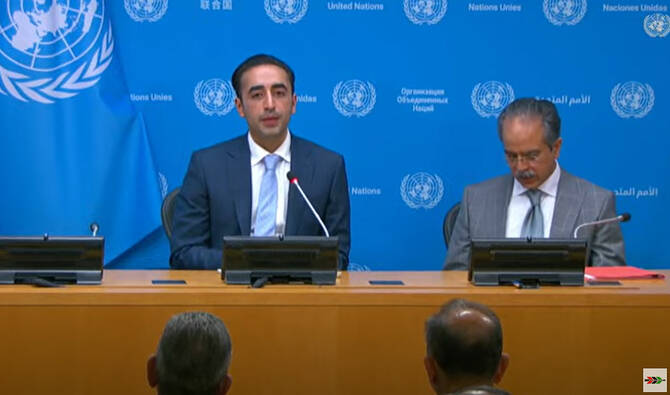

ISLAMABAD: The head of Pakistan’s parliamentary delegation constituted to visit key world capitals and present Islamabad’s stance on last month’s military standoff with India said on Tuesday New Delhi was emulating Israel’s belligerence in the region, urging Prime Minister Narendra Modi not to be guided by “the worst examples possible.”
The remarks were made by former Pakistani foreign minister Bilawal Bhutto-Zardari during a media interaction at the United Nations Correspondents Association.
The Pakistani delegation arrived in New York on Monday as part of Islamabad’s diplomatic outreach amid heightened tensions with India, despite a recent ceasefire. It has held a series of meetings with top international diplomats, urging the global community to help the two nuclear-armed South Asian neighbors enter a comprehensive dialogue to peacefully resolve their differences.
Responding to a question during the news conference, Bhutto-Zardari drew parallels between the Israeli settler program in the West Bank and India’s post-2019 demographic changes in Kashmir, describing Modi as a “poor copy” of Israeli Prime Minister Benjamin Netanyahu.
“As far as India being inspired by the Israeli government, unfortunately, it’s being inspired in all the wrong ways,” he said. “Its conduct outside of international law, its violation of international governance, the United Nations Charter, the arrogance with which it thought it could get away with this — that you can just scream terrorism and it justifies that you can attack any Muslim country at whim.”
“In short, it’s based on this building of precedents that we’ve seen over time — be it in the context of the Iraq War, and obviously the actions within Gaza recently have inspired some of the actions by the Indian government,” he added. “But Mr. Modi is sort of the Temu version of Netanyahu — sort of a poor copy — and we call upon the Indian government to not be inspired by the worst examples possible.”
Bhutto-Zardari, who chairs the Pakistan Peoples Party, called on both India and Pakistan to reclaim their shared heritage as heirs of the ancient Indus Valley Civilization and reflect that in their conduct.
“One of the most incredible things about the Indus Valley Civilization is that with all the archaeology that’s gone on, we’ve not found a single weapon at all,” he said. “They had great advancements — urban planning, agriculture, water distribution, even sewage systems — but not a single weapon.”
“How far we’ve come from our roots,” he continued. “That grand Indus Valley Civilization, which didn’t have a single weapon, is now armed to the teeth.”
The former Pakistani foreign minister said Modi could either pursue peace and become a true heir of the Indus Valley Civilization or continue down a path of conflict.
“Mr. Modi started off as being perceived as the Butcher of Gujarat,” he said, referring to the 2002 anti-Muslim riots in the Indian state where Modi was chief minister. “He went on to become the Butcher of Kashmir, and he aspires to be the Butcher of the Indus Valley Civilization with his assault on the Indus Waters Treaty.”
The Pakistani delegation also met with United Nations Secretary-General António Guterres at UN Headquarters on Tuesday.
Bhutto-Zardari delivered a letter from Pakistan’s prime minister and briefed the UN chief on Islamabad’s position in the aftermath of the April 22 Pahalgam attack in Indian-administered Kashmir on tourists, which New Delhi had blamed on Pakistan.
He rejected India’s allegations against Islamabad as “baseless and premature,” and criticized its unilateral military actions, civilian casualties and the suspension of the Indus Water Treaty — calling these actions a dangerous escalation with potentially destabilizing consequences for the region.
Bhutto-Zardari said Pakistan remained committed to international law and the principles of the UN Charter, while warning against what he called India’s attempt to establish a “dangerous new normal” marked by unilateralism and the use of force in a nuclear environment.
According to an official readout, Secretary-General Guterres assured the delegation the UN would fully engage in promoting peace and stability in South Asia and continue to support all efforts to reduce tensions and resolve disputes.