

Police arrest 49 suspected militants in Pakistan’s Punjab in a month

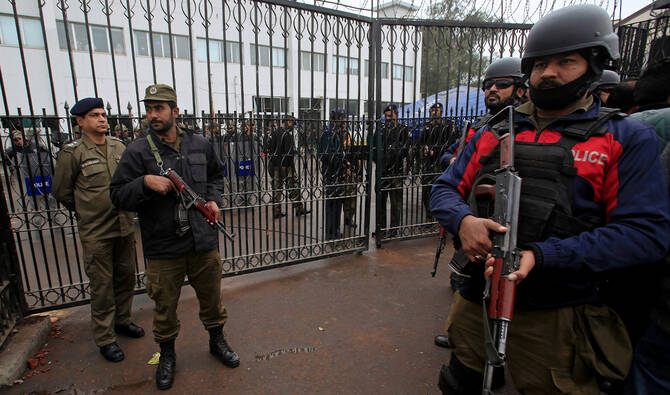
Police officers stand guard for security measures outside a building in Lahore, Pakistan, on December 12, 2019. (REUTERS/File)
Short Url
Updated 17 January 2026
Follow

Police arrest 49 suspected militants in Pakistan’s Punjab in a month

  • The development follows a steep rise in militancy-related deaths in Pakistan last year
  • Authorities have lodged cases against the arrested suspects affiliated with banned outfits

ISLAMABAD: The counter-terrorism department (CTD) of Punjab police has arrested 49 militants in different areas of Pakistan’s most populous province in a month and foiled a major terror plan, the CTD said on Saturday.

Pakistan is currently facing an uptick in militant attacks, mainly by the Tehreek-e-Taliban Pakistan (TTP), in its northwestern Khyber Pakhtunkhwa (KP) province, which borders Punjab.

The attacks in KP have forced authorities in Punjab to heighten security and take pre-emptive measures in view of potential spillover of militants into the country’s most populous province.

CTD officials arrested these militants in 425 intelligence-based operations and seized weapons, explosives and other prohibited materials from the arrestees, according to a CTD spokesperson.

“Forty-four cases have been registered against the arrested terrorists and further investigation is being carried out,” the spokesperson said in a statement.

The development comes a steep rise in militancy-related deaths in Pakistan in 2025. According to statistics released by the Pakistan Institute for Conflict and Security Studies (PICSS) last month, combat-related deaths in 2025 rose 73 percent to 3,387. These included 2,115 militants, 664 security forces personnel, 580 civilians and 28 members of pro-government peace committees, the think tank said.

CTD conducted 6,131 combing operations in the province and arrested 599 suspects, according to the statement. Around 570 police reports were registered against these suspects, which led to 477 recoveries.

In Nov., the Punjab government had launched the country’s “first” mobile counterterrorism unit to monitor complex security operations in real time, while in Sept. the province announced the arrest of 90 suspected militants in a three-month counter-terrorism sweep.

Pakistan has struggled to contain the surging in militancy in KP since a fragile truce between the Pakistani Taliban and Islamabad broke down in Nov. 2022. The country faces another decades-long insurgency by Baloch separatists in its southwestern Balochistan province.

Islamabad has frequently accused Afghanistan of allowing the use of its soil and India of backing militant groups for attacks against Pakistan. Kabul and New Delhi deny the allegation.


Pakistan urges pilgrims to complete Saudi biometrics as Hajj preparations gain pace

Updated 4 sec ago
Follow

Pakistan urges pilgrims to complete Saudi biometrics as Hajj preparations gain pace

  • Government warns pilgrims biometric verification is required for Hajj visas
  • Step follows tighter oversight after last year’s Hajj travel disruptions

ISLAMABAD: Pakistan’s government on Friday urged aspiring pilgrims to complete mandatory Saudi biometric verification for Hajj visas, as preparations for the 2026 pilgrimage gather pace following stricter oversight of the Hajj process.

The announcement comes only a day after Pakistan’s Religious Affairs Minister Sardar Muhammad Yousuf said regulations for private Hajj operators had been tightened, reducing their quota following widespread complaints last year, when tens of thousands of pilgrims were unable to travel under the private Hajj scheme.

“Saudi biometric verification is mandatory for the issuance of Hajj visas,” the Ministry of Religious Affairs said in a statement, urging pilgrims to complete the process promptly to avoid delays.

“Hajj pilgrims should complete their biometric verification at home using the ‘Saudi Visa Bio’ app as soon as possible,” it added.

The statement said the pilgrims who were unable to complete biometric verification through the mobile application should visit designated Saudi Tasheer centers before Feb. 8, adding that details of the centers were available on Pakistan’s official Hajj mobile application.

Pakistan has been steadily implementing digital and procedural requirements for pilgrims ahead of Hajj 2026, including mandatory training sessions, biometric checks and greater use of mobile applications, as part of efforts to reduce mismanagement.

Saudi Arabia has allocated Pakistan a quota of 179,210 pilgrims for Hajj 2026, with the majority of seats reserved under the government scheme and the remainder allocated to private tour operators.