

Police arrest 49 suspected militants in Pakistan’s Punjab in a month

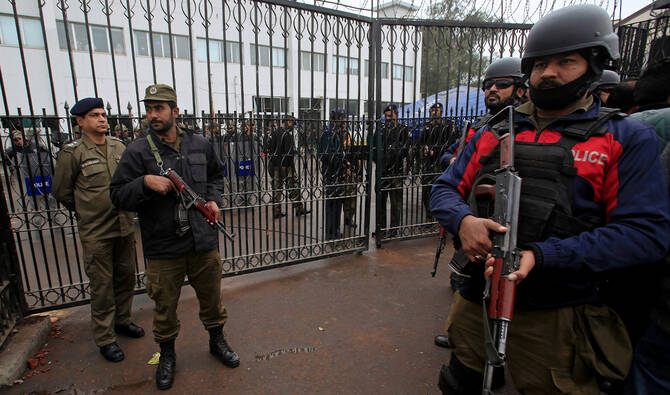
Police officers stand guard for security measures outside a building in Lahore, Pakistan, on December 12, 2019. (REUTERS/File)
Short Url
Updated 17 January 2026
Follow

Police arrest 49 suspected militants in Pakistan’s Punjab in a month

  • The development follows a steep rise in militancy-related deaths in Pakistan last year
  • Authorities have lodged cases against the arrested suspects affiliated with banned outfits

ISLAMABAD: The counter-terrorism department (CTD) of Punjab police has arrested 49 militants in different areas of Pakistan’s most populous province in a month and foiled a major terror plan, the CTD said on Saturday.

Pakistan is currently facing an uptick in militant attacks, mainly by the Tehreek-e-Taliban Pakistan (TTP), in its northwestern Khyber Pakhtunkhwa (KP) province, which borders Punjab.

The attacks in KP have forced authorities in Punjab to heighten security and take pre-emptive measures in view of potential spillover of militants into the country’s most populous province.

CTD officials arrested these militants in 425 intelligence-based operations and seized weapons, explosives and other prohibited materials from the arrestees, according to a CTD spokesperson.

“Forty-four cases have been registered against the arrested terrorists and further investigation is being carried out,” the spokesperson said in a statement.

The development comes a steep rise in militancy-related deaths in Pakistan in 2025. According to statistics released by the Pakistan Institute for Conflict and Security Studies (PICSS) last month, combat-related deaths in 2025 rose 73 percent to 3,387. These included 2,115 militants, 664 security forces personnel, 580 civilians and 28 members of pro-government peace committees, the think tank said.

CTD conducted 6,131 combing operations in the province and arrested 599 suspects, according to the statement. Around 570 police reports were registered against these suspects, which led to 477 recoveries.

In Nov., the Punjab government had launched the country’s “first” mobile counterterrorism unit to monitor complex security operations in real time, while in Sept. the province announced the arrest of 90 suspected militants in a three-month counter-terrorism sweep.

Pakistan has struggled to contain the surging in militancy in KP since a fragile truce between the Pakistani Taliban and Islamabad broke down in Nov. 2022. The country faces another decades-long insurgency by Baloch separatists in its southwestern Balochistan province.

Islamabad has frequently accused Afghanistan of allowing the use of its soil and India of backing militant groups for attacks against Pakistan. Kabul and New Delhi deny the allegation.


Pakistan mulls space-based monitoring to support port expansion, maritime safety

Updated 10 sec ago
Follow

Pakistan mulls space-based monitoring to support port expansion, maritime safety

  • Minister says satellite technology could aid port planning and environmental protection
  • Islamabad seeks to modernize ports as it eyes transshipment role, Central Asian trade

KARACHI: Pakistan is considering the use of space-based monitoring systems to support port expansion, maritime safety and environmental protection, the country’s maritime affairs minister said on Wednesday, as he visited the headquarters of the national space agency.

The visit comes as Islamabad seeks to position itself as a transshipment hub by upgrading cargo handling, streamlining import and export processes and offering its southern ports on the Arabian Sea to landlocked Central Asian states as trade gateways.

“Advanced space-based monitoring systems can play a vital role in safeguarding seas, improving maritime management and strengthening responses to environmental threats,” Maritime Affairs Minister Muhammad Junaid Anwar Chaudhry said, according to a statement released after his visit.

Chaudhry was briefed on satellite-based assessments identifying potential sites for new ports, as well as tools for maritime traffic monitoring and disaster response.

Pakistan has been working to expand and modernize its port infrastructure to improve efficiency and attract regional cargo flows, particularly as it seeks to enhance connectivity through its coastline along the Arabian Sea.

During the visit, officials from the Pakistan Space and Upper Atmosphere Research Commission (SUPARCO) outlined the use of high-resolution satellite imagery, artificial intelligence and digital modelling to monitor ports, track cargo dwell time, detect oil spills and support search-and-rescue operations at sea.

“We can benefit from continuous monitoring of coastal ecosystems to assess water quality, sediment dispersion and overall environmental health,” Chaudhry said, adding that data-driven approaches were essential for informed policymaking in the maritime sector.

He also highlighted the growing risks posed by climate change, including rising sea levels, coastal erosion and extreme weather events, and said stronger cooperation between maritime authorities and scientific institutions was needed to protect coastal communities and infrastructure.

SUPARCO officials said the agency was ready to develop artificial intelligence-based solutions for ports and maritime operations, including systems to address customs-related inefficiencies and improve emergency response times.
The minister said the ministry and SUPARCO would move toward formalizing cooperation through a structured framework to support joint initiatives.