

Russia says no quick ‘breakthroughs’ in ‘complex’ Ukraine talks

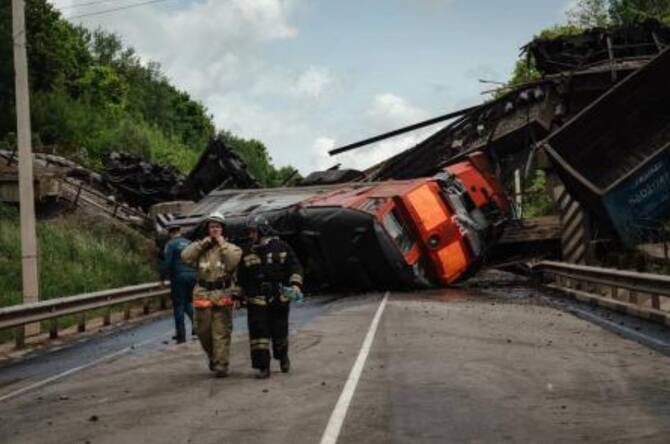
This handout photograph posted on the Telegram account of Kursk region acting governor Alexander Khinshtein on Jun. 1, 2025 shows a damaged freight train at the site of a railway bridge collapse in the Kursk region. (AFP)
Short Url
Updated 03 June 2025
Follow

Russia says no quick ‘breakthroughs’ in ‘complex’ Ukraine talks

  • “The settlement issue is extremely complex and involves a large number of nuances,” Peskov said
  • Zelensky on Tuesday accused Russia of “deliberately” targeting civilians in a rocket attack on the city of Sumy

MOSCOW: Russia on Tuesday said it was wrong to expect a quick breakthrough in Ukraine talks, a day after Moscow rejected Kyiv’s call for an unconditional ceasefire at negotiations in Istanbul.

The sides agreed on a large-scale swap of captured soldiers and exchanged their roadmaps to peace, or so-called “memorandums,” at the discussions, which lasted under two hours.

More than three years into Russia’s offensive — which has killed tens of thousands on both sides and forced millions from their homes in eastern Ukraine — the two sides appear as irreconcilable as ever.

“The settlement issue is extremely complex and involves a large number of nuances,” Kremlin spokesman Dmitry Peskov told reporters on Tuesday.

“It would be wrong to expect immediate solutions and breakthroughs,” he added.

Moscow demanded Ukraine pull its troops out of four eastern and southern regions that Moscow claims to have annexed as a precondition to pausing its offensive, according to the document handed to the Ukrainians that was published by Russian state media.

Kyiv had pressed for a full and unconditional ceasefire. Russia instead offered a partial truce of two to three days in some areas of the frontline, its top negotiator said after the talks.

Peskov also dismissed the idea of a summit between the presidents of Russia, Ukraine and the United States.

“In the near future, it is unlikely,” Peskov told reporters when asked about the chances of the leaders meeting, adding that such a summit could only happen after Russian and Ukrainian negotiators reach an “agreement.”

The White House had said on Monday US President Donald Trump was “open” to the idea, which is also backed by Ukraine’s Volodymyr Zelensky and Turkiye’s Recep Tayyip Erdogan.

Zelensky on Tuesday accused Russia of “deliberately” targeting civilians in a rocket attack on the city of Sumy, some 30 kilometers (18 miles) from the Russian border, that killed three people.

Russian troops have accelerated their advance, seeking to establish what Putin called a “buffer zone” inside Ukraine’s northeastern Sumy region.

Zelensky posted a video from the emergency services showing destroyed cars and the body of one victim lying on the road.

The attack “says everything one needs to know about Russia’s so-called ‘desire’ to end this war,” he added, calling for “decisive actions” from the United States and Europe to push Russia into a ceasefire.

“Every day, Russia gives new reasons for tougher sanctions and stronger support for our defense,” he said.

Three people were also killed in a rocket attack in the northeastern Kharkiv region.

Moscow’s army said it had captured the village of Andriivka in the Sumy region, located around five kilometers from the Russian border.

Zelensky said last week that Russia was amassing some 50,000 soldiers for an offensive on the region.

Meanwhile Ukraine’s SBU security service claimed it had hit a pillar of the Crimean bridge, linking the annexed peninsula to Russia, with an underwater explosive device.

The extent of the damage was unclear and cars were on Tuesday using the bridge following a temporary closure after the attack.

A delegation of top Ukrainian officials also landed in Washington for talks with US officials on defense and economic issues, including the possibility of new sanctions, Zelensky’s office said.

Trump, who said he could end the conflict swiftly when he returned to the White House in January, has repeatedly expressed anger at both Putin and Zelensky as the fighting drags through its fourth year with no end in sight.

But he has held off from imposing new economic penalties on Moscow.


Carney says Canada has no plans to pursue free trade agreement with China as Trump threatens tariffs

Updated 26 January 2026
Follow

Carney says Canada has no plans to pursue free trade agreement with China as Trump threatens tariffs

TORONTO: Canadian Prime Minister Mark Carney said Sunday his country has no intention of pursuing a free trade deal with China. He was responding to US President Donald Trump’s threat to impose a 100 percent tariff on goods imported from Canada if America’s northern neighbor went ahead with a trade deal with Beijing.
Carney said his recent agreement with China merely cuts tariffs on a few sectors that were recently hit with tariffs.
Trump claims otherwise, posting that “China is successfully and completely taking over the once Great Country of Canada. So sad to see it happen. I only hope they leave Ice Hockey alone! President DJT”
The prime minister said under the free trade agreement with the US and Mexico there are commitments not to pursue free trade agreements with nonmarket economies without prior notification.
“We have no intention of doing that with China or any other nonmarket economy,” Carney said. “What we have done with China is to rectify some issues that developed in the last couple of years.”
In 2024, Canada mirrored the United States by putting a 100 percent tariff on electric vehicles from Beijing and a 25 percent tariff on steel and aluminum. China had responded by imposing 100 percent import taxes on Canadian canola oil and meal and 25 percent on pork and seafood.
Breaking with the United States this month during a visit to China, Carney cut its 100 percent tariff on Chinese electric cars in return for lower tariffs on those Canadian products.
Carney has said there would be an initial annual cap of 49,000 vehicles on Chinese EV exports coming into Canada at a tariff rate of 6.1 percent, growing to about 70,000 over five years. He noted there was no cap before 2024. He also has said the initial cap on Chinese EV imports was about 3 percent of the 1.8 million vehicles sold in Canada annually and that, in exchange, China is expected to begin investing in the Canadian auto industry within three years.
Trump posted a video Sunday in which the chief executive of the Canadian Vehicle Manufacturers’ Association warns there will be no Canadian auto industry without US access, while noting the Canadian market alone is too small to justify large scale manufacturing from China.
“A MUST WATCH. Canada is systematically destroying itself. The China deal is a disaster for them. Will go down as one of the worst deals, of any kind, in history. All their businesses are moving to the USA. I want to see Canada SURVIVE AND THRIVE! President DJT,” Trump posted on social media.
Trump’s post on Saturday said that if Carney “thinks he is going to make Canada a ‘Drop Off Port’ for China to send goods and products into the United States, he is sorely mistaken.”
“We can’t let Canada become an opening that the Chinese pour their cheap goods into the U.S,” US Treasury Secretary Scott Bessent said on ABC’s “This Week.”
“We have a , but based off — based on that, which is going to be renegotiated this summer, and I’m not sure what Prime Minister Carney is doing here, other than trying to virtue-signal to his globalist friends at Davos.”
Trump’s threat came amid an escalating war of words with Carney as the Republican president’s push to acquire Greenland strained the NATO alliance.
Carney has emerged as a leader of a movement for countries to find ways to link up and counter the US under Trump. Speaking in Davos before Trump, Carney said, “Middle powers must act together because if you are not at the table, you are on the menu” and he warned about coercion by great powers — without mentioning Trump’s name. The prime minister received widespread praise and attention for his remarks, upstaging Trump at the World Economic Forum.
Trump’s push to acquire Greenland has come after he has repeatedly needled Canada over its sovereignty and suggested it also be absorbed into the United States as a 51st state. He posted an altered image on social media this week showing a map of the United States that included Canada, Venezuela, Greenland and Cuba as part of its territory.