

ADB approves $800 million program to support Pakistan’s public finance reforms

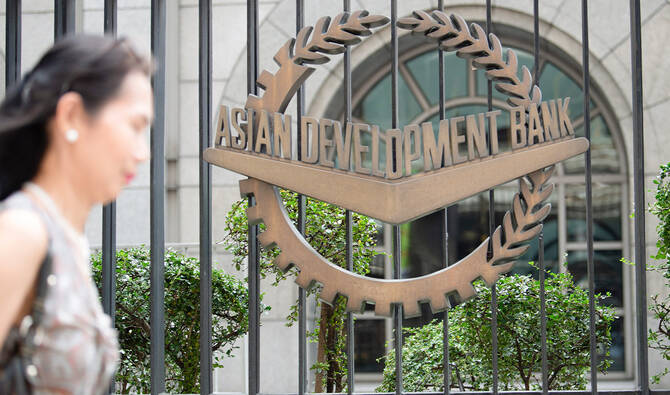
A woman walks past the logo of the Asian Development Bank (ADB) outside the bank's headquarters in Manila on April 15, 2025. (AFP/File)
Short Url
Updated 03 June 2025
Follow

ADB approves $800 million program to support Pakistan’s public finance reforms

  • ADB says the package will support tax reforms and digitalization to help boost fiscal sustainability
  • It includes a $500 million guarantee to help Pakistan unlock up to $1 billion from commercial banks

KARACHI: The Asian Development Bank (ADB) on Tuesday approved an $800 million financing package for Pakistan to help the country improve fiscal sustainability, strengthen public financial management and support economic reforms.

The funding, part of the Improved Resource Mobilization and Utilization Reform Program (Subprogram 2), includes a $300 million policy-based loan and ADB’s first-ever policy-based guarantee of up to $500 million, which is expected to help Pakistan raise as much as $1 billion from commercial banks.

“Pakistan has made significant progress in improving macroeconomic conditions,” ADB’s Country Director for Pakistan, Emma Fan, said in a statement. “This program backs the government’s commitment to further policy and institutional reforms that will strengthen public finances and promote sustainable growth.”

The program supports reforms to tax policy, administration and compliance, along with improvements in public expenditure management, cash handling and digitalization.

It also aims to facilitate investment and private sector development, with the broader goal of reducing Pakistan’s fiscal deficit and public debt while creating space for development and social spending.

Khurram Schehzad, adviser to Pakistan’s finance minister, also confirmed the development in a social media post, saying “diplomacy” led by the finance ministry and economic affairs division had helped secure majority support at ADB Board.

The ADB said the program is backed by a comprehensive support package involving technical assistance and coordination with development partners to help Pakistan build long-term fiscal resilience.

A founding member of ADB, Pakistan has received more than $52 billion in public and private sector financing from the bank since 1966, spanning infrastructure, energy, transport, food security and social services.

ADB plays a leading role in supporting inclusive and sustainable development across Asia and the Pacific.


Pakistan approves $713 million to ease power sector’s cash flow constraints

Updated 5 sec ago
Follow

Pakistan approves $713 million to ease power sector’s cash flow constraints

  • Finance minister chairs Economic Coordination Committee meeting to approve grants, review economic situation
  • Pakistan is grappling with a ballooning “circular debt,” or unpaid bills and subsidies, that has choked its power sector

KARACHI: Pakistan’s top economic body this week approved a grant of $713 million to ease the power sector’s cash flow constraints, the Finance Division said in a statement, as Islamabad looks to reform its priority sectors. 

The development took place as Finance Minister Muhammad Aurangzeb chaired a meeting of the Economic Coordination Committee (ECC) to approve grants for various projects and review the overall economic situation of the country. 

“[ECC approved] another Technical Supplementary Grant amounting to Rs200 billion ($713 million) under the head of Government of Pakistan investment in DISCOs’ equity to address cash flow constraints in the power sector,” the Finance Division said on Thursday. 

DISCOs, which handle billing, recoveries and grid maintenance, have long suffered from corruption and political interference. 

Pakistan has attempted to privatize its loss-making state-owned enterprises to raise funds and reform them as envisaged under a $7 billion International Monetary Fund (IMF) program secured last year. 

Prime Minister Shehbaz Sharif’s government plans to privatize three DISCOs, the Islamabad Electric Supply Company (IESCO), Faisalabad Electric Supply Company (FESCO) and Gujranwala Electric Power Company (GEPCO) in the months ahead. 

The Pakistani government, which owns or controls much of the power infrastructure, is grappling with a ballooning “circular debt,” or unpaid bills and subsidies, that has choked the power sector and weighed on the economy.

The liquidity crunch has disrupted supply, discouraged investment and added to fiscal pressure, making it a key focus under Pakistan’s IMF program.

The ECC also approved, on the interior ministry’s proposal, a provision of Rs 4.775 billion [$17.19 million] as payment to 945 families of “missing persons” as identified by the Commission of Inquiry on Enforced Disappearances. 

“The disbursement will be made under the supervision of the Commission in accordance with approved procedures,” it added. 

Taking stock of the economic situation, the ECC noted that cumulative inflation for the period July–November averaged 5 percent, which it said was “significantly lower” than the 7.9 percent figure recorded during the corresponding period of the previous year. 

It attributed this improvement to prudent fiscal management, effective price stabilization measures and close market monitoring by the government.