ISTANBUL: US President Donald Trump is “open” to meeting his Russian and Ukrainian counterparts in Turkiye, the White House said, after the two sides failed on Monday to make headway toward an elusive ceasefire.
Delegations from both sides did, however, agree another large-scale prisoner exchange in their meeting in Istanbul, which in mid-May also hosted their first round of face-to-face talks.
Turkish President Recep Tayyip Erdogan proposed that Russian President Vladimir Putin, Ukrainian President Volodymyr Zelensky and Trump come together for a third round later this month in either Istanbul or Ankara.
Putin has so far refused such a meeting. But Zelensky has said he is willing, underlining that key issues can only be resolved at leaders-level.
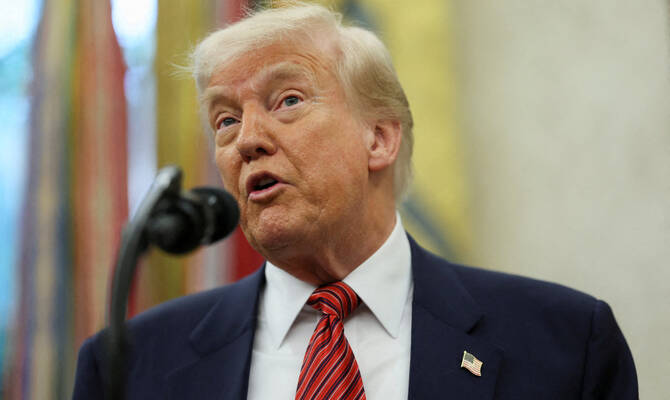
Trump, who wants a swift end to the three-year war, is “open” to a three-way summit “if it comes to that, but he wants both of these leaders and both sides to come to the table together,” White House spokeswoman Karoline Leavitt said in Washington.
But despite Trump’s willingness to meet with Putin and Zelensky, no US representative took part in Monday’s talks in Istanbul, according to a State Department spokesperson.
Zelensky said that, “We are very much awaiting strong steps from the United States” and urged Trump to toughen sanctions on Russia to “push” it to agree to a full ceasefire.
In Monday’s meeting, Ukraine said that Moscow had rejected its call for an unconditional ceasefire. It offered instead a partial truce of two to three days in some areas of the frontline.
Russia will only agree a full ceasefire if Ukrainian troops pull back entirely from four regions — Donetsk, Lugansk, Zaporizhzhia and Kherson — according to its negotiating terms reported on by Russian state media. Russia currently only partly controls those regions.
Moscow has also demanded a ban on Kyiv joining NATO, limiting Ukraine’s military and ending Western military support.
Top negotiators from both sides agreed to swap all severely wounded soldiers and captured fighters under the age of 25.
Russia’s lead negotiator Vladimir Medinsky said it would involve “at least 1,000” on each side.
The two sides also agreed to hand over the bodies of 6,000 soldiers, Ukraine said after the talks.
“The Russian side continued to reject the motion of an unconditional ceasefire,” Ukraine’s Deputy Foreign Minister Sergiy Kyslytsya told reporters after the talks.
Russia said it had offered a limited pause in fighting.
“We have proposed a specific ceasefire for two to three days in certain areas of the front line,” Medinsky said, adding that this was needed to collect the bodies of dead soldiers from the battlefield.
Zelensky hit back on social media: “I think ‘idiots’, because the whole point of a ceasefire is to stop people from becoming dead in the first place.”
Kyiv said it would study a document the Russian side handed its negotiators outlining its demands for both peace and a full ceasefire.
Zelensky said after the Istanbul talks concluded that any deal for lasting peace must not “reward” Putin, and has called for an immediate and unconditional ceasefire to cover combat on air, sea and land.
Ukrainian Defense Minister Rustem Umerov, who led his country’s delegation, called for a next meeting to take place before the end of June. He also said a Putin-Zelensky summit should be discussed.
Turkish Foreign Minister Hakan Fidan said after the talks — inside a luxury hotel on the banks of the Bosphorus — that they were held “in a constructive atmosphere.”
“During the meeting, the parties decided to continue preparations for a possible meeting at the leader level,” Fidan said on social media.
Tens of thousands have been killed since Russia launched its full-scale invasion of Ukraine, with swathes of eastern and southern Ukraine destroyed and millions forced to flee their homes in Europe’s largest refugee crisis since World War II.
In the front-line town of Dobropillya in eastern Ukraine, 53-year-old Volodymyr told AFP he had no hope left for an end to the conflict.
“We thought that everything would stop. And now there is nothing to wait for. We have no home, nothing. We were almost killed by drones,” he said.
After months of setbacks for Kyiv’s military, Ukraine said it had carried out an audacious attack on Sunday, smuggling drones into Russia and then firing them at air bases, damaging around 40 strategic Russian bombers worth $7 billion in a major special operation.


![]()

Trump ‘open’ to meeting Ukraine, Russia leaders to push ceasefire
Short Url
https://arab.news/4pt84
Trump ‘open’ to meeting Ukraine, Russia leaders to push ceasefire
- Russia will only agree a full ceasefire if Ukrainian troops pull back entirely from four regions — Donetsk, Lugansk, Zaporizhzhia and Kherson


Latest updates


© 2026 SAUDI RESEARCH & PUBLISHING COMPANY, All Rights Reserved And subject to Terms of Use Agreement.