KYIV, Ukraine: A Ukrainian drone attack has destroyed more than 40 Russian planes deep in Russia’s territory, Ukraine’s Security Service said on Sunday, while Moscow pounded Ukraine with missiles and drones just hours before a new round of direct peace talks in Istanbul
A military official, who spoke with The Associated Press on condition of anonymity to disclose operational details, said the far-reaching attack took more than a year and a half to execute and was personally supervised by Ukrainian President Volodymyr Zelensky.
In his evening address, Zelensky said that 117 drones had been used in the operation. He claimed the operation had been headquartered out of an office next to the local FSB headquarters. The FSB is the Russian intelligence and security service.
The military source said it was an “extremely complex” operation, involving the smuggling of first-person view, or FPV, drones to Russia, where they were then placed in mobile wooden houses.
“Later, drones were hidden under the roofs of these houses while already placed on trucks. At the right moment, the roofs of the houses were remotely opened, and the drones flew to hit Russian bombers,” the source said.
Social media footage shared by Russian media appeared to show the drones rising from inside containers while other panels lay discarded on the road. One clip appeared to show men climbing onto a truck in an attempt to halt the drones.
Long-range bombers targeted
The drones hit 41 planes stationed at military airfields on Sunday afternoon, including A-50, Tu-95 and Tu-22M aircraft, the official said. Moscow has previously used Tupolev Tu-95 and Tu-22 long-range bombers to launch missiles at Ukraine, while A-50s are used to coordinate targets and detect air defenses and guided missiles.
The Security Service of Ukraine said that the operation, which it codenamed “Web”, had destroyed 34 percent of Russia’s fleet of air missile carriers with damages estimated at $7 billion. The claim could not be independently verified.
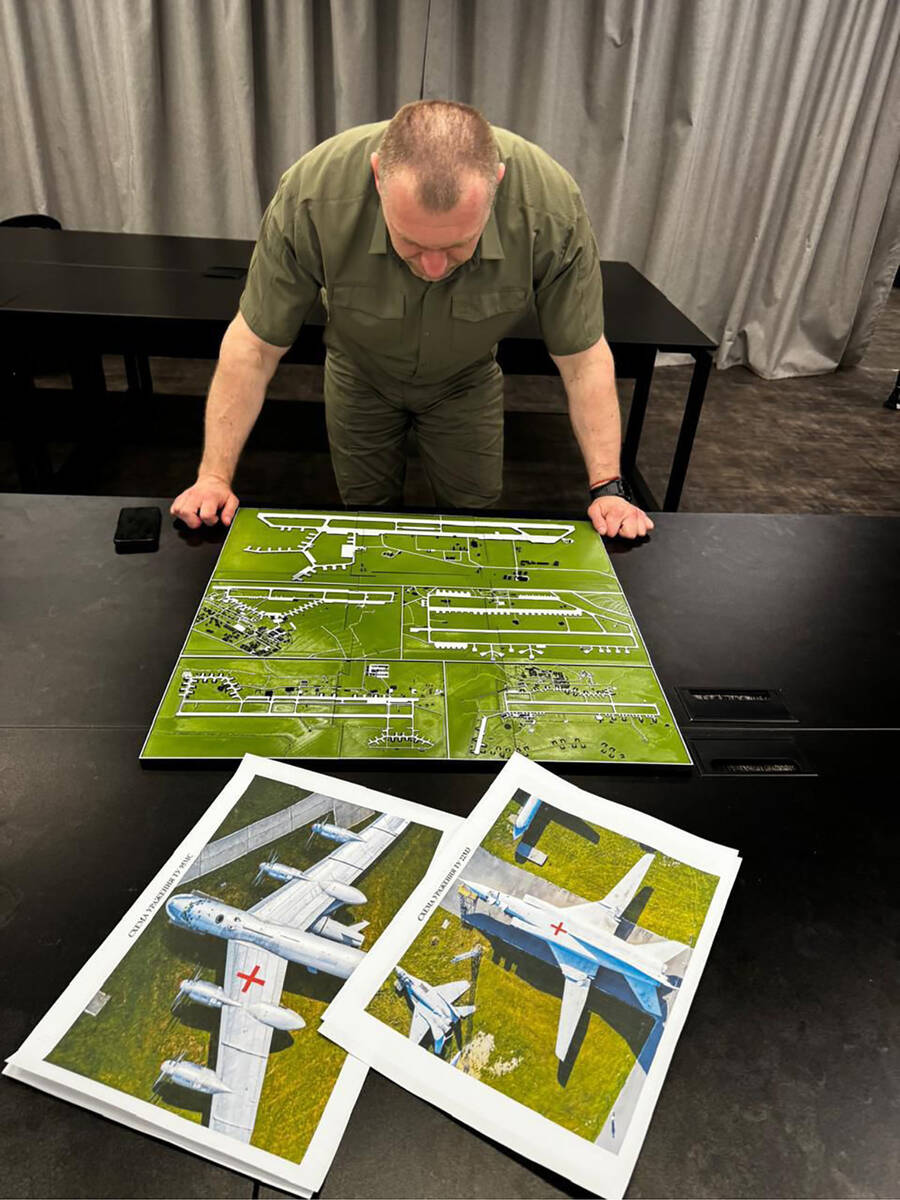
In this undated photo provided by the Ukrainian Security Service, head of the Security Service Vasyl Malyuk studies a photo of a map of Russia's strategic aviation location in his office in Ukraine. (Ukrainian Security Service via AP)
Russia’s Defense Ministry in a statement confirmed the attacks, which damaged aircraft and sparked fires on air bases in the Irkutsk region, more than 4,000 kilometers (2,500 miles) from Ukraine, as well as the Murmansk region in the north, it said. Strikes were also repelled in the Amur region in Russia’s Far East and in the western regions of Ivanovo and Ryazan, the ministry said.
US Defense Secretary Pete Hegseth was briefed on Ukraine’s attack Russia during a stop at Nellis Air Force Base and was monitoring the situation. A senior defense official said on the condition of anonymity to discuss sensitive matters that the US was not given notification before the attack. The official said it represented a level of sophistication the US had not seen before.
Also on Sunday, Russia’s top investigative body said that explosions had caused two bridges to collapse and derailed two trains in western Russia overnight, killing seven in one of the incidents and injuring dozens more. Russian officials, however, did not say what had caused the blasts and the word “explosions” was later removed from an Investigative Committee press release.
Attack ahead of talks
The drone attack came the same day as Zelensky said Ukraine will send a delegation to Istanbul for a new round of direct peace talks with Russia on Monday.
In a statement on Telegram, Zelensky said that Defense Minister Rustem Umerov will lead the Ukrainian delegation. “We are doing everything to protect our independence, our state and our people,” Zelensky said.
Ukrainian officials had previously called on the Kremlin to provide a promised memorandum setting out its position on ending the war before the meeting takes place. Moscow had said it would share its memorandum during the talks.
Russian strike hits an army unit
Russia on Sunday launched the biggest number of drones — 472 — on Ukraine since the full-scale invasion in February 2022, Ukraine’s air force said.

Emergency workers remove debris from a private house that was damaged in a Russian drone strike, amid Russia's attack on Ukraine, in Zaporizhzhia, Ukraine, June 1, 2025. (REUTERS)
Russian forces also launched seven missiles alongside the barrage of drones, said Yuriy Ignat, head of communications for the air force. Earlier Sunday, Ukraine’s army said at least 12 Ukrainian service members were killed and more than 60 were injured in a Russian missile strike on an army training unit.
Ukrainian army commander Mykhailo Drapatyi later Sunday submitted his resignation following the attack. He was a respected commander whose leadership saw Ukraine regain land on the eastern front for the first time since Kyiv’s 2022 counteroffensive.
The training unit was located to the rear of the 1,000-kilometer (620-mile) active front line, where Russian reconnaissance and strike drones are able to strike. Ukraine’s forces lack troops and take extra precautions to avoid mass gatherings as the skies across the front line are saturated with Russian drones looking for targets.