

British FM says Morocco’s autonomy plan for W. Sahara ‘most credible’ solution

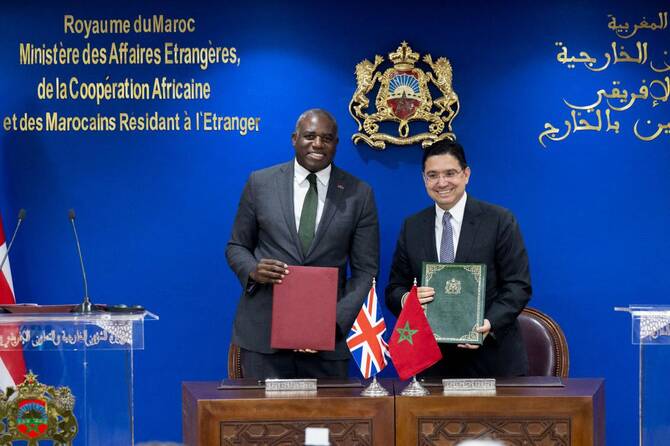
Britain's Foreign Secretary David Lammy (L) and his Moroccan counterpart Nasser Bourita sign agreements in Rabat, June 1, 2025. (AFP)
Short Url
Updated 01 June 2025
Follow

British FM says Morocco’s autonomy plan for W. Sahara ‘most credible’ solution

  • Britain previously backed self-determination for the disputed Western Sahara, which Morocco claims as an integral part of its kingdom
  • Spain and Germany now officially back the Moroccan autonomy plan, while France last summer recognized Morocco’s sovereignty over the territory

RABAT: British Foreign Minister David Lammy said on Sunday that Morocco’s autonomy plan for the territory of Western Sahara was the “most credible” solution to the decades-long dispute, reversing London’s long-standing position.
Western Sahara, a mineral-rich former Spanish colony, is largely controlled by Morocco but has been claimed in its entirety for decades by the pro-independence Polisario Front, which is backed by Algeria.
Morocco has been campaigning for broad support for its autonomy plan after obtaining US recognition of Morocco’s sovereignty over the disputed territory in 2020, in exchange for the normalization of diplomatic relations with Israel.
“The United Kingdom considers Morocco’s autonomy proposal submitted in 2007 as the most credible, viable and pragmatic basis for a lasting resolution of the dispute,” Lammy told reporters in Rabat.
Britain previously backed self-determination for the disputed territory, which Morocco claims as an integral part of its kingdom.

The United Kingdom considers Morocco’s autonomy proposal submitted in 2007 as the most credible, viable and pragmatic basis for a lasting resolution of the dispute

UK Foreign Minister David Lammy

Moroccan foreign minister Nasser Bourita welcomed the shift, saying the new British position contributed “greatly to advancing this momentum and promoting the UN path toward a definitive and mutually acceptable solution based on the autonomy initiative.”
Rabat’s push for support for its autonomy plan has seen success.
Spain and Germany now officially back the Moroccan autonomy plan, while France last summer recognized Morocco’s sovereignty over the territory.
“This year is a vital window of opportunity to secure a resolution before we reach 50 years of the dispute in November,” said Lammy.
The foreign minister also said it encouraged “relevant parties to engage urgently and positively with the United Nations-led political process.”
The United Nations considers Western Sahara a “non-self-governing territory” and has had a peacekeeping mission there since 1991, whose stated aim is to organize a referendum on the territory’s future.
But Rabat has repeatedly ruled out any vote where independence is an option, instead proposing an autonomy plan.
The ceasefire collapsed in mid-November 2020 after Moroccan troops were deployed to the far south of the territory to remove separatists blocking the only route to Mauritania — a route they claimed was illegal, as it did not exist in 1991.
The UN Security Council is calling for negotiations without preconditions, while Morocco insists they focus solely on its autonomy plan.
“The only viable and durable solution will be one that is mutually acceptable to the relevant parties and is arrived at through compromise,” added Lammy.
In a joint statement, the United Kingdom noted that its export credit agency, UK Export Finance, may consider supporting projects in the Sahara as part of its commitment to mobilize 5 billion British pounds (approximately 5.9 billion euros) for new economic initiatives in Morocco.


Fourth pair of Filipino conjoined twins to undergo separation surgery in Riyadh

Updated 5 sec ago
Follow

Fourth pair of Filipino conjoined twins to undergo separation surgery in Riyadh

  • The Manuel twins and their parents met with the Saudi ambassador to Manila
  • Kingdom’s flagship program for conjoined twins has separated over 140 children 

MANILA: Conjoined twins Olivia and Gianna Manuel will travel to Riyadh for separation surgery, becoming the fourth pair of Filipino twins to be treated under the Saudi Conjoined Twins Program, the Kingdom’s Embassy in Manila said on Tuesday. 

The 20-month-old girls from the town of Talavera in the central Philippine province of Nueva Ecija were born in April 2024. They are joined from the chest to the abdomen, a condition known as omphalopagus. 

Saudi Ambassador Faisal Ibrahim Al-Ghamdi received them on Monday, “ahead of their departure to the Kingdom,” the embassy said in a statement. 

“The family of the twins conveyed their profound gratitude and appreciation to the Government of the Kingdom of Saudi Arabia for this generous gesture and the medical and humanitarian care extended to their daughters.”

Olivia and Gianna’s mother first learned about the Saudi Conjoined Twins Program last year when she was still in the hospital with the girls, closely monitored by doctors for three months after they were born. 

“From the time I gave birth to the twins, I already started searching about conjoined twins,” Ginalyn Manuel told Arab News.

In the beginning, she followed updates on Akhizah and Ayeesha Yusoph, the second pair of Filipino twins to be selected for separation surgery under the program. 

But at the time, she could not find anyone who was able to help connect her to the King Salman Humanitarian Aid and Relief Center, which runs the conjoined twins initiative. 

“Then in May, I saw the Misa twins. The mother posted that they were about to fly and she was thanking Saudi Arabia and the embassy,” Manuel said. 

Maurice Ann and Klea Misa are the third pair of conjoined twins from Lubang, a municipality on the Philippine island of Mindoro, who flew to Riyadh earlier this year in May for a separation surgery.

Through their social media posts, Manuel tried again to make online connections, eventually finding the right people to link her up with KSrelief. 

“Then in July, (KSrelief) sent us an email asking for the medical records of my twins, and that started the whole process,” she said. 

Conjoined twins are a rare phenomenon, estimated to occur once in every 50,000 to 60,000 births. 

Saudi Arabia is known as a pioneer in the field of separation surgery. KSrelief was established by King Salman in 2015 and is headed by Dr. Abdullah Al-Rabeeah, one of the world’s most renowned pediatric surgeons.

Since 1990, he and his team have separated more than 140 children from 27 countries who were born sharing internal organs with their twins.

The Misa twins, who are joined at the head, are currently being prepared for their surgery in Riyadh. 

The first pair of Filipino conjoined twins, Ann and Mae Manzo, were separated under the program in March 2004. They were joined at the abdomen, pelvis and perineum. 

They were followed by the Yusoph twins, who were joined at the lower chest and abdomen and shared one liver. Their successful separation surgery was conducted in September 2024.