Britain plans at least six new weapons factories in defense review

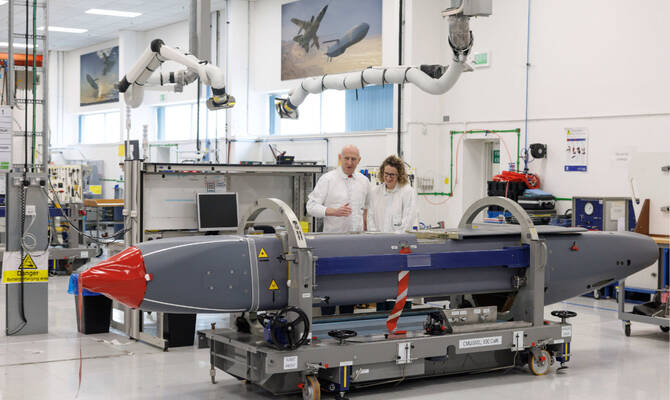
Louise Holmes, MBDA UK Deputy Managing Director, shows Britain's Defense Secretary John Healey, left, a storm shadow missile on an assembly line at the MBDA Storm Shadow factory in Stevenage, England, Saturday May 31, 2025. (AP)
Short Url
Updated 01 June 2025
Follow

Britain plans at least six new weapons factories in defense review

  • The 1.5 billion-pound ($2.0 billion) investment will be included in the Strategic Defense Review, a 10-year plan for military equipment and services

MANCHESTER, England: Britain will build at least six new factories producing weapons and explosives as part of a major review of its defense capabilities, the government said on Saturday.
The 1.5 billion-pound ($2.0 billion) investment will be included in the Strategic Defense Review, a 10-year plan for military equipment and services. The SDR is expected to be published on Monday.
The Ministry of Defense added that it planned to procure up to 7,000 long-range weapons built in Britain. Together, the measures announced on Saturday will create around 1,800 jobs, the MoD said.
“The hard-fought lessons from (Russian President Vladimir) Putin’s illegal invasion of Ukraine show a military is only as strong as the industry that stands behind them,” Defense Secretary John Healey said in a statement.
“We are strengthening the UK’s industrial base to better deter our adversaries and make the UK secure at home and strong abroad.”
The extra investment will mean Britain will spend around 6 billion pounds on munitions in the current parliament, the MoD said.
Earlier on Saturday, the MoD said it would spend an extra 1.5 billion pounds to tackle the poor state of housing for the country’s armed forces.


Thousands in Kosovo march against war crimes trials on 18th anniversary of independence declaration

Updated 2 sec ago
Follow

Thousands in Kosovo march against war crimes trials on 18th anniversary of independence declaration

  • Protesters, many wrapped in red and black Albanian flags, braved cold and snowy weather in the capital, Pristina, to voice their opposition to the proceedings in The Hague
  • PM Albin Kurti added that ‘the KLA-led war was pure, liberation (struggle) and an anti-colonial war ... a just struggle of an occupied and oppressed people under apartheid’
PRISTINA, Kosovo: An air of defiance marked Kosovo’s independence celebrations on Tuesday as thousands of people joined a march in support of former fighters who are facing trial at a Netherlands-based court for alleged war crimes during a 1998-1999 separatist war from Serbia.
Protesters, many wrapped in red and black Albanian flags, braved cold and snowy weather in the capital, Pristina, to voice their opposition to the proceedings in The Hague against former president and rebel leader Hashim Thaci and three others accused of atrocities during and after the conflict that killed some 13,000 people.
Earlier on Tuesday, Kosovo’s security forces paraded in Pristina as part of the independence ceremonies, and Parliament held a special session.
The war started in 1998 when the rebel Kosovo Liberation Army launched its struggle for independence and Serbia responded with a brutal crackdown. The war ended after NATO bombed Serbia for 78 days in 1999, eventually forcing it to pull out its troops from the territory.
Serbia still does not recognize the 2008 declaration of independence of Kosovo and this has been a source of persistent tension in the volatile Balkan region. As both Kosovo and Serbia seek European Union membership, they have been told they must normalize ties before joining.
Prosecutors at the Kosovo Specialist Chambers in The Hague — which formally is part of Kosovo’s judicial system although seated abroad — have asked for a maximum 45-year prison sentence for Thaci and the other defendants. Thaci also faces a separate trial on charges of intimidating witnesses that will begin later this month.
Officials and protesters in Kosovo have criticized the proceedings as political and designed to strike a false balance with Serbia whose political and military leaders previously had been tried and convicted of war crimes in Kosovo by a separate UN court.
Protesters at Tuesday’s march held banners reading “History cannot be rewritten” and “Freedom for the liberators.” They arranged metal fences around a landmark independence monument and placed a sign reading ”Kosovo in Prison” on top of it.
President Vjosa Osmani said in a statement that “truth cannot be changed by attempts to rewrite history or to tarnish and devalue the struggle of Kosovo’s people for freedom.”
Prime Minister Albin Kurti added that “the KLA-led war was pure, liberation (struggle) and an anti-colonial war ... a just struggle of an occupied and oppressed people under apartheid.”
In Belgrade, a Serbian government liaison office for Kosovo described the independence declaration 18 years ago as a “flagrant violation of international law.” The statement alleged “systematic terror” and persecution against minority Serbs in Kosovo.
The United States and most EU countries are among more than 100 nations that have recognized Kosovo’s independence while Russia and China have backed Serbia’s claim on the territory.
Thaci resigned from office in 2020 to defend himself against the 10 charges of crimes against humanity and war crimes.
The court and an associated prosecutor’s office were created after a 2011 report by the Council of Europe, a human rights body, following allegations that KLA fighters trafficked human organs taken from prisoners and killed Serbs and fellow ethnic Albanians. The organ harvesting allegations haven’t been included in indictments issued by the court.