Myanmar junta extends ceasefire again after quake

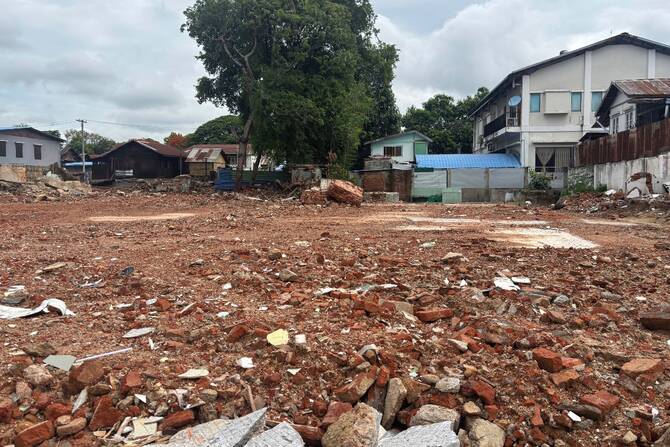
An empty field with a collapsed building caused by a strong earthquake in Naypyitaw, Myanmar. (AP)
Short Url
Updated 01 June 2025
Follow

Myanmar junta extends ceasefire again after quake

  • A statement from the junta information team on Saturday said there would be an extension of the armistice, which expired May 31, until June 30

YANGON: Myanmar’s junta has extended a post-earthquake truce, after the expiry of a previous humanitarian ceasefire it was accused of flouting with a continued campaign of air strikes.
The junta initially declared a truce in the many-sided civil war after a huge quake in late March killed nearly 3,800 people and left tens of thousands homeless.
The truce has been extended before, although conflict monitors say fighting has continued, including regular air strikes.
A statement from the junta information team on Saturday said there would be an extension of the armistice — which expired May 31 — until June 30.
This would “facilitate rehabilitation and reconstruction activities in earthquake-affected areas,” it said in the statement.
It added that the state was “intensively engaging in reconstruction of damaged government offices and departments, public residences and transport facilities.”
The ceasefire would also allow the country to hold “a free and fair multi-party democracy general election,” according to the statement.
The country’s junta chief said earlier this year that a long-promised election will be held by January, the first in the war-torn nation since the military staged a coup in 2021.
In the statement, the military also warned it would still strike back against any offensives by the array of ethnic armed groups and anti-coup fighters.
The announcement comes after Malaysian foreign minister Mohamad Hasan used a regional meeting last week to call for the extension and expansion of a ceasefire “beyond the currently affected zones.”
Malaysia currently holds the rotating chairmanship of the 10-country Association of Southeast Asian Nations (ASEAN).
The bloc has led so far fruitless diplomatic efforts to end Myanmar’s conflict since the junta deposed civilian leader Aung San Suu Kyi in February 2021.


Climate activist group files second lawsuit against Sweden

Updated 5 sec ago
Follow

Climate activist group files second lawsuit against Sweden

  • Sweden’s Supreme Court in February 2025 ruled that the complaint filed against the state was inadmissible
  • “We still have a chance to get out of the planetary crises and build a safe and fair world,” Edling said

STOCKHOLM: A group of climate activists said Friday they were filing another lawsuit against the Swedish state for alleged climate inaction, after the Supreme Court threw out their case last year.
The group behind the lawsuit, Aurora, first tried to sue the Swedish state in late 2022.
Sweden’s Supreme Court in February 2025 ruled that the complaint filed against the state — brought by an individual, with 300 other people joining it as a class action lawsuit — was inadmissible.
The court at the time noted the “very high requirements for individuals to have the right to bring such a claim” against a state.
“We still have a chance to get out of the planetary crises and build a safe and fair world. But this requires that rich countries that emit as much as Sweden stop breaking the law,” Aurora spokesperson Ida Edling said in a statement Friday.
The group, which said the lawsuit had been filed with the Stockholm District Court Friday, said it believes the Swedish state is obligated “to reduce Sweden’s emissions as much and as quickly as necessary in order for the country to be in line with its fair share.”
“This means that emissions from several sectors must reach zero before 2030,” the group said, while noting this was 15 years before Sweden’s currently set targets.
The Swedish Environmental Protection Agency as well as the OECD warned last year that Sweden was at risk of not reaching its own goal of net zero emissions by 2045.
While the first lawsuit was unsuccessful, the group noted that international courts had made several landmark decisions since the first suit was filed, spotlighting two in particular.
In an April 2024 decision, Europe’s top rights court, the European Court of Human Rights, ruled that Switzerland was not doing enough to tackle climate change, the first country ever to be condemned by an international tribunal for not taking sufficient action to curb global warming.
In 2025, the International Court of Justice issued an advisory opinion stating that countries violating their climate obligations were committing an “unlawful” act.