

Anti-aircraft missiles fire as drones fly over Port Sudan: witnesses

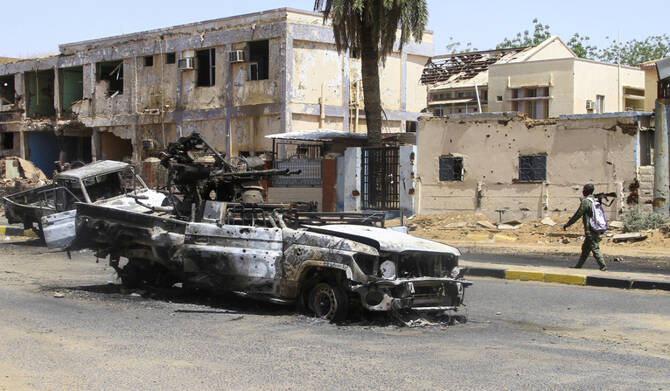
A Sudanese man walks past destroyed military vehicles in front of a hospital in Khartoum on April 28, 2025. (AFP)
Short Url
Updated 01 June 2025
Follow

Anti-aircraft missiles fire as drones fly over Port Sudan: witnesses

  • Since Sudanese authorities fled the capital Khartoum early in the war, Port Sudan has hosted government ministries, the United Nations and hundreds of thousands of people

PORT SUDAN, Sudan: Anti-aircraft missiles fired over Sudan’s wartime capital Port Sudan on Saturday, eyewitnesses reported, as drones flew over the once-safe haven city.
Since April 2023, war has raged between Sudan’s regular army and the paramilitary Rapid Support Forces.
Port Sudan, seat of the army-backed government, came under attack by drones blamed on the RSF for the first time early this month.
The campaign of drone strikes attacked infrastructure including the country’s last functioning civilian international airport, power stations and major fuel depots.
The near-daily strikes had stopped for over a week until Saturday, when residents in the city heard “the sound of anti-aircraft missiles north and west of the city and drones flying in the sky,” one witness told AFP.
Since Sudanese authorities fled the capital Khartoum early in the war, Port Sudan has hosted government ministries, the United Nations and hundreds of thousands of people.
Nearly all aid into the country — home to nearly 25 million people suffering dire food insecurity — transits through Port Sudan.
The war has killed tens of thousands, uprooted 13 million and created what the UN describes as the world’s largest hunger and displacement crises.
It has also effectively split Sudan in two, with the army holding the center, east and north, while the paramilitaries and their allies control nearly all of Darfur and parts of the south.
Since losing Khartoum in March, the RSF has adopted a two-pronged strategy: long-range drone strikes on army-held cities accompanied by counteroffensives to reclaim territory in the country’s south.
The drone strikes have impacted infrastructure across Sudan’s army-held northeast, with attacks on power stations causing blackouts for millions of people.
A blackout in Khartoum also cut off access to clean water, according to health authorities, causing a cholera outbreak that has killed close to 300 people this month.


Amnesty says Algeria unlawfully returned Tunisia asylum seeker

Updated 4 sec ago
Follow

Amnesty says Algeria unlawfully returned Tunisia asylum seeker

  • Amnesty International said Makhlouf was handed over to Tunisian police on January 18 without prior notice to him or his lawyers, in a move the group called “unlawful refoulement”

TUNIS: Global rights group Amnesty accused Algerian authorities on Monday of breaching international law by forcibly returning a political dissident to Tunisia, even though he was a registered asylum seeker.
Seifeddine Makhlouf, a former parliamentarian and critic of Tunisian President Kais Saied, was reportedly sentenced to prison for “plotting against state security” before his return to the North African country.
Makhlouf, who is the leader of the Al Karama party, sought asylum in Algeria in July 2024 after facing detention in Tunisia, and registered as an asylum seeker with the UN refugee agency UNHCR.
Amnesty International said Makhlouf was handed over to Tunisian police on January 18 without prior notice to him or his lawyers, in a move the group called “unlawful refoulement.”
“Makhlouf’s forced return is a violation of the principle of non-refoulement,” Amnesty’s MENA deputy chief Sara Hashash said in a statement published by the group.
“By handing him over to Tunisian authorities without allowing him any opportunity to contest the decision or assessing the risks he faces in Tunisia... Algeria has breached its obligations under international human rights law, including the Refugee Convention,” she added.
Saied froze parliament in July 2021 and seized far-reaching executive powers in what critics have called a “coup.”
Since then, local and international NGOs have denounced a regression of rights and freedoms in Tunisia.
Amnesty said Makhlouf was later imprisoned in Algeria for irregular entry and placed in administrative detention, during which he was denied access to the UN refugee agency.
The rights group said Makhlouf was arrested upon his arrival in Tunisia to serve sentences handed down in his absence.
Reports said a Tunisian court sentenced Makhlouf on January 13 to five years in prison for “plotting against state security.”
The Amnesty statement called for “verdicts rendered in absentia to be quashed and for a new and fair trial to be held before an independent and impartial court.”
Hashash warned that Makhlouf’s case reflects wider regional repression, calling his extradition “particularly alarming given the escalating crackdown on dissent in Tunisia, where the judiciary has been increasingly weaponized to silence political opposition.”
She said that Algeria’s actions “set a dangerous precedent,” adding that “bilateral cooperation now takes precedence over the most fundamental principles of international human rights and refugee law.”