

Pakistan PM says Indian bid to set ‘new norm’ thwarted, vows to focus on economy and governance

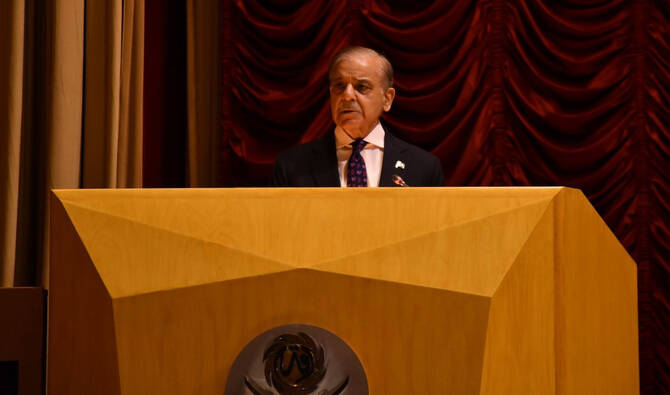
Pakistan Prime Minister Shehbaz Sharif addressing senior military officers at the Command and Staff College in Quetta, on May 31, 2025. (PTV News)
Short Url
Updated 31 May 2025
Follow

Pakistan PM says Indian bid to set ‘new norm’ thwarted, vows to focus on economy and governance

  • Shehbaz Sharif tells military officials in Quetta India suffered setbacks on battlefield and in diplomatic realm
  • He reiterates that New Delhi will not be allowed to ‘weaponize water,’ calling IWT suspension a ‘red line’

ISLAMABAD: Prime Minister Shehbaz Sharif on Saturday highlighted a range of security threats facing Pakistan days after a military standoff with India, saying New Delhi’s attempt to establish a “new norm” by targeting his country at will had been thwarted, though Pakistan must now focus on strengthening economy and governance.

The remarks came during a televised address to senior military officers at the Command and Staff College in Quetta, where the premier recounted the recent escalation between the two nuclear-armed neighbors.

The flare-up followed an April attack on tourists in Indian-administered Kashmir, which New Delhi blamed on a Pakistan. Islamabad denied the allegation and called for an impartial probe, but tensions rapidly escalated into four days of cross-border hostilities, ending after a US-brokered ceasefire on May 10.

“The threats we face are no longer limited to conventional battlefields,” Sharif said during his address. “They are multifaceted, ranging from kinetic warfare to cyberattacks, economic coercion to disinformation campaigns and hybrid threats that challenge both our borders and our ideological frontiers.”

“The recent Indian aggression against Pakistan, violating our territorial integrity and targeting our innocent civilians, was not merely countered successfully, but instead we succeeded in turning the tables on those who were dreaming of establishing a new norm,” he said.

Sharif added that Pakistan accepted the ceasefire offer “in the interest of peace, progress and prosperity in South Asia,” asserting that India’s claim of a new strategic precedent “was buried for all times to come by our brave armed forces.”

“In fact, it was Pakistan that established the new norm in its relations with India,” he said. “Henceforth, we will not allow her to behave in an arrogant and haughty manner.”

The prime minister said India had suffered “serious setbacks in both warfare and finest diplomacy” during the episode.

Turning to domestic matters, Sharif said while the military had fulfilled its responsibility, Pakistan still faced “major challenges in the field of economy and governance.”

He cited the dire financial situation when his administration took office, saying it compelled Pakistan to seek external assistance from lenders such as the International Monetary Fund (IMF).

However, he maintained the economy had since stabilized and was now on a positive trajectory.

The prime minister also criticized India’s recent move to suspend the Indus Waters Treaty (IWT), a World Bank-brokered water-sharing agreement signed in 1960, reiterating it was unacceptable to his country.

“We will not allow India to weaponize water by holding the Indus Waters Treaty in abeyance,” he said. “This is an absolute red line for us.”


Pakistan says PM Sharif has received invitation to join Gaza peace board

Updated 5 sec ago
Follow

Pakistan says PM Sharif has received invitation to join Gaza peace board

  • Board is set to supervise temporary governance of Gaza
  • Gaza has been under a shaky ceasefire since October

ISLAMABAD: Pakistan’s foreign ministry said on Sunday Prime Minister Shehbaz Sharif had received an invitation from US President Donald Trump to join the so-called “Board of Peace” for Gaza.

The White House on Friday announced some members of this board, which would outlive its role supervising the temporary governance of Gaza, under a fragile ceasefire since October. 

The names include US Secretary of State Marco Rubio, President Donald Trump’s special envoy Steve Witkoff, former British prime minister Tony Blair and Trump’s son-in-law, Jared Kushner. Trump is the chair of the board, according to a plan the White House unveiled in October.

Israel and the Palestinian group Hamas signed off on Trump’s plan, which says a Palestinian technocratic administration will be overseen by an international board, which will supervise Gaza’s governance for a transitional period.

“The Prime Minister of Pakistan has received the invitation from the President of the United States to join the Board of Peace on Gaza,” the Foreign Office said in a statement. 

“Pakistan will remain engaged with international efforts for peace and security in Gaza, leading to a lasting solution to the Palestine issue in accordance with United Nations resolutions.”

Many rights experts and advocates have said Trump overseeing a board to supervise a foreign territory’s governance resembles a colonial structure, while Blair’s involvement was criticized last year due to his role in the Iraq war and the history of British imperialism in the Middle East.

The White House did not detail the responsibilities of each member of the board. The names do not include any Palestinians. The White House said more members will be announced over the coming weeks.

It also named a separate, 11-member “Gaza Executive Board” to support the technocratic body, including Turkish Foreign Minister Hakan Fidan, UN Middle East peace coordinator Sigrid Kaag, United Arab Emirates International Cooperation Minister Reem Al-Hashimy, and Israeli-Cypriot billionaire Yakir Gabay.

But Israeli Prime Minister Benjamin Netanyahu’s office has said the composition of this board had not been coordinated with Israel and contradicted its policy — possibly a reference to Fidan’s presence, as Israel objects to Turkish involvement. 

With inputs from Reuters