Authorities begin action against vehicles without e-tags in Pakistani capital

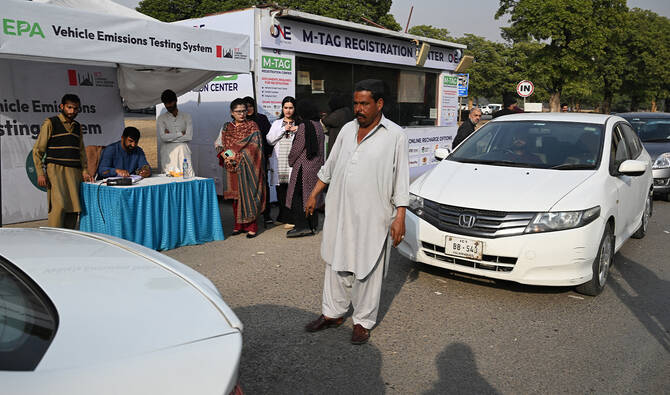
This picture taken on December 10, 2025, shows residents examining their cars at an emission testing point in Islamabad. (AFP/File)
Short Url
Updated 18 January 2026
Follow

Authorities begin action against vehicles without e-tags in Pakistani capital

  • Capital administration made e-tags mandatory for all vehicles in Islamabad in Nov.
  • Vehicles already equipped with a motorway tag, or m-tag, do not require an e-tag

ISLAMABAD: Authorities have begun action against vehicles plying roads in the Pakistani capital of Islamabad without electronic tags, or e-tags, the Islamabad administration said on Sunday, in a move aimed at streamlining traffic management and improving monitoring at the city’s entry and exit points.

The capital administration made e-tags mandatory for all vehicles in Islamabad in Nov. last year to enhance security in the city. Vehicles already equipped with a motorway tag, or m-tag, do not require an e-tag.

The move is aimed at regulating traffic flow, improving record-keeping, and ensuring that vehicles entering the federal capital are properly registered within the system, according to the officials.

The enforcement relies on e-tag readers installed at entry and check points across the capital, which automatically identify untagged vehicles and allow authorities to take action without manual checks.

“Vehicles without m-tags are being stopped at various checkpoints,” the Islamabad administration said in a statement, citing a top excise official. “Citizens are requested to get the tags installed as soon as possible to avoid legal trouble.”

Readers are fully operational at various check points across the city to identify vehicles without e-tags, according to the statement. Installation of e-tags is also underway at 17 points set up in different areas.

“A total of 166,888 vehicles have so far been successfully issued m-tags,” the statement read.

Last month, Interior Minister Mohsin Naqvi also reviewed Islamabad’s monitoring system and said reforms in Safe City project operations and the effective use of technology were the “need of the hour,” according to his ministry.

“Under the Capital Smart City initiative, citizen services such as Rescue 1122, traffic management, security, and the Capital Development Authority (CDA) would be integrated into a centralized system,” Naqvi said.


Uzbekistan president arrives in Pakistan to increase trade, defense, energy cooperation

Updated 5 sec ago
Follow

Uzbekistan president arrives in Pakistan to increase trade, defense, energy cooperation

  • Uzbek President Shavkat Mirziyoyev leads high-level delegation of ministers, business leaders on Feb. 5-6 visit, says state media 
  • Visit takes place days after Pakistan, Uzbekistan reaffirmed $2 billion trade target during intergovernmental commission meeting

ISLAMABAD: Uzbekistan President Shavkat Mirziyoyev arrived in Pakistan’s capital Islamabad on Thursday, with a high-level delegation to identify new avenues for bilateral cooperation in trade, defense, energy and other avenues, state-run media reported. 

The visit takes place after the 10th session of the Pakistan–Uzbekistan Intergovernmental Commission (IGC) on Trade, Economic and Scientific-Technical Cooperation was held in Islamabad on Feb. 2. Both sides reaffirmed their $2 billion trade target and agreed to push for regional connectivity, develop trade routes and accelerate cooperation in several sectors. 

Mirziyoyev was given a red-carpet welcome when his aircraft landed at the Nur Khan Airbase, the state-run Associated Press of Pakistan (APP) said. He was welcomed by President Asif Ali Zardari, Prime Minister Shehbaz Sharif and senior members of the cabinet. 

“Discussions will focus on reviewing the entire gamut of bilateral relations and identifying new avenues to further deepen cooperation in diverse sectors, including trade, energy, defense, education, people-to-people exchange and regional connectivity,” APP reported. 

The Uzbek president will meet President Zardari, hold delegation-level talks with Prime Minister Sharif, and address the Pakistan-Uzbekistan Business Forum during his visit. 

Mirziyoyev’s visit takes place two days after Kazakhstan President Kassym-Jomart Tokayev arrived in Islamabad to hold talks on trade, business and connectivity. 

Pakistan and Kazakhstan signed 37 memoranda of understanding (MoUs) and set a target of raising bilateral trade to $1 billion within a year during Tokayev’s visit. 

Pakistan and Uzbekistan have steadily increased economic ties in recent years as Islamabad seeks greater access to landlocked Central Asian markets, aiming to position itself as a regional transit and trade hub linking South Asia with Central Asia.

Pakistan was the first Central Asian partner with which Uzbekistan signed a bilateral Transit Trade Agreement, along with a Preferential Trade Agreement in March 2022, covering 17 items, which became operational in 2023.

Pakistan’s finance ministry said last month that Azerbaijan’s state energy company SOCAR was set to finalize an investment in the country’s oil and gas sector following high-level engagements at the World Economic Forum in Davos.