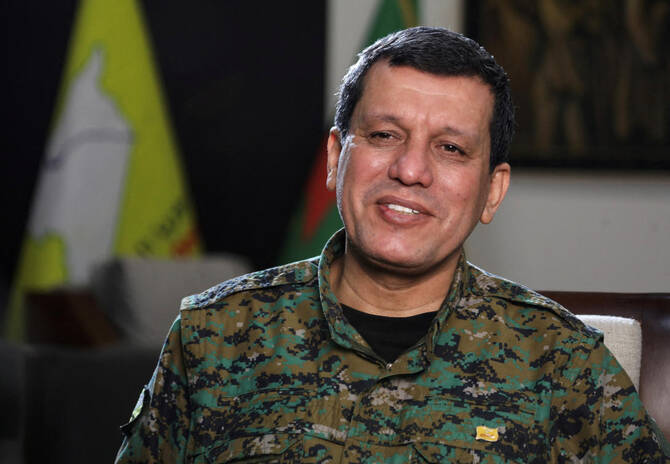
BEIRUT: The commander of Kurdish forces that control northeast Syria said on Friday that his group is in direct contact with Turkiye and that he would be open to improving ties, including by meeting Turkish President Tayyip Erdogan.
The public comments represented a significant diplomatic overture by Mazloum Abdi, whose Syrian Democratic Forces fought Turkish troops and Ankara-backed Syrian rebels during Syria’s 14-year civil war.
Turkiye has said the main Kurdish group at the core of the SDF is indistinguishable from the militant Kurdistan Workers Party (PKK), which decided earlier this month to disband after 40 years of conflict with Turkiye.
Abdi told regional broadcaster Shams TV in an interview aired on Friday that his group was in touch with Turkiye, without saying how long the communication channels had been open.
“We have direct ties, direct channels of communication with Turkiye, as well as through mediators, and we hope that these ties are developed,” Abdi said. There was no immediate comment from Turkiye on Abdi’s remarks.
He noted his forces and Turkish fighters “fought long wars against each other” but that a temporary truce had brought a halt to those clashes for the last two months. Abdi said he hoped the truce could become permanent.
When asked whether he was planning to meet Erdogan, Abdi said he had no current plans to do so but “I am not opposed... We are not in a state of war with Turkiye and in the future, ties could be developed between us. We’re open to this.”
The Al-Monitor news website reported on Friday that Turkiye had proposed a meeting between Abdi and a top Turkish official, possibly Turkiye’s foreign minister or its intelligence chief.
A Turkish diplomatic source denied the report, saying “the claims about Turkiye and our country’s authorities” in the story were “not true,” without elaborating.
In December, Turkiye and the SDF agreed on a US-mediated ceasefire after fighting broke out as rebel groups advanced on Damascus and overthrew Bashar Assad.
Abdi in March signed a deal with Syria’s interim President Ahmed Al-Sharaa to incorporate the semi-autonomous administration of northeast Syria into the main state institutions based in Damascus.
On Thursday, Erdogan accused the SDF of “stalling” implementation of that deal.
In the interview, Abdi denied accusations that the SDF was in contact with Israel.
“People have accused us of this. In this interview, I am saying publicly that we have no ties with Israel,” he said.
But he said his group supported good ties with Syria’s neighbors. When asked if that included Israel, Abdi responded, “with everyone.”


![]()

Syrian Kurdish commander in touch with Turkiye, open to meeting Erdogan
Short Url
https://arab.news/9yqac
Syrian Kurdish commander in touch with Turkiye, open to meeting Erdogan
Latest updates


© 2026 SAUDI RESEARCH & PUBLISHING COMPANY, All Rights Reserved And subject to Terms of Use Agreement.