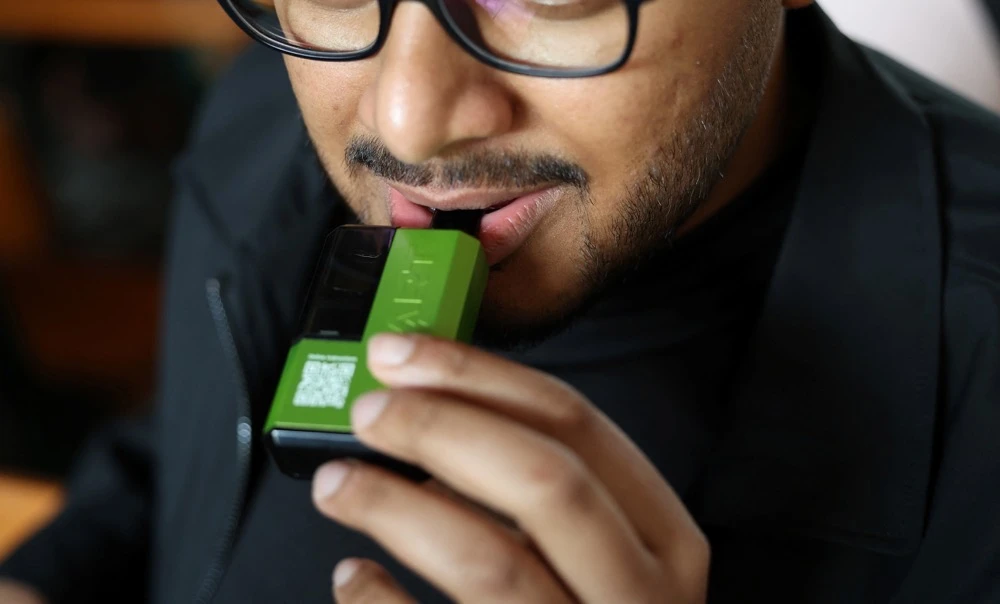
LONDON: A ban on disposable vapes goes into effect across the UK on Sunday in a bid to protect children’s health and tackle a “throwaway” culture.
“For too long, single-use vapes have blighted our streets as litter and hooked our children on nicotine,” junior environment minister Mary Creagh said.
She said the government was calling “time on these nasty devices” — a type of e-cigarette which are very popular with young people — and banning sales of single-use vapes or their supply in a crackdown on UK corner shops and supermarkets.
Those caught flouting the ban will face a £200 fine, while repeat offenders risk up to two years in prison.
Young people and children in particular have been attracted to cheap and colorful disposable vapes, which have snazzy flavours such as mint, chocolate, mango or watermelon, since they were introduced in the UK in 2021.
In 2024, nearly five million disposable vapes were thrown away each week, according to Material Focus, an independent UK-based non-profit.
More than 40 tons of lithium, a key metal used in the technology industry, was discarded each year along with single-use vapes — enough to power 5,000 electrical vehicles, the NGO said.
Fire services have also warned about the risk of discarded vapes catching light among household rubbish.
“Every vape has potential to start a fire if incorrectly disposed of,” said Justin Greenaway, commercial manager at electronic waste processing company SWEEEP Kuusakoski.
The new law, first proposed by the previous Conservative government, also aims to stem a rise in vaping.
“This new law is a step toward reducing vaping among children, while ensuring products are available to support people to quit smoking,” said Caroline Cerny, deputy chief executive for health charity Action on Smoking and Health .
A recent ASH survey said 11 percent of adults vape, or about 5.6 million people, and 18 percent of 11 to 17 year olds — about 980,000 under-18s. Among vapers, some 52 percent of young adults aged between 18 to 24 preferred single-use vapes.
The long-term health risks of vaping remain unclear.
E-cigarettes do not produce tar or carbon monoxide, two of the most harmful elements in tobacco smoke. But they do still contain highly addictive nicotine.
The upcoming ban has already led to a fall in disposable vapes. According to ASH, the use of disposables by 18-24-year-old vapers fell from 52 percent in 2024 to 40 percent in 2025.
The UK ban follows similar European moves. Belgium and France became the first EU countries to ban sales of disposable vapes.
Ireland is also preparing to introduce new restrictions.
But critics have argued many users will simply switch to refillable or reusable vaping devices, which will limit the impact on nicotine consumption.
And industry experts say the ban could lead to more illegal products entering the UK market.
The bill “only makes it illegal to sell disposable vapes — it does not prohibit their use,” warned Dan Marchant, director of Vape Club, the UK’s largest online vape retailer.
“We risk a surge of illegal and potentially dangerous items flooding the black market.”
UK ban on disposable vapes goes into effect
https://arab.news/ryy7k
UK ban on disposable vapes goes into effect
- Those caught flouting the ban will face a £200 fine
India rolls out strictest anti-pollution curbs as toxic smog engulfs Delhi
- Private monitors in several parts of northern Delhi recorded AQI spikes between 550 and 700s
- Authorities invoked stage four of the capital region’s emergency pollution-control framework
NEW DELHI: India’s capital choked under a thick blanket of smog on Sunday, with the government imposing anti-pollution curbs after monitoring stations in some areas recorded extremely hazardous air quality.
Home to 30 million people, Delhi has not recorded a single “clean air” day in 2025, with Air Quality Index readings hitting high above the 50 score throughout the year.
On the AQI scale from 0 to 500, good air quality is represented by levels below 50, while levels above 300 are dangerous.
Worsening since late October, official records over the weekend were in the severe to severe-plus range of 400–500, but as 24-hour averages, they did not capture the peaks. Private monitors in several parts of North and North West Delhi recorded AQI spikes above 550 and even into the 700s in real-time.
On Saturday evening, the Ministry of Environment’s Commission for Air Quality Management invoked stage four — the highest level — of the Graded Response Action Plan for Delhi and surrounding areas.
To “prevent further deterioration of air quality in the region,” the commission suspended all non-essential construction, shut stone crushers and mining operations, stopped entry of trucks into the capital region, and ordered schools to shift to hybrid classes or online, where possible.
While authorities blamed the pollution on “adverse meteorological conditions,” residents have been demanding more government action.
“The situation is so bad in Delhi that we don’t have any option but to force kids to do online classes. The government has failed us; it has not done anything to address the issue,” said Nabanita Nayak, who decided for her teenage children to attend school online only, despite concerns over their screen addiction.
“If the kids are too much in front of laptops, that’s also an issue. As a mother, I am worried.”
Delhi’s pollution has been worsening since Diwali in late October, when the average AQI has been above 370, or “very poor.” Since mid-November, it has been over 400, which means “severe” air quality, with certain areas recording 500 and above, which is classified as a “hazardous” level.
“I don’t feel proud living in Delhi. It’s the capital city of the country … We talk about being a developed nation by 2047 — we have deadlines,” said Jagriti Arora, who is keeping her 7-year-old daughter at home to prevent allergy flare-ups caused by air pollution.
“The government has to do something … China had a big problem with pollution, but now they’ve managed to bring it down.”
Delhi’s air quality deteriorates in winter due to local emissions and seasonal weather conditions. Cold temperatures and low wind speeds result in a temperature inversion, which traps pollutants close to the ground instead of letting them disperse. This allows emissions from millions of vehicles, ongoing construction, and nearby industrial activity to accumulate in the air. Urban waste burning and dust from construction sites further add to it.
“This is not a new thing. This has been happening now for over 10 years,” Arora said. “You can see it. You don’t need to actually look at an AQI meter to see how bad the pollution is these days.”