

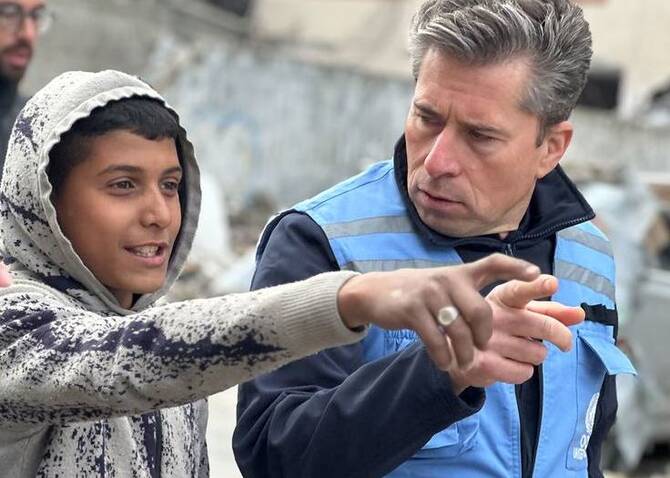

LONDON: Israel’s blocking of food aid to starving Palestinians in Gaza in an attempt to forcibly remove the population amounts to a war crime, the UN’s humanitarian chief said in an interview broadcast on Friday.
Israel allowed a trickle of supplies into Gaza last week after a complete blockade for nearly three months. But there have been chaotic and deadly scenes amid a new distribution system that sidelined the UN.
“We’re seeing food sat on the borders and not being allowed in when there is a population on the other side of the border that is starving, and we’re hearing Israeli ministers say that is to put pressure on the population of Gaza,” Tom Fletcher told the BBC.
Using food as a weapon “is classified as a war crime,” he said, adding that would be for the courts and history to judge.
He also warned Israel against the forced displacement of Palestinians from Gaza to another country, a policy that Israeli Prime Minister Benjamin Netanyahu and members of his hard-line cabinet have advocated.
Earlier this month, Israel’s extremist Finance Minister Bezalel Smotrich said Gaza would be “totally destroyed” within six months and Palestinians there would be so despairing that they would be “looking for relocation to begin a new life in other places.”
Fletcher called on Netanyahu to ensure that “this language, and ultimately, this policy ... of forced displacement, isn’t enacted.”
Since Israel broke a two-month ceasefire in March it has ramped up its operations in Gaza, killing thousands more Palestinian civilians in an attempt to take full military control of the territory.
The increased violence has led European countries to shift their stance and threaten sanctions against Israel if it does not stop the slaughter and allow the full flow of aid.
On May 14, Fletcher told the UN Security Council that it must act to prevent genocide in Gaza. He said the comments were in response to what his colleagues on the ground were telling him.
“What they’re reporting is forced displacement. They’re reporting starvation, they’re reporting torture, and they’re reporting deaths on a massive scale,” he said.
“In previous cases, Rwanda, Srebrenica and Sri Lanka, the world had told us afterwards that we didn’t act in time, that we didn’t sound the warning and ask that the world respond to prevent genocide.
“And that’s my call to the Security Council and the world right now, ‘will you act to prevent genocide?’”
He added: “History will be tough in the way it judges us. And it must be.”
The conflict has killed almost 54,000 Palestinians since it started in October 2023 when a Hamas-led assault killed 1,200 Israelis and seized dozens of hostages.


