

Israel’s Gaza war producing ‘staggering’ carbon footprint

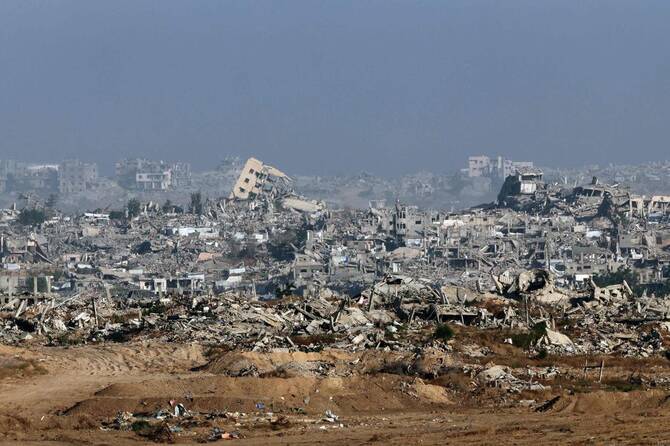
The emissions caused by Israel’s war on Gaza as well as estimated reconstruction costs are greater than the annual footprint of 100 individual countries, new research has found. (AFP/File)
Short Url
Updated 30 May 2025
Follow

Israel’s Gaza war producing ‘staggering’ carbon footprint

  • Emissions from military activity, reconstruction more than annual footprint of 100 countries: Study
  • Analyst: ‘Sobering reminder of the ecological and environmental cost of Israel’s genocidal campaign’

LONDON: The emissions caused by Israel’s war on Gaza as well as estimated reconstruction costs are greater than the annual footprint of 100 individual countries, new research has found.

The war caused more carbon emissions than the annual combined total of Costa Rica and Estonia in its first 15 months.

The research, published by the Social Science Research Network, was shared exclusively with The Guardian.

Destroying, clearing and rebuilding the Gaza Strip could produce 31 million tonnes of carbon dioxide equivalent (tCO2e), researchers from the UK and US found.

There is no obligation for states to record military emissions to the UN’s climate body, with researchers warning that the lack of accountability could lead to an underreporting of the global carbon footprint.

The study’s data, which also includes estimates of emissions relating to Hamas and Hezbollah activity, highlights the asymmetry between each side.

Hamas’s use of bunker fuel and rockets accounted for about 3,000 tCO2e, just 0.2 percent of the conflict’s total carbon footprint.

Israel’s use of weapons, equipment, tanks and ordnance produced 50 percent of emissions, the study found.

Researchers also included estimated emissions from Yemen’s Houthi militia, which has traded strikes with Israel over the course of the war. Iran and Israel’s tit-for-tat attacks, and the war in southern Lebanon, were also recorded.

All military activity arising from the Gaza war produced the equivalent, in emissions, of charging 2.6 billion smartphones or running 84 gas power plants for a year.

The figure includes the tC02e estimate — 557,359 — of the pre-war construction of Hamas’s tunnel network and Israel’s “iron wall” barrier surrounding Gaza. The findings could eventually help calculate claims for reparations, The Guardian reported.

More than 99 percent of the tCO2e generated between Oct. 7, 2023, and the temporary ceasefire in January this year was attributed to Israeli bombardment and the invasion of Gaza.

US involvement in the emissions was also highlighted by researchers. They found that almost 30 percent of greenhouse gases generated in the same period came from regular resupply flights carrying military equipment to Israel from American stockpiles in Europe.

Israel’s destruction of Gaza has produced an estimated 60 million tonnes of toxic rubble that requires clearing, producing what researchers warned would be the biggest emissions toll of the conflict.

Removing debris, rebuilding 436,000 destroyed apartments, roads, 700 schools, mosques and administrative sites will produce an estimated 29.4 million tCO2e.

Zena Agha, analyst for Palestinian policy network Al-Shabaka, said: “This report is a staggering and sobering reminder of the ecological and environmental cost of Israel’s genocidal campaign … But this is also the US, UK and EU’s war, all of which have provided seemingly limitless military resources to enable Israel to devastate the most densely populated place on the planet.

“This brings home the destabilizing (regional) impact of the Israeli settler state and its inseparability from the western military-industrial complex.”

In producing the report, researchers used open-source information, media articles and data from independent groups, including UN agencies.

Hadeel Ikhmais, head of the climate change office at the Palestinian Environmental Quality Authority, said: “Wars not only kill people but also release toxic chemicals, destroy infrastructure, pollute soil, air and water resources and accelerate climate and environmental disasters.

“War also destroys climate adaptation and hinders environmental management. Not counting carbon emissions is a black hole in accountability that allows governments to get away from their environmental crimes.”


Women main victims of Sudan conflict abuses: minister to AFP

Updated 24 January 2026
Follow

Women main victims of Sudan conflict abuses: minister to AFP

  • Khalifa said sexual violence has been reported on both sides, but she insisted it is “systematic” among the RSF
  • Her ministry has documented more than 1,800 rapes between April 2023 and October 2025

PORT SUDAN: Women are the main victims of abuse in Sudan’s war, facing “the world’s worst” sexual violence and other crimes committed with impunity, a rights activist turned social affairs minister for the army-backed government told AFP.
The Sudanese army and the paramilitary Rapid Support Forces (RSF) have been locked in a brutal conflict since April 2023 that has killed tens of thousands of people, displaced around 11 million and been marked by widespread sexual violence.
Sulaima Ishaq Al-Khalifa said abuses against women routinely accompanied looting and attacks, with reports of rape often perpetrated as “the family witnessed” the crime.
“There is no age limit. A woman of 85 could be raped, a child of one year could be raped,” the trained psychologist told AFP at her home in Port Sudan.
The longtime women’s rights activist, recently appointed to the government, said that women were also being subjected to sexual slavery and trafficked to neighboring countries, alongside forced marriages arranged to avoid shame.
Khalifa said sexual violence has been reported on both sides, but she insisted it is “systematic” among the RSF, who she says use it “as a weapon of war” and for the purposes of “ethnic cleansing.”
Her ministry has documented more than 1,800 rapes between April 2023 and October 2025 — a figure that does not include atrocities documented in western Darfur and the neighboring Kordofan region from late October onwards.
“It’s about... humiliating people, forcing them to leave their houses and places and cities. And also breaking... the social fabrics,” Khalifa said.
“When you are using sexual violence as a weapon of war, that means you want to extend... the war forever,” because it feeds a “sense of revenge,” she added.

- ‘War crimes’ -

A report by the SIHA Network, an activist group that documents abuses against women in the Horn of Africa, found that more than three-quarters of recorded cases involved rape, with 87 percent attributed to the RSF.
The United Nations has repeatedly raised alarm over what it describes as targeted attacks on non?Arab communities in Darfur, while the International Criminal Court (ICC) has opened a formal investigation into “war crimes” by both sides.
Briefing the UN Security Council in mid-January, ICC deputy prosecutor Nazhat Shameem Khan said investigators had uncovered evidence of an “organized, calculated campaign” in El-Fasher — the army’s last stronghold in Darfur captured by the RSF in late October.
The campaign, Khan added, involved mass rapes and executions “on a massive scale,” sometimes “filmed and celebrated” by the perpetrators and “fueled by a sense of complete impunity.”
Darfur endured a brutal wave of atrocities in the early 2000s, and a former Janjaweed commander — from the militia structure that later evolved into the RSF — was recently found guilty by the International Criminal Court of multiple war crimes, including rape.
“What’s happening now is much more ugly. Because the mass rape thing is happening and documented,” said Khalifa.
RSF fighters carrying out the assaults “have been very proud about doing this and they don’t see it as a crime,” she added.
“You feel that they have a green light to do whatever they want.”
In Darfur, several survivors said RSF fighters “have been accusing them of being lesser people, like calling them ‘slaves’, and saying that when I’m attacking you, assaulting you sexually, I’m actually ‘honoring’ you, because I am more educated than you, or (of) more pure blood than you.”

- ‘Torture operation’ -

Women in Khartoum and Darfur, including El-Fasher, have described rapes carried out by a range of foreign nationals.
These were “mercenaries from West Africa, speaking French, including from Mali, Burkina Faso, Nigeria, Chad, as well as Colombia and Libya” — allegedly fighting alongside the RSF, Khalifa added.
Some victims were abducted and held as sexual slaves, while others were sold through trafficking networks operating across Sudan’s porous borders, said Khalifa.
Many of these cases remain difficult to document because of the collapse of state institutions.
In conservative communities, social stigma also remains a major obstacle to documenting the scale of the abuse.
Families often force victims into marriage to “cover up what happened,” particularly when pregnancies result from rape, according to the minister.
“We call it a torture operation,” she said, describing “frightening” cases in which children and adolescent girls under 18 are forced into marriage.
