

Centuries-old toymaking tradition lives on in southern India

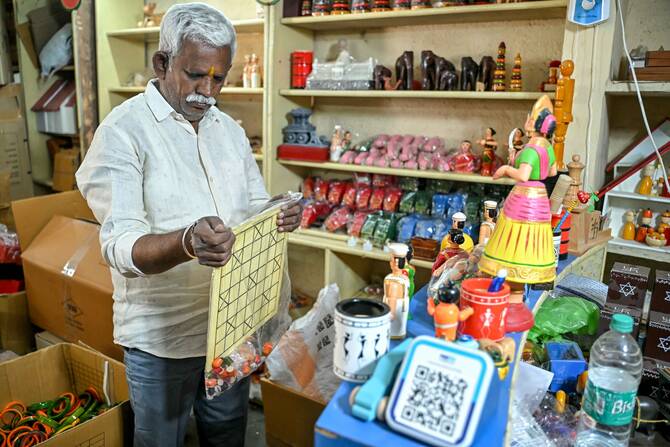
This photograph taken on Feb. 26, 2025 shows a worker packing wooden toys for export at a toy store in Channapatna, Karnataka. (AFP)
Short Url
Updated 30 May 2025
Follow

Centuries-old toymaking tradition lives on in southern India

  • Origins of toymaking in Channapatna can be traced back to Muslim ruler Tipu Sultan
  • Today, the city in the southern Indian state of Karnataka is popularly known as ‘toy town’ 

NEW DELHI: For as long as he can remember, the wooden toys of Channapatna have been a part of Suhel Parvez’s life. 

As family members carefully tended the centuries-old art of toy making, Parvez grew up watching unique colors and intricate designs come to life. 

“I have been brought up seeing these, because in our home (in) every place they worked on this,” Parvez told Arab News. 

Today, the 35-year-old is one of a few thousand local artisans working to keep the craft alive. 

“I am the fifth-generation artisan, and we are continuing the legacy of our ancestors who started this,” he said.

In the southern Indian state of Karnataka, thanks to a traditional form of toy-making that can be traced back to the 18th century, Channapatna is popularly known as the “toy town,” or “gombegala ooru.” According to local artisans, the craft started in the region after Tipu Sultan, the Muslim ruler of the kingdom of Mysore, asked artists from Persia to train the locals. 

From dolls to spinning tops, Channapatna’s toys are carved from local ivory wood and dipped in bright colors made from natural ingredients, such as turmeric and indigo. While they were once all hand-carved, artisans have since begun to use some machines to keep the industry competitive. 

In India, the craft is protected as a geographical indication, or GI, which is a form of intellectual property under the World Trade Organization. 

The toys — popular for their long-lasting quality — have also made international headlines throughout the years. In 2010 they experienced a boom after former US First Lady Michelle Obama bought some during one of her visits to New Delhi. 

In 2025, as wooden toys regain popularity across the world due to their eco-friendly qualities, craftsmen like Parvez are seeing new opportunities opening up. 

“Many countries are boycotting plastic material, and for child safety people are moving slowly towards wooden toys. We have good opportunities in coming years,” Parvez said. 

His Bharath Arts and Crafts unit produces traditional toys the region is known for, and also more modern versions of those often used for educational purposes. 

“We don’t involve any chemical process in that … right from sourcing tools (to the) end, final product, this will be a 100 percent chemical-free process,” he added, referring to the Channapatna toys. 

“Apart from that we have one more (type) known as modern toys or educational toys which are made out of synthetic colors which are non-toxic.”

While Parvez and his fellow craftsmen have exported their products to the US, UK and Australia, he says the Middle East and Africa are emerging markets for the wooden toys of southern India.

“We have very good markets (in the) Middle East and African countries — these are the emerging opportunities for us,” he said. 

These days, Channapatna’s toy making industry mostly comprises seasoned artisans, those who have been in the field for decades, according to local craftsman Srinivasa Kariappa. 

“Those who are working in the industry have at least 15 or 20 years of experience, new people are not joining,” he told Arab News. 

The 37-year-old, who runs Harsha Industries, believes that there is still time to welcome new people to preserve the tradition. 

“Handwork is important in Channapatna toys,” he said. “The government should open a training center where a new set of people can come and join the toy industry. We need new families and people to join the industry and expand (it).”


Two high-speed trains derail in Spain, police sources say 21 people killed

Updated 19 January 2026
Follow

Two high-speed trains derail in Spain, police sources say 21 people killed

  • The accident happened near Adamuz, in Cordoba province. So far, 21 people ​have been confirmed dead by police

MADRID: A high-speed train derailed and smashed into another oncoming train in southern Spain on Sunday, pushing the second train off the tracks in a collision that police sources confirmed to Reuters had killed at least 21 people.
The accident happened near Adamuz, in Cordoba province. So far, 21 people ​have been confirmed dead by police, with state broadcaster Television Espanola adding that 100 people had been injured, 25 seriously. The driver of one of the trains, which was traveling from Madrid to Huelva, was among those who died, the TV station added.
“The Iryo 6189 Malaga — (to Madrid) train has derailed from the track at Adamuz, crashing onto the adjacent track. The (Madrid) to Huelva train which was traveling on the adjacent track has also derailed,” said Adif, which runs the rail network, in a social media post.
Adif said the accident happened at 6:40 p.m. (1740 GMT), about 10 minutes after the Iryo train left Cordoba heading toward Madrid.
Iryo is a private rail operator, majority-owned by Italian state-controlled railway group Ferrovie dello Stato. The train involved was a Freccia 1000 train which was traveling between ‌Malaga and Madrid, ‌a spokesperson for Ferrovie dello Stato said.
The company said in a statement that it ‌deeply ⁠regretted what ​had happened ‌and had activated all emergency protocols to work closely with the relevant authorities to manage the situation.
The second train was operated by Renfe, which also did not respond to a request for comment.
Adif has suspended all rail services between Madrid and Andalusia.

HORRIFIC SCENE
The Iryo train had more than 300 passengers on board, while the Renfe train had around 100.
Paco Carmona, Cordoba fire chief, told TVE the first train heading to Madrid from Malaga had been evacuated.
The other train’s carriages were badly damaged, he said, with twisted metal and seats. “There are still people trapped. We don’t know how many people have died and the operation is concentrating on getting people out of areas which are very narrow,” he ⁠said. “We have to remove the bodies to reach anyone who is still alive. It is proving to be a complicated task.”
Transport Minister Oscar Puente said he was following events ‌from rail operator Adif’s headquarters in Madrid.
“The latest information is very serious,” ‍he posted on X. “The impact was terrible, causing the first two ‍carriages of the Renfe train to be thrown off the track. The number of victims cannot be confirmed at this time. ‍The most important thing now is to help the victims.”
The mayor of Adamuz, Rafael Moreno, told El Pais newspaper that he had been among the first to arrive at the scene of the accident alongside the local police and saw what he believed to be a badly lacerated body several meters from the accident site.
“The scene is horrific,” he said. “I don’t think they were on the same track, but it’s not clear. Now ​the mayors and residents of the area are focused on helping the passengers.”

CALLS FOR MEDICS
Images on local television showed a reception center set up for passengers in the town of Adamuz, population 5,000, with locals coming ⁠and going with food and blankets amid nighttime temperatures of around 42 degrees Fahrenheit (6 degrees Celsius).
A woman named Carmen posted on X that she had been on board the Iryo train to Madrid. “Ten minutes after departing (from Cordoba) the train started to shake a lot, and it derailed from coach 6 behind us. The lights went out.”
Footage posted by another Iryo train passenger, also on X, showed an Iryo staffer in a fluorescent jacket instructing passengers to remain in their seats in the darkened carriages, and those with first aid training to keep watch over fellow passengers. He also urged people to maintain mobile phone batteries to be able to use their torches when they disembarked.
Salvador Jimenez, a journalist for RTVE who was on board the Iryo train, shared images showing the nose of the rear carriage of the train lying on its side, with evacuated passengers sitting on the side of the carriage facing upwards.
Jimenez told TVE by phone from beside the stricken trains that passengers had used emergency hammers to smash the windows and climb out, and they had seen two people taken ‌out of the overturned carriages on stretchers.
“There’s a certain uncertainty about when we’ll get to Madrid, where we’ll spend the night, we’ve had no message from the train company yet,” he said. “It’s very cold but here we are.”