

Pakistan criminalizes child marriages in Islamabad despite opposition from Council of Islamic Ideology

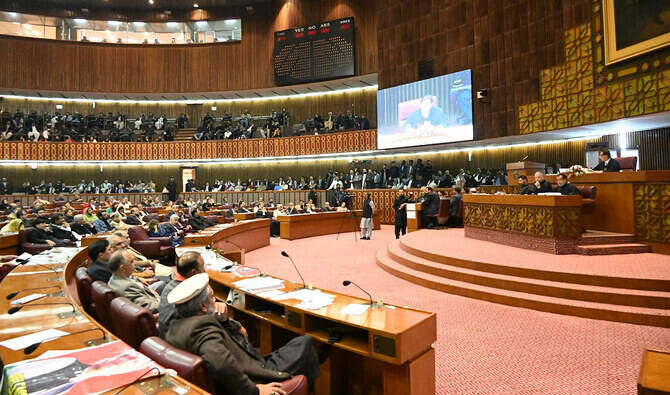
In this handout photo, taken and released by the Government of Pakistan, members of Pakistan’s lower house of parliament attend the National Assembly meeting in Islamabad on March 1, 2024. (Photo courtesy: X/@NAofPakistan/File)
Short Url
Updated 30 May 2025
Follow

Pakistan criminalizes child marriages in Islamabad despite opposition from Council of Islamic Ideology

  • Under the new law, the minimum age for marriage is set at 18 for both men and women in the federal capital
  • Prison terms of up to seven years have been introduced for those who facilitate or coerce children into early marriages

ISLAMABAD: Pakistani President Asif Ali Zardari on Friday signed into law a bill criminalizing child marriages in the federal capital of Islamabad, despite opposition from a constitutional body that advises the Pakistani government on the compatibility of laws with Islam.

The law criminalizes underage marriages and introduces strict penalties of up to seven years in prison for family members, clerics and marriage registrars who facilitate or coerce children into early marriages. Any sexual relations within a marriage involving a minor, regardless of consent, will be considered statutory rape, according to the law. An adult man who marries a girl under the legal age could face up to three years in prison.

Pakistan’s National Assembly had unanimously passed the Islamabad Capital Territory Child Marriage Restraint Bill tabled by Pakistan Peoples Party’s (PPP) Sharmila Faruqui on May 16. Under the new law, the minimum legal age for marriage for both men and women in Islamabad is 18. Previously, it was 16 for girls and 18 for boys.

However, the Council of Islamic Ideology this week declared the said bill “un-Islamic,” saying that clauses of the bill, such as fixing the age limit for marriage and declaring marriage below the age of 18 as child abuse and punishable, did not conform with Islamic injunctions.

“The Islamabad Capital Territory Child Marriage Restraint Bill, 2025 is assented to, as passed by the Parliament,” President Zardari was quoted as saying in a notification issued from his office.

In Pakistan, 29 percent of girls are married by the age of 18 and 4 percent marry before the age of 15, according to Girls Not Brides, a global coalition working to end child marriage. In comparison, five percent of boys marry before 18.

PPP Senator Sherry Rehman thanked the president for signing the bill into law “despite all pressure.”

“Proud moment for Pakistan,” she said on X. “Thank you to all the women and men who made this possible after a long journey of twists and turns.”

Pakistan ranks among the top 10 countries globally with the highest absolute number of women who were married or in a union before turning 18.
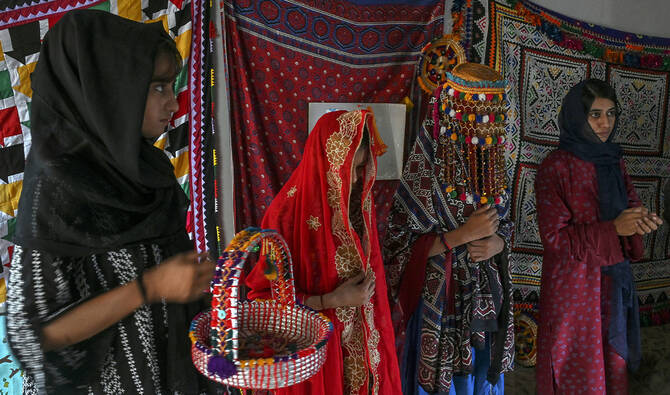


In this photograph taken on August 4, 2024 social workers at NGO Sujag Sansar take part in a theatre practice ahead of their performance, intending to create awareness on dangers of child-marriages at the NGO office in Johi, Dadu district of Sindh province. (AFP/File)

Girls who marry young are less likely to complete their education and are more vulnerable to domestic violence, abuse and serious health complications.

Pregnancy poses significantly higher risks for child brides, increasing the chances of obstetric fistulas, sexually transmitted infections and even maternal death. Teenagers are far more likely to die from childbirth-related complications than women in their twenties.


Pakistan terms climate change, demographic pressures as ‘pressing existential risks’

Updated 06 December 2025
Follow

Pakistan terms climate change, demographic pressures as ‘pressing existential risks’

  • Pakistan has suffered frequent climate change-induced disasters, including floods this year that killed over 1,000
  • Pakistan finmin highlights stabilization measures at Doha Forum, discusses economic cooperation with Qatar 

ISLAMABAD: Pakistan’s Finance Minister Muhammad Aurangzeb on Saturday described climate change and demographic pressures as “pressing existential risks” facing the country, calling for urgent climate financing. 

The finance minister was speaking as a member of a high-level panel at the 23rd edition of the Doha Forum, which is being held from Dec. 6–7 in the Qatari capital. Aurangzeb was invited as a speaker on the discussion titled: ‘Global Trade Tensions: Economic Impact and Policy Responses in MENA.’

“He reaffirmed that while Pakistan remained vigilant in the face of geopolitical uncertainty, the more pressing existential risks were climate change and demographic pressures,” the Finance Division said. 

Pakistan has suffered repeated climate disasters in recent years, most notably the 2022 super-floods that submerged one-third of the country, displaced millions and caused an estimated $30 billion in losses. 

This year’s floods killed over 1,000 people and caused at least $2.9 billion in damages to agriculture and infrastructure. Scientists say Pakistan remains among the world’s most climate-vulnerable nations despite contributing less than 1 percent of global greenhouse-gas emissions.

Aurangzeb has previously said climate change and Pakistan’s fast-rising population are the only two factors that can hinder the South Asian country’s efforts to become a $3 trillion economy in the future. 

The finance minister noted that this year’s floods in Pakistan had shaved at least 0.5 percent off GDP growth, calling for urgent climate financing and investment in resilient infrastructure. 

When asked about Pakistan’s fiscal resilience and capability to absorb external shocks, Aurangzeb said Islamabad had rebuilt fiscal buffers. He pointed out that both the primary fiscal balance and current account had returned to surplus, supported significantly by strong remittance inflows of $18–20 billion annually from the Middle East and North Africa (MENA) and Gulf Cooperation Council (GCC) regions. 

Separately, Aurangzeb met his Qatari counterpart Ali Bin Ahmed Al Kuwari to discuss bilateral cooperation. 

“Both sides reaffirmed their commitment to strengthening economic ties, particularly by maximizing opportunities created through the newly concluded GCC–Pakistan Free Trade Agreement, expanding trade flows, and deepening energy cooperation, including long-term LNG collaboration,” the finance ministry said. 

The two also discussed collaboration on digital infrastructure, skills development and regulatory reform. They agreed to establish structured mechanisms to continue joint work in trade diversification, technology, climate resilience, and investment facilitation, the finance ministry said.