US supercomputer named after Nobel laureate Jennifer Doudna to power AI and scientific research

1 / 3
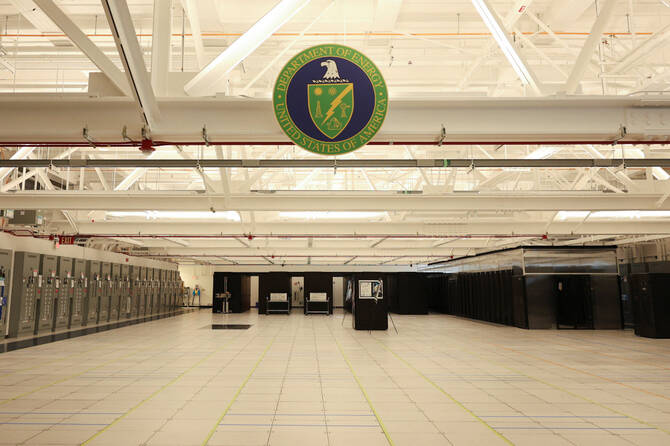
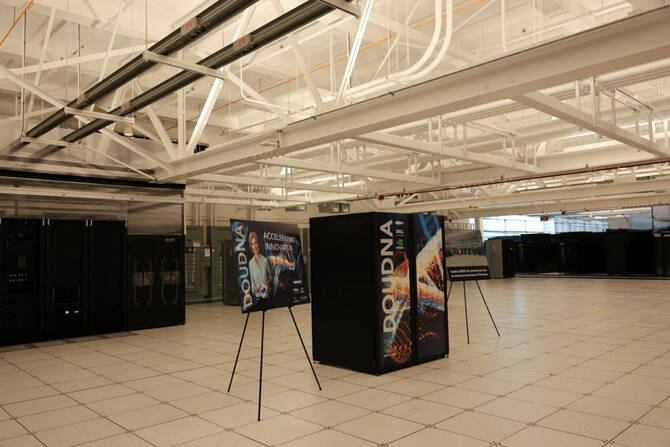
A view of the National Energy Research Scientific Computing Center (NERSC) facility at the Lawrence Berkeley National Laboratory, which will house the US supercomputer to be powered by Nvidia's forthcoming Vera Rubin chips, in Berkeley, California. (REUTERS)
2 / 3
A view of the National Energy Research Scientific Computing Center (NERSC) facility at the Lawrence Berkeley National Laboratory, which will house the US supercomputer to be powered by Nvidia's forthcoming Vera Rubin chips, in Berkeley, California. (REUTERS)
3 / 3
A view of the National Energy Research Scientific Computing Center (NERSC) facility at the Lawrence Berkeley National Laboratory, which will house the US supercomputer to be powered by Nvidia's forthcoming Vera Rubin chips, in Berkeley, California. (REUTERS)
Short Url
Updated 30 May 2025
Follow

US supercomputer named after Nobel laureate Jennifer Doudna to power AI and scientific research

  • Dell Technologies contracted with the energy department to build the computer
  • Not clear yet how the computer will rank on the listing of the world’s fastest supercomputers

BERKELEY, California: A new supercomputer named after a winner of the Nobel Prize in chemistry will help power artificial intelligence technology and scientific discoveries from a perch in the hills above the University of California, Berkeley, federal officials said Thursday.
US Energy Secretary Chris Wright announced the project Thursday alongside executives from computer maker Dell Technologies and Nvidia CEO Jensen Huang.
The new computing system at the Lawrence Berkeley National Laboratory will be called Doudna after Berkeley professor and biochemist Jennifer Doudna, who won a Nobel in 2020 for her work on the gene-editing technology CRISPR. It’s due to switch on next year.
“One of the key use cases will be genomics research,” said Dion Harris, a product executive in Nvidia’s AI and high-performance computing division, in an interview. “It was basically just a nod to her contributions to the field.”
Dell is contracted with the energy department to build the computer, the latest to be housed at Berkeley Lab’s National Energy Research Scientific Computing Center. Previous computers there have been named after other Nobel winners: Saul Perlmutter, an astrophysicist, and Gerty Cori, a biochemist.
It’s not clear yet how the computer will rank on the TOP500 listing of the world’s fastest supercomputers. The current top-ranked computer is El Capitan, located about an hour’s drive away at the Lawrence Livermore National Laboratory. That’s followed by other supercomputers at US national labs in Tennessee and Illinois.


Sydney man jailed for mailing reptiles in popcorn bags

Updated 17 February 2026
Follow

Sydney man jailed for mailing reptiles in popcorn bags

  • The eight-year term handed down on Friday was a record for wildlife smuggling, federal environment officials said

SYDNEY: A Sydney man who tried to post native lizards, dragons and other reptiles out of Australia in bags of popcorn and biscuit tins has been sentenced to eight years in jail, authorities said Tuesday.
The eight-year term handed down on Friday was a record for wildlife smuggling, federal environment officials said.
A district court in Sydney gave the man, 61-year-old Neil Simpson, a non-parole period of five years and four months.
Investigators recovered 101 Australian reptiles from seized parcels destined for Hong Kong, South Korea, Sri Lanka and Romania, the officials said in a statement.
The animals — including shingleback lizards, western blue-tongue lizards, bearded dragons and southern pygmy spiny-tailed skinks — were posted in 15 packages between 2018 and 2023.
“Lizards, skinks and dragons were secured in calico bags. These bags were concealed in bags of popcorn, biscuit tins and a women’s handbag and placed inside cardboard boxes,” the statement said.
The smuggler had attempted to get others to post the animals on his behalf but was identified by government investigators and the New South Wales police, it added.
Three other people were convicted for taking part in the crime.
The New South Wales government’s environment department said that “the illegal wildlife trade is not a victimless crime,” harming conservation and stripping the state “and Australia of its unique biodiversity.”