

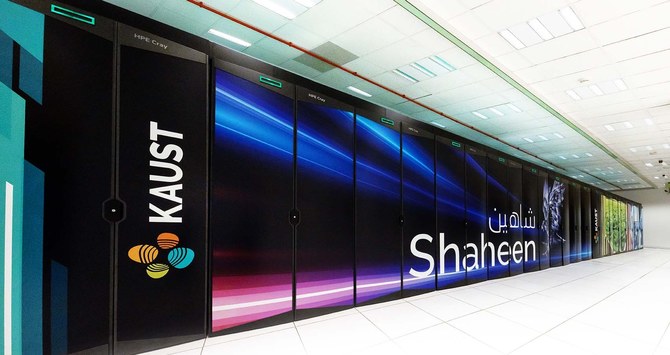
KAUST’s Shaheen III claims title of most powerful supercomputer in Middle East

These mathematical models will be used in various operations including scientific discovery, engineering design, and policy support. Pic/Supplied
Short Url
Updated 15 November 2023
Follow

KAUST’s Shaheen III claims title of most powerful supercomputer in Middle East

RIYADH: Scientific exploration and innovation are set to receive a boost with the operation of the Shaheen III supercomputer at King Abdullah University of Science and Technology in Saudi Arabia.  

Developed by Hewlett Packard Enterprise, Shaheen III has already secured its place as the most powerful supercomputer in the Middle East, according to a recent report by TOP500, known for releasing statistics for this sector. 

Tony F. Chan, president of KAUST, said: “Shaheen III takes KAUST’s world-class research capabilities to the next level through its processing power and ability to create models across many fields in a short period of time.”   

The system is expected to play a pivotal role in supporting the construction and testing of predictive mathematical models. It employs a multifaceted approach that includes traditional simulations based on differential equations, statistical emulation, and machine learning based on neural networks. 

These mathematical models will be used in various operations including scientific discovery, engineering design, and policy support. 

He added: “Shaheen III will be crucial in supporting sustainability campaigns related to our National Center for Climate Change and for national projects that align with the Kingdom’s Vision 2030, helping to accelerate Saudi Arabia’s growth in areas such as sustainable development.” 

Ranked 20th globally for supercomputer efficiency, the system is six times faster than its predecessor, Shaheen II, and boasts processing power exceeding that of 500,000 of the latest MacBook Pros. 

“Supercomputing is part of KAUST’s research and curricular DNA, with many of our faculty recruited around supercomputing. Computational approaches formerly lagged theoretical, observational, and experimental approaches. Now, more often than not, they lead because of supercomputers like Shaheen III,” said David Keyes, KAUST’s founding dean. 

In its initial operational phase, Shaheen III will focus on powering research contributing to sustainability goals, encompassing materials, catalysis, combustion of alternative fuels, carbon sequestration, and bioinformatics. 

“Research universities like KAUST are increasingly putting supercomputers at the heart of their curriculum because modeling, simulation, machine learning and AI capabilities are fundamental to scientific discovery and innovation,” said Trish Damkroger, senior vice president and chief product officer, HPC, AI & Labs at HPE. 

According to TOP500’s list, Frontier, hosted at the Oak Ridge Leadership Computing Facility in Tennessee, retains its status as the world’s most advanced supercomputer.  

Following closely are Argonne National Laboratory’s Aurora and Microsoft’s Eagle, securing the second and third spots, respectively.


Saudi Arabia, Japan trade rises 38% between 2016 and 2024, minister says

Updated 11 January 2026
Follow

Saudi Arabia, Japan trade rises 38% between 2016 and 2024, minister says

RIYADH: Trade between Saudi Arabia and Japan has increased by 38 percent between 2016 and 2024 to reach SR138 billion ($36 billion), the Kingdom’s investment minister revealed.

Speaking at the Saudi-Japanese Ministerial Investment Forum 2026, Khalid Al-Falih explained that this makes the Asian country the Kingdom’s third-largest trading partner, according to Asharq Bloomberg.

This falls in line with the fact that Saudi Arabia has been a very important country for Japan from the viewpoint of its energy security, having been a stable supplier of crude oil for many years.

It also aligns well with how Japan is fully committed to supporting Vision 2030 by sharing its knowledge and advanced technologies.

“This trade is dominated by the Kingdom's exports of energy products, specifically oil, gas, and their derivatives. We certainly look forward to the Saudi private sector increasing trade with Japan, particularly in high-tech Japanese products,” Al-Falih said.

He added: “As for investment, Japanese investment in the Kingdom is good and strong, but we look forward to raising the level of Japanese investments in the Kingdom. Today, the Kingdom offers promising opportunities for Japanese companies in several fields, including the traditional sector that links the two economies: energy.”

The minister went on to note that additional sectors that both countries can also collaborate in include green and blue hydrogen, investments in advanced industries, health, food security, innovation, entrepreneurship, among others.

During his speech, Al-Falih shed light on how the Kingdom’s pavilion at Expo 2025 in Osaka achieved remarkable success, with the exhibition receiving more than 3 million visitors, reflecting the Japanese public’s interest in Saudi Arabia.

“The pavilion also organized approximately 700 new business events, several each day, including 88 major investment events led by the Ministry of Investment. Today, as we prepare for the upcoming Expo 2030, we look forward to building upon Japan’s achievements,” he said.

The minister added: “During our visit to Japan, we agreed to establish a partnership to transfer the remarkable Japanese experience from Expo Osaka 2025 to Expo Riyadh 2030. I am certain that the Japanese pavilion at Expo Riyadh will rival the Saudi pavilion at Expo Osaka in terms of organization, innovation, and visitor turnout.”

Al-Falih also shed light on how Saudi-Japanese relations celebrated their 70th anniversary last year, and today marks the 71st year of these relations as well as how they have flourished over the decades, moving from one strategic level to an even higher one.