US supercomputer named after Nobel laureate Jennifer Doudna to power AI and scientific research

1 / 3
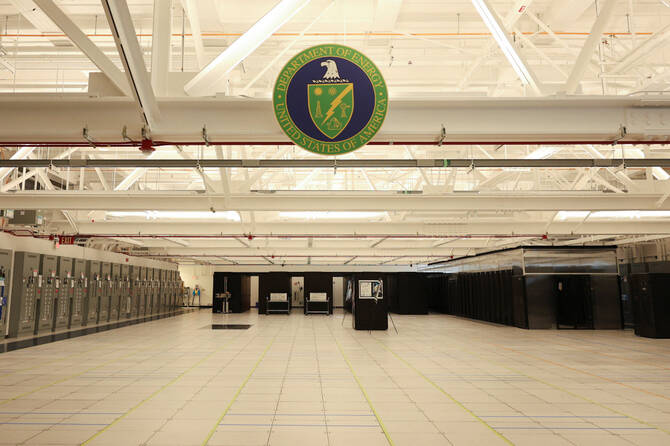
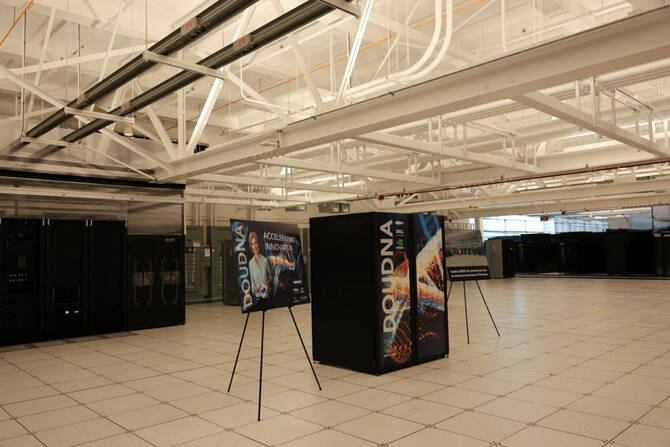
A view of the National Energy Research Scientific Computing Center (NERSC) facility at the Lawrence Berkeley National Laboratory, which will house the US supercomputer to be powered by Nvidia's forthcoming Vera Rubin chips, in Berkeley, California. (REUTERS)
2 / 3
A view of the National Energy Research Scientific Computing Center (NERSC) facility at the Lawrence Berkeley National Laboratory, which will house the US supercomputer to be powered by Nvidia's forthcoming Vera Rubin chips, in Berkeley, California. (REUTERS)
3 / 3
A view of the National Energy Research Scientific Computing Center (NERSC) facility at the Lawrence Berkeley National Laboratory, which will house the US supercomputer to be powered by Nvidia's forthcoming Vera Rubin chips, in Berkeley, California. (REUTERS)
Short Url
Updated 30 May 2025
Follow

US supercomputer named after Nobel laureate Jennifer Doudna to power AI and scientific research

  • Dell Technologies contracted with the energy department to build the computer
  • Not clear yet how the computer will rank on the listing of the world’s fastest supercomputers

BERKELEY, California: A new supercomputer named after a winner of the Nobel Prize in chemistry will help power artificial intelligence technology and scientific discoveries from a perch in the hills above the University of California, Berkeley, federal officials said Thursday.
US Energy Secretary Chris Wright announced the project Thursday alongside executives from computer maker Dell Technologies and Nvidia CEO Jensen Huang.
The new computing system at the Lawrence Berkeley National Laboratory will be called Doudna after Berkeley professor and biochemist Jennifer Doudna, who won a Nobel in 2020 for her work on the gene-editing technology CRISPR. It’s due to switch on next year.
“One of the key use cases will be genomics research,” said Dion Harris, a product executive in Nvidia’s AI and high-performance computing division, in an interview. “It was basically just a nod to her contributions to the field.”
Dell is contracted with the energy department to build the computer, the latest to be housed at Berkeley Lab’s National Energy Research Scientific Computing Center. Previous computers there have been named after other Nobel winners: Saul Perlmutter, an astrophysicist, and Gerty Cori, a biochemist.
It’s not clear yet how the computer will rank on the TOP500 listing of the world’s fastest supercomputers. The current top-ranked computer is El Capitan, located about an hour’s drive away at the Lawrence Livermore National Laboratory. That’s followed by other supercomputers at US national labs in Tennessee and Illinois.


Fans bid farewell to Japan’s only pandas

Updated 25 January 2026
Follow

Fans bid farewell to Japan’s only pandas

TOKYO: Panda lovers in Tokyo said goodbye on Sunday to a hugely popular pair of the bears that are set to return to China, leaving Japan without the beloved animals for the first time in half a century.
Loaned out as part of China’s “panda diplomacy” program, the distinctive black-and-white animals have symbolized friendship between Beijing and Tokyo since the normalization of diplomatic ties in 1972.
Some visitors at Ueno Zoological Gardens were left teary-eyed as they watched Japan’s only two pandas Lei Lei and Xiao Xiao munch on bamboo.
The animals are expected to leave for China on Tuesday following a souring of relations between Asia’s two largest economies.
“I feel like seeing pandas can help create a connection with China too, so in that sense I really would like pandas to come back to Japan again,” said Gen Takahashi, 39, a Tokyo resident who visited the zoo with his wife and their two-year-old daughter.
“Kids love pandas as well, so if we could see them with our own eyes in Japan, I’d definitely want to go.”
The pandas’ abrupt return was announced last month after Japan’s conservative premier Sanae Takaichi hinted Tokyo could intervene militarily in the event of any attack on Taiwan.
Her comment provoked the ire of Beijing, which regards the island as its own territory.
The 4,400 lucky winners of an online lottery took turns viewing the four-year-old twins at Ueno zoo while others gathered nearby, many sporting panda-themed shirts, bags and dolls to celebrate the moment.
Mayuko Sumida traveled several hours from the central Aichi region in the hope of seeing them despite not winning the lottery.
“Even though it’s so big, its movements are really funny-sometimes it even acts kind of like a person,” she said, adding that she was “totally hooked.”
“Japan’s going to be left with zero pandas. It feels kind of sad,” she said.
Their departure might not be politically motivated, but if pandas return to Japan in the future it would symbolize warming relations, said Masaki Ienaga, a professor at Tokyo Woman’s Christian University and expert in East Asian international relations.
“In the future...if there are intentions of improving bilateral ties on both sides, it’s possible that (the return of) pandas will be on the table,” he told AFP.