

Army chief calls water Pakistan’s ‘red line,’ rejects any deal on Kashmir

Pakistan’s Chief of Army Staff Field Marshal Asim Munir speaks during a “Hilal Talks” forum at the Army Auditorium in Rawalpindi on May 29, 2025. (Handout/ISPR)
Short Url
Updated 29 May 2025
Follow

Army chief calls water Pakistan’s ‘red line,’ rejects any deal on Kashmir

  • Field Marshal Asim Munir addresses university academics at the inaugural Hilal Talks forum
  • He urges them to pass on Pakistan’s story and help shape the character of future generations

KARACHI: Pakistan’s army chief, Field Marshal Asim Munir, on Thursday called water his country’s “red line” and ruled out any deal on Kashmir during an address to university academics at the military’s inaugural Hilal Talks forum.

The forum is designed to engage Pakistan’s academic community on national and regional issues, where the army chief spoke just days after a military standoff with nuclear-armed India in which both sides resorted to missile, drone and artillery strikes.

Munir’s statement followed India’s unilateral suspension of the Indus Waters Treaty, a World Bank-brokered agreement that has governed water-sharing between the two countries since 1960. Kashmir, a Himalayan region claimed by both India and Pakistan but ruled in parts, also remains a major flashpoint between both states.

“No deal on Kashmir is possible,” the army chief was quoted as saying by the military’s media wing, Inter-Services Public Relations (ISPR), while addressing the forum. “We can never forget Kashmir.”

“Water is Pakistan’s red line,” he continued, “and we will never compromise on the basic right of 240 million Pakistanis.”

Munir said Pakistan would never accept India’s dominance, adding New Delhi had tried to suppress the Kashmir issue for decades but that was no longer possible.

The army chief spoke at the Army Auditorium in Rawalpindi where he was joined virtually by over 1,800 participants, including vice chancellors, senior faculty and students from across Pakistan.

Hilal Talks is a newly launched initiative aimed at fostering sustained dialogue between Pakistan’s military and its academic institutions, with a focus on national harmony.

Munir urged educators to serve as custodians of Pakistan’s story and builders of future generations.

“Teachers are Pakistan’s greatest asset,” he said. “Whatever I am today, it is because of my parents and my teachers.”
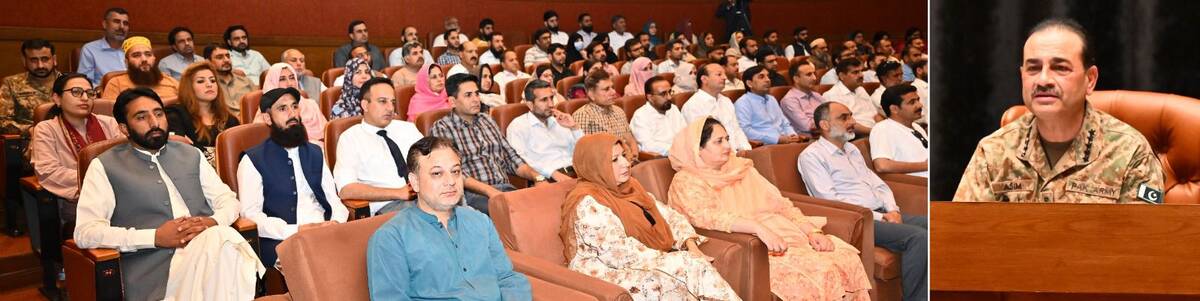


This combination of photos shows Pakistan’s Chief of Army Staff Field Marshal Asim Munir speaking to university academics during a “Hilal Talks” forum at the Army Auditorium in Rawalpindi on May 29, 2025. (Handout/ISPR)

“You are the ones who must pass on Pakistan’s story to the next generation,” he added. “It is your responsibility to shape [students’] character.”

The army chief reiterated India was stoking unrest in Pakistan’s southwestern province of Balochistan, saying, “The terrorist insurgents in Balochistan are a foreign-backed menace and have nothing to do with the local population.”

He said it was important for Pakistan to become a strong state where all institutions operate within their constitutional limits and without political, financial or personal interference.

“We must reject any narrative that seeks to weaken the state,” he added.


Pakistan says repaid over $13.06 billion domestic debt early in last 14 months

Updated 29 January 2026
Follow

Pakistan says repaid over $13.06 billion domestic debt early in last 14 months

  • Finance adviser says repayment shows “decisive shift” toward fiscal discipline, responsible economic management
  • Says Pakistan’s total public debt has declined from over $286.6 billion in June 2025 to $284.7 billion in November 2025

KARACHI: Pakistan has repaid Rs3,650 billion [$13.06 billion] in domestic debt before time during the last 14 months, Adviser to the Finance Minister Khurram Schehzad said on Thursday, adding that the achievement reflected a shift in the country’s approach toward fiscal discipline. 

Schehzad said Pakistan has been repaying its debt before maturity, owed to the market as well as the State Bank of Pakistan (SBP), since December 2024. He said the government had repaid the central bank Rs300 billion [$1.08 billion] in its latest repayment on Thursday. 

“This landmark achievement reflects a decisive shift toward fiscal discipline, credibility, and responsible economic management,” Schehzad wrote on social media platform X. 

Giving a breakdown of what he said was Pakistan’s “early debt retirement journey,” the finance official said Pakistan retired Rs1,000 billion [$3.576 billion] in December 2024, Rs500 billion [$1.78 billion] in June 2025, Rs1,160 billion [$4.150 billion] in August 2025, Rs200 billion [$715 million] in October 2025, Rs494 billion [$1.76 billion] in December 2025 and $1.08 billion in January 2026. 

He said with the latest debt repaid today, the July to January period of fiscal year 2026 alone recorded Rs2,150 billion [$7.69 billion] in early retirement, which was 44 percent higher than the debt retired in FY25.

He said of the total early repayments, the government has repaid 65 percent of the central bank’s debt, 30 percent of the treasury bills debt and five percent of the Pakistan Investment Bonds (PIBs) debt. 

The official said Pakistan’s total public debt has declined from over Rs 80.5 trillion [$286.6 billion] in June 2025 to Rs80 trillion [$284.7 billion] in November 2025. 

“Crucially, Pakistan’s debt-to-GDP ratio, around 74 percent in FY22, has declined to around 70 percent, reflecting a broader strengthening of fiscal fundamentals alongside disciplined debt management,” Schehzad wrote. 

Pakistan’s government has said the country’s fragile economy is on an upward trajectory. The South Asian country has been trying to navigate a tricky path to economic recovery under a $7 billion loan from the International Monetary Fund.