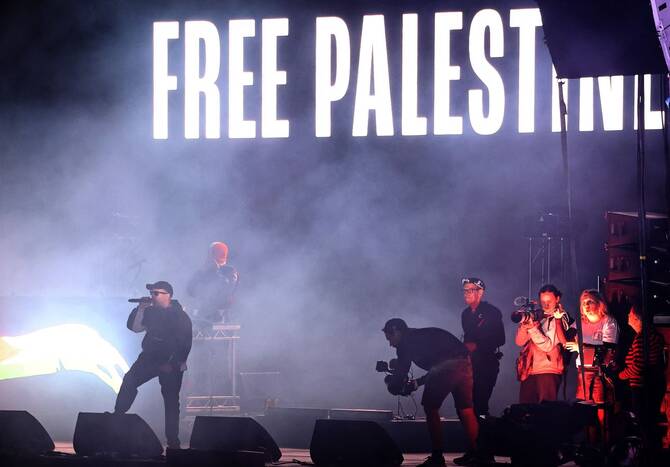
Kneecap dropped from Scotland’s TRNSMT Festival amid police safety concerns

Northern Irish rap group Kneecap has been pulled from the lineup of Scotland’s TRNSMT music festival, with organizers citing police concerns over safety as the reason for the last-minute removal. (AFP)
Short Url
Updated 29 May 2025
Follow

Kneecap dropped from Scotland’s TRNSMT Festival amid police safety concerns

DUBAI: Northern Irish rap group Kneecap has been pulled from the lineup of Scotland’s TRNSMT music festival, with organizers citing police concerns over safety as the reason for the last-minute removal.

The politically outspoken trio, known for fusing Irish republicanism with rap and for their recent pro-Palestinian stance at California’s Coachella, were scheduled to perform on July 11. But festival organizers announced on Wednesday that they would no longer appear, following discussions with Police Scotland.

Police Scotland clarified that while concerns were raised, booking decisions were made independently by the festival: “Any decision in relation to the line-up is a matter for the organisers. Police Scotland was not consulted prior to the acts being booked.”

In a statement on X, Kneecap addressed fans: “To the thousands of people who bought tickets, flights and hotels to see us play, we are sorry … it is out of our hands.” They added, “Glasgow has always been a huge city for us. We’ve played there many, many times, with no issues — ever. Make of that what you will.”

The band will instead perform at Glasgow’s O2 Academy on July 8.

The decision comes as group member Liam Óg Ó hAnnaidh, known as Mo Chara, faces a terrorism charge in the UK for allegedly displaying a Hezbollah flag during a London concert in November 2024. He is due to appear in court on June 18. Kneecap has called the charge “political policing,” linking it to efforts to silence dissent.

“This is a carnival of distraction,” the group said. “We are not the story, genocide is.”


In the ‘Paris of the Middle East,’ Brigitte Bardot is mourned alongside memories of a golden era

Updated 29 December 2025
Follow

In the ‘Paris of the Middle East,’ Brigitte Bardot is mourned alongside memories of a golden era

  • Bardot’s visit in 1967 coincided with Lebanon’s cultural zenith
  • Nation highlighted as center of global style and sophistication

DUBAI: The death of French film legend Brigitte Bardot at 91 has focused attention on one of the 20th century’s most captivating cultural icons — and a remarkable, if brief, moment when her star power intersected with Lebanon’s own golden age.

In March 1967, Bardot arrived in Beirut for a four-day visit that would briefly place the French screen legend at the heart of a Middle Eastern hotspot of glamor and modernity.

Brigitte Bardot in Baalbek, Lebanon. (Instagram)

At the time, Beirut was celebrated as the “Paris of the Middle East,” known for its luxuriant hotels, lively nightlife and cosmopolitan mix of cultures.

Mimi Raad, a noted Lebanese image consultant who is the Head of Image Department at MBC1, said to Arab News, “The 60s were considered the Golden Age of Beirut. Lebanese women, known at that time as the most ‘avant-garde’ and stylish women in the Middle East, were fascinated by Brigitte Bardot’s iconic style as well as by her carefree attitude and freedom. The Lebanese high society would look up to the European glamour and Brigitte Bardot was this breath of novelty in style and attitude.”

“Her visits to Lebanon cemented Lebanon's image as a glamorous Mediterranean destination, often compared to Saint-Tropez, reinforcing Beirut's reputation as a cosmopolitan hub and a trendy holiday destination that mirrored the chicest parts of Europe during that era.”

Bardot stayed in the famed, five-star Phoenicia Hotel where international celebrities lounged by the pool and rubbed shoulders with jet-set elites. Paparazzi captured her in relaxed celebrity mode by the poolside, emblematic of both her global appeal and Beirut’s vibrant scene.

During her short stay the actress wandered through the old Beirut souk, the bustling marketplace that was then a fusion of merchants selling jewelry, watches, and luxury goods.

She visited Assaad Georges Daou, a jeweler celebrated for designing pieces for royalty and film stars — a testament to Beirut’s reputation as a fashion and style hub in the region.

Bardot also ventured beyond the capital to Byblos, an ancient Phoenician port city with sparkling sea views and historic ruins.

There she strolled the scenic harbor and old souk, sampled local seafood and soaked up seaside leisure that mirrored the relaxed Mediterranean allure she embodied onscreen.

Her departure from Lebanon was part of a Mediterranean cruise. According to some accounts, the voyage was interrupted by mechanical trouble that stranded the vessel briefly at sea.


A post shared by BETA (@betalebanon)

Bardot became a global star after appearing in “And God created Woman” in 1956, and went on to appear in about 50 more movies before retiring in 1973.

Bardot then dedicated over four decades to protecting animals, a mission that resonated with animal welfare groups globally, including in Lebanon.

Beirut for the Ethical Treatment of Animals took to social media to post a heartfelt tribute, greeting her death with “immense sadness” and highlighting her “unwavering commitment” to their mission.

“Today, we say goodbye to Brigitte Bardot — a legendary soul whose love for animals reshaped countless lives. From the silver screen to the front lines of animal welfare, she devoted more than four decades to protecting those who cannot speak for themselves,” the post read.

“Through the Brigitte Bardot Foundation, she turned compassion into action and inspired the world to care more deeply, love more fiercely, and stand up for the voiceless.

“At BETA, we extend our deepest gratitude to Brigitte Bardot and the Brigitte Bardot Foundation for their generous support and unwavering commitment.

“Your kindness strengthened our mission, brought hope where there was despair, and helped save so many precious lives.”

Bardot’s visit left a lasting image of Lebanon as a center of international style and sophistication.