

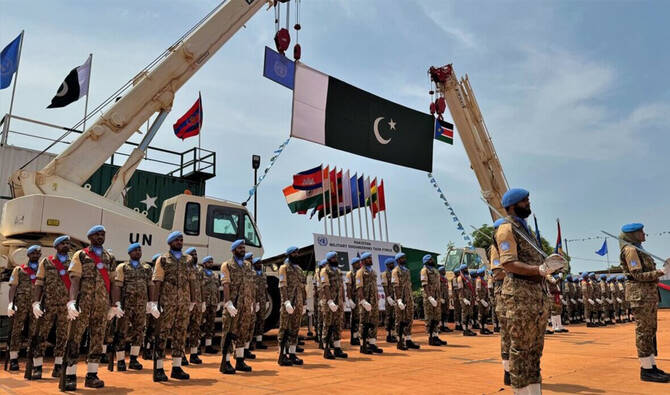
International UN Peacekeepers Day: Pakistan remembers 181 of its own lost in line of duty

The picture shared by Radio Pakistan on May 22, 2024, shows UN honoring Pakistani peacekeepers for their work in saving Bentiu from floods in South Sudan. (South Sudan)
Short Url
Updated 29 May 2025
Follow

International UN Peacekeepers Day: Pakistan remembers 181 of its own lost in line of duty

  • Over 235,000 Pakistani peacekeepers have served in 48 UN missions worldwide in seven-decade history of UN peacekeeping 
  • May 29 marks creation of UN Truce Supervision Organization in 1948 to monitor ceasefire after 1948 Arab-Israeli War

ISLAMABAD: Pakistan joined the international community in celebrating the International Day of United Nations Peacekeepers today, Thursday, the prime minister’s office said in a message, paying tribute to 181 Pakistanis who had been killed in the line of duty.

The International Day of United Nations Peacekeepers, May 29, is “an international day to pay tribute to all the men and women who have served and continue to serve in United Nations peacekeeping operations for their high level of professionalism, dedication, and courage and to honor the memory of those who have lost their lives in the cause of peace.”

“In the seven-decade history of UN peacekeeping missions, more than 235,000 Pakistani peacekeepers have rendered distinguished service in 48 UN missions around the world,” PM Shehbaz Sharif said in a message. 

“181 Pakistani peacekeepers have made the eternal sacrifice of their lives in achieving international peace and security.”

Sharif said the international day was an opportune occasion to review the many challenges facing UN peacekeeping, such as increasingly unilateral policies, financial sanctions, growing threats to the safety and security of UN peacekeepers, targeting of UN peacekeeping operations based on disinformation, and the destabilizing effects of new and emerging technologies.

In an effort to address these challenges, Pakistan, along with the Republic of Korea, co-hosted the UN Peacekeeping Ministerial Meeting in Islamabad last month with the theme, “Towards a Safer and More Effective Peace: Using Technology and an Integrated Approach”.

Pakistan also hosts the United Nations Military Observer Group in India and Pakistan (UNMOGIP), one of the oldest UN peacekeeping missions, tasked with monitoring the ceasefire along the Line of Control in the UN-recognized disputed territory of Jammu and Kashmir.

The date, May 29, for the International Day of United Nations Peacekeepers, marks the anniversary of the creation of the United Nations Truce Supervision Organization in 1948 to monitor the ceasefire after the 1948 Arab-Israeli War, which was the first ever UN peacekeeping mission.


Pakistan Air Force conducts successful test of air-launched cruise missile

Updated 03 January 2026
Follow

Pakistan Air Force conducts successful test of air-launched cruise missile

  • The indigenously developed ‘Taimoor’ missile has a range of 600 kilometers and carries a conventional warhead
  • The missile is designed to fly at low altitudes, which enables it to evade hostile air, missile defense systems

ISLAMABAD: The Pakistan Air Force (PAF) has successfully conducted a test of an air-launched cruise missile, ‘Taimoor,’ the Pakistani military said on Saturday, marking another significant milestone in advancement of national aerospace and defense capabilities.

The indigenously developed Taimoor weapon system is capable of engaging enemy land and sea targets with high precision. The missile has a range of 600 kilometers and carries a conventional warhead.

The missile test comes months after a brief but intense military conflict between Pakistan and India in which the nuclear-armed neighbors exchanged missile and artillery fire and deployed drones and fighter jets.

Equipped with state-of-the-art navigation and guidance system, Taimoor is designed to fly at very low altitudes, enabling it to effectively evade hostile air and missile defense systems.

“Its precision-strike capability significantly enhances the conventional deterrence and operational flexibility of Pakistan Air Force, further strengthening the country’s overall defense posture,” said the Inter-Services Public Relations (ISPR), the military’s media wing.

“The successful flight test underscores the technical maturity, innovation and self-reliance achieved by Pakistan’s defense industry.”

The missile’s launch was witnessed by senior officers of the armed forces along with distinguished scientists and engineers, who played a pivotal role in the development of this advanced weapon system.

PAF’s Air Chief Marshal Zaheer Ahmed Baber Sidhu congratulated the scientists, engineers and the entire PAF team on this remarkable achievement, lauding their professional excellence, dedication and unwavering commitment to strengthening Pakistan’s defense capabilities.

“The air chief reaffirmed that such accomplishments are a testament to the nation’s resolve to achieve technological self-sufficiency and maintain a credible conventional deterrent in the evolving regional security environment,” the ISPR said.

“The successful test of the Taimoor weapon system reflects Pakistan Air Force’s continued pursuit of operational readiness, technological superiority and national security objectives.”

Pakistan has placed greater emphasis on battle readiness in recent months. On Dec. 15, Pakistan Navy test-fired surface-to-air missile in the northern Arabian Sea.

Prior to that, Chief of Defense Forces Field Marshal Asim Munir visited frontline garrisons of Gujranwala and Sialkot to observe a field training exercise involving tanks and drones, where he had highlighted the importance of technological adaptability, saying modern warfare required agility, precision, situational awareness and rapid decision-making.