

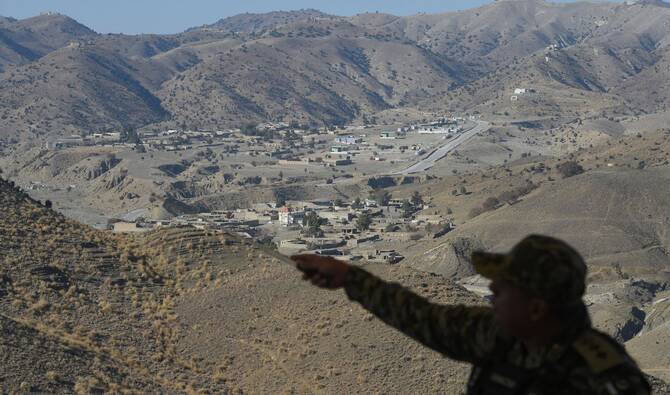

PESHAWAR: At least 22 people, including children, were wounded in a suspected quadcopter attack near a volleyball ground in Pakistan’s northwestern South Waziristan district, police said on Wednesday, adding that it was unclear who was behind the assault.
Earlier this month, a suspected drone strike killed four children and wounded five others in North Waziristan district in the Khyber Pakhtunkhwa province, prompting thousands of residents to stage a protest by placing the children’s bodies on a main road to demand justice. It wasn’t immediately clear who was behind the May 5 attack in the town of Mir Ali, which has been a stronghold of the Pakistani Taliban in the past.
In the latest incident, Lower South Waziristan police spokesperson Habib Islam told Arab News an unidentified quadcopter drone detonated an explosive device on Tuesday evening in the town of Azam Warsak.
The blast occurred just before sunset as residents, including children, were playing a volleyball game nearby, leaving approximately two dozen civilians wounded.
“The origin and operators of the drone remain undetermined at this stage,” Islam said.
“A comprehensive joint investigation involving security forces and civilian authorities is currently underway to establish the chain of command behind this attack. We will pursue all evidentiary leads to conclusively identify and bring the perpetrators to justice.”
Dr. Jan Muhammad Shinwari, the Medical Superintendent at Wana’s District Headquarters Hospital (DHQ) in South Waziristan, said 22 injured had been admitted to the facility.
“Most of the injured have now been discharged after being provided medical treatment,” Shinwari told Arab News. “Two of the children were referred to the adjacent Dera Ismail Khan hospital who were now said to be in stable condition.”
Zubair Wazir, a Member of the National Assembly (MNA) from the South Waziristan district, called the drone strike “a tragic development.”
“It was brutal, inhumane and senseless,” he told Arab News, condemning the killing of civilians on Pakistani soil.
“We hold the government responsible for the deaths of innocent people attacked while playing volleyball. This time, we will launch a forceful protest to prevent such incidents from recurring.”
Wazir said he had held a series of meetings with top security and civil officials, who assured him a thorough investigation would be conducted and those responsible held accountable.
Local elder Saleh Jan called the attack a “flagrant human rights violation.”
“This attack has poured fuel on the fire of local anger. We are trapped in a nightmare, helpless, with no clear path to stop these atrocities,” he said. “Who will answer for our safety? Who will shield us from the next strike?”
There have been civilian casualties in military strikes in some parts of the country in recent years. In March, 11 people, including women and children, were killed when a drone attack targeted a house in the northwestern city of Mardan.
A statement by the provincial government at the time had only said that there was “collateral damage” in an operation that was conducted to target militants in a remote village. Residents in March also rallied until the government agreed to compensate the victims’ families.
Officials say militants have also been using quadcopters to target troops, but it was still unclear who was responsible for the drone attacks in Mir Ali and Azam Warsak.
The latest civilian casualties came amid ongoing military operations against the Pakistani Taliban, which have a strong presence in the northwestern Khyber Pakhtunkhwa province bordering Afghanistan. The Pakistani Taliban, known as Tehreek-e-Taliban Pakistan, are a separate insurgent group from the Afghan Taliban, and they often target troops in the region.
Several districts in KP, especially North and South Waziristan, were long a base for the Pakistani Taliban and other militant groups. The TTP have stepped up attacks in the region in recent months.
With inputs from AP


