

Pakistan reroutes kinnow exports to Gulf, Asia after Afghan closure – commerce ministry

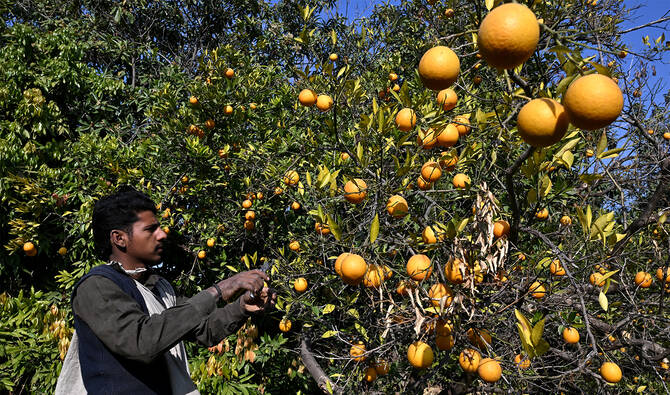
A worker harvests oranges from a tree at an orchard in Khanpur, Khyber Pakhtunkhwa province, on January 8, 2026. (AFP/File)
Short Url
Updated 19 January 2026
Follow

Pakistan reroutes kinnow exports to Gulf, Asia after Afghan closure – commerce ministry

  • Border shutdown with Afghanistan since late 2025 disrupted a key overland route for Pakistan’s citrus exports
  • Kinnow shipments earned about $40 million during peak season despite loss of a major regional market

KARACHI: Pakistan has rerouted kinnow orange exports to the Gulf and Southeast Asia after the closure of the Afghan market disrupted one of the country’s largest traditional destinations for the citrus crop, the commerce ministry said on Monday, underscoring a push to diversify export markets amid regional security tensions.

The shift follows Pakistan’s closure of major border crossings with Afghanistan in late 2025 after deadly clashes and a sharp rise in militant attacks that Islamabad says originated from Afghan territory. Pakistan has linked the restrictions to concerns over cross-border militancy, saying trade routes would remain constrained until Kabul takes credible steps to curb militant activity, a charge Afghan authorities deny.

Before the shutdown, bilateral trade between Pakistan and Afghanistan exceeded $1.6 billion annually, with overland routes playing a crucial role in the export of perishables such as kinnow, a Pakistani variety of mandarin orange. Exporters have warned that prolonged border disruptions particularly hurt citrus shipments during the winter harvest, forcing consignments to seek longer and costlier alternative routes.

Despite the disruption, the Ministry of Commerce said exporters successfully redirected shipments to other destinations.

“Priority was given to expanding access to markets in the Middle East, Southeast Asia, and other non-traditional destinations, while ensuring compliance with international quality and phytosanitary standards,” the ministry of commerce said in a statement on Monday.

According to official export figures cited by the ministry, Pakistan earned approximately $40 million from kinnow exports within 45 days, covering December and the first half of January, as shipments maintained momentum despite the loss of the Afghan market.

The ministry said it coordinated closely with the Trade Development Authority of Pakistan (TDAP), overseas trade missions and logistics partners to facilitate rerouting, documentation and market outreach, helping exporters avoid losses during the peak citrus export window.

Officials said the diversification drive helped sustain foreign-exchange inflows and protect growers, packers and exporters across the citrus value chain, while reinforcing Pakistan’s reputation as a reliable supplier in Gulf and Asian markets.

The performance, the ministry added, is being viewed as a positive signal for broader agricultural exports as Pakistan seeks to reduce dependence on a limited number of regional trade routes amid persistent geopolitical and security risks.


Saudi Arabia condemns separatist attacks in Pakistan’s Balochistan

Updated 31 January 2026
Follow

Saudi Arabia condemns separatist attacks in Pakistan’s Balochistan

  • Kingdom says it stands with Pakistan as security forces kill 92 militants in counteroffensive
  • Attacks hit multiple districts including Quetta and Gwadar, killing civilians and security personnel

ISLAMABAD: Saudi Arabia on Saturday condemned separatist attacks in Pakistan’s southwestern Balochistan province, expressing solidarity with Islamabad after a wave of coordinated violence killed civilians and security personnel across multiple districts.

In a statement cited by the Saudi ambassador to Pakistan, Nawaf bin Said Al-Malki, the Kingdom said it rejected violence in all its forms and stood with Pakistan as its security forces responded to the attacks.

“The Ministry of Foreign Affairs of the Kingdom of Saudi Arabia strongly condemns the attacks carried out by separatist elements in various areas of Pakistan’s Balochistan province,” he said in a social media message. “The Kingdom of Saudi Arabia renews its firm position rejecting all acts of terrorism and extremism.”

Pakistan’s military said on Saturday its forces killed 92 militants, including three suicide bombers, while repelling coordinated attacks across the southwestern province, following assaults that targeted civilians and law enforcement personnel in several towns, including Quetta, Gwadar, Mastung and Kharan.

The military said 18 civilians, including women and children, were killed in attacks on laborer families in Gwadar and Kharan, while 15 security personnel died during clearance operations and armed standoffs.

Saudi Arabia’s foreign ministry also conveyed condolences to the families of those killed and wished a speedy recovery to the injured, reaffirming its support for Pakistan’s efforts to safeguard stability and security.

Balochistan, which borders Iran and Afghanistan, has faced a decades-long separatist insurgency marked by attacks on security forces, infrastructure projects and civilians, as Pakistan steps up counter-militancy operations in the region.