Pakistan reroutes kinnow exports to Gulf, Asia after Afghan closure – commerce ministry

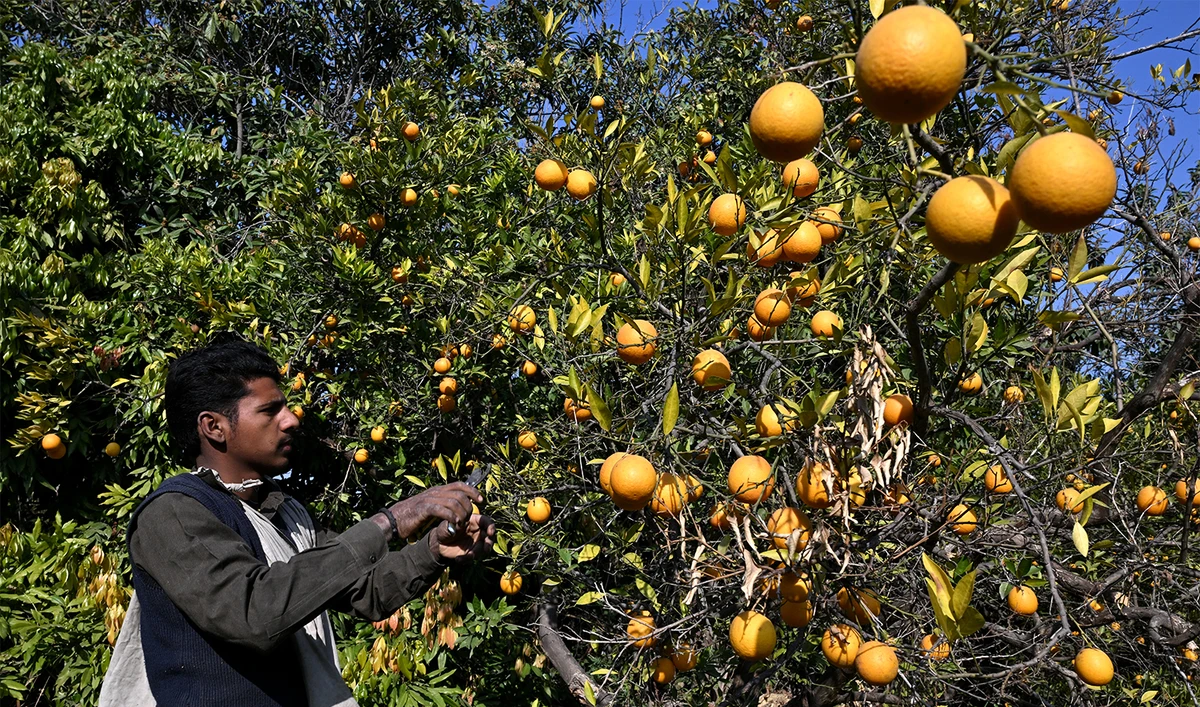
A worker harvests oranges from a tree at an orchard in Khanpur, Khyber Pakhtunkhwa province, on January 8, 2026. (AFP/File)
Short Url
Updated 19 January 2026
Follow

Pakistan reroutes kinnow exports to Gulf, Asia after Afghan closure – commerce ministry

  • Border shutdown with Afghanistan since late 2025 disrupted a key overland route for Pakistan’s citrus exports
  • Kinnow shipments earned about $40 million during peak season despite loss of a major regional market

KARACHI: Pakistan has rerouted kinnow orange exports to the Gulf and Southeast Asia after the closure of the Afghan market disrupted one of the country’s largest traditional destinations for the citrus crop, the commerce ministry said on Monday, underscoring a push to diversify export markets amid regional security tensions.

The shift follows Pakistan’s closure of major border crossings with Afghanistan in late 2025 after deadly clashes and a sharp rise in militant attacks that Islamabad says originated from Afghan territory. Pakistan has linked the restrictions to concerns over cross-border militancy, saying trade routes would remain constrained until Kabul takes credible steps to curb militant activity, a charge Afghan authorities deny.

Before the shutdown, bilateral trade between Pakistan and Afghanistan exceeded $1.6 billion annually, with overland routes playing a crucial role in the export of perishables such as kinnow, a Pakistani variety of mandarin orange. Exporters have warned that prolonged border disruptions particularly hurt citrus shipments during the winter harvest, forcing consignments to seek longer and costlier alternative routes.

Despite the disruption, the Ministry of Commerce said exporters successfully redirected shipments to other destinations.

“Priority was given to expanding access to markets in the Middle East, Southeast Asia, and other non-traditional destinations, while ensuring compliance with international quality and phytosanitary standards,” the ministry of commerce said in a statement on Monday.

According to official export figures cited by the ministry, Pakistan earned approximately $40 million from kinnow exports within 45 days, covering December and the first half of January, as shipments maintained momentum despite the loss of the Afghan market.

The ministry said it coordinated closely with the Trade Development Authority of Pakistan (TDAP), overseas trade missions and logistics partners to facilitate rerouting, documentation and market outreach, helping exporters avoid losses during the peak citrus export window.

Officials said the diversification drive helped sustain foreign-exchange inflows and protect growers, packers and exporters across the citrus value chain, while reinforcing Pakistan’s reputation as a reliable supplier in Gulf and Asian markets.

The performance, the ministry added, is being viewed as a positive signal for broader agricultural exports as Pakistan seeks to reduce dependence on a limited number of regional trade routes amid persistent geopolitical and security risks.
Pakistan highlights Gwadar transshipment role as shipping routes face disruption over regional tensions

Updated 05 March 2026
Follow

Pakistan highlights Gwadar transshipment role as shipping routes face disruption over regional tensions

  • Pakistani ports possess “untapped potential” to attract global shipping lines for transshipment operations, says minister
  • Pakistan eyes leveraging Gwadar as regional transshipment hub as Iran’s closure of Strait of Hormuz disrupts global maritime trade

KARACHI: Pakistan’s Maritime Affairs Minister Junaid Anwar Chaudhry on Thursday highlighted the importance of the port city of Gwadar’s transshipment role as major shipping routes, including the Strait of Hormuz, face disruption due to Iran’s ongoing conflict with the US and Israel in the Gulf. 

The meeting takes place as Iran has effectively closed the Strait of Hormuz, a strategic waterway that lies between it and Oman. It is one of the world’s most critical oil transit routes, with roughly 20 percent of global oil supplies passing through it. Iran has vowed it will attack any ship that enters the strait, causing energy prices to rise sharply on Monday amid disruptions to tanker traffic in the waterway.

Gwadar is a deep-sea port in Pakistan’s southwestern Balochistan province that lies close to the Strait of Hormuz. Pakistani officials have in the past highlighted Gwadar’s geostrategic position as the shortest trade route to the Gulf and Central Asia, stressing that it has the potential to become a regional transshipment hub.

Chaudhry chaired a high-level meeting of government officials to assess emerging logistical challenges facing Pakistan’s trade, particularly in the energy sector, amid tensions in the Gulf. 

“Special focus was placed on fully leveraging the potential of Gwadar Port as a regional transshipment hub and positioning it as an alternative of regional instability,” Pakistan’s maritime affairs ministry said in a statement. 

The minister said Pakistani ports possessed “significant untapped potential” to attract international shipping lines for transshipment operations, noting that it could also ensure long-term sustainability and growth of the country’s maritime sector.

Participants of the meeting discussed measures to strengthen Pakistan’s position as a viable alternative transit and transshipment destination, as key waterways are affected by the disruption. 

The committee also reviewed proposals to amend relevant rules and regulations to facilitate international transshipment operations through on-dock and off-dock terminals.

The chairmen of the Port Qasim Authority, Karachi Port Trust and Gwadar Port Authority attended the meeting, briefing committee members on the current operational readiness of their ports. They spoke about the available capacity for container transshipment, bulk cargo handling and refueling services at Pakistani ports. 

The port in Gwadar is a central part of the China-Pakistan Economic Corridor (CPEC), under which Beijing has funneled tens of billions of dollars into massive transport, energy and infrastructure projects in Pakistan.

Pakistan has long eyed the deep-sea port as a key asset that can help boost its trade with Central Asian states, the Gulf region and ensure the country earns valuable foreign exchange.