
KARACHI: The flight of capital from Pakistan to the UAE, Saudi Arabia, the UK and other investor-friendly nations could rise to $30 billion in the next five years if the government failed to rationalize taxes on the construction industry in the FY26 budget next month, builders and developers said this week.
The outflow of capital from Pakistan is driven by factors like high transaction taxes, economic uncertainty, and the perception of a more favorable tax environment and higher returns in international markets. This trend is particularly pronounced in the UAE, where Pakistani investors have made significant investments in real estate.
Pakistan’s tax policy on real estate has been criticized for being high compared to regional and international benchmarks while countries like the UAE offer lower tax rates and more attractive returns on real estate investments. Political and economic instability in Pakistan have also discouraged investment and led to capital flight as investors seek safer, more stable markets.
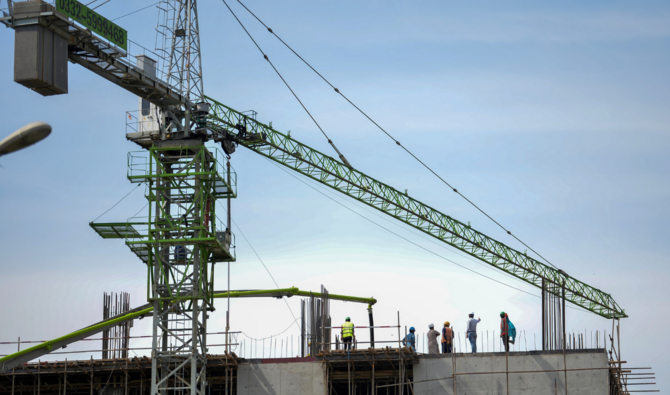
Pakistan’s construction industry, with its 10 million skilled and unskilled employees, is the second biggest employer after agriculture but its contribution to the gross domestic product has declined more than six percent to 2.6 percent in the last four years.
“Unfortunately, due to the prevailing economic conditions in Pakistan, a lot of builders and developers have already transferred their money out of Pakistan and are constructing projects in UAE, Saudi Arabia and other countries,” Mohammad Hassan Bakhshi, chairman Association of Builders and Developers of Pakistan (ABAD), told Arab News in an interview in Karachi.
In Pakistan, housing is a heavily-taxed industry, with taxes ranging from as much as 40 percent property transfer tax to 60 percent levy on builders and developers earning more than Rs 150 billion ($532 million).
These taxes are “too high,” the ABAD chairman said, suggesting that the property transfer tax be reduced to five or six percent.
By 2022, Pakistanis had invested $12 billion in the UAE, which was expected to increase to $25 billion this year and $30 billion by 2030, said Bakhshi, citing data from the Federal Board of Revenue, the state tax collector.
“Big builders and developers of Pakistan have already shifted or are in process of shifting their capital, their investment,” and entrepreneurship skills to Saudi Arabia, Dubai, the US and UK, the ABAD chief added.
Pakistan’s construction industry has Rs 90 trillion ($319 billion) cash capitalization, 10 times bigger than Pakistan Stock Exchange’s Rs 10 trillion ($35 billion). The size of Pakistan’s total budget for FY26 is expected to be Rs 17 trillion, according to local media reports.
“OPTIMISTIC”
Pakistan, the world’s fifth most populous nation, is facing a 12 million housing shortage that industry stakeholders say can be turned into an opportunity by the government to create economic activity and spur growth.
Arshad Mehmood Awan, an Islamabad-based real estate professional and CEO of Homy Properties, said the government could reduce the shortage of residential units by launching affordable housing projects and making bank loans accessible online in the new budget.
“Regarding housing finance, we are expecting the government to devise a strategy, a plan that would enable the common man to easily avail housing finance from banks,” Awan told Arab News.
Arif Habib, the chairman of Arif Habib Group, said he was “optimistic” about the new budget, saying premier Shehbaz Sharif had formed a task force to develop proposals for the housing market.
The government, he said, had decided to withdraw excise duty and was considering reducing some advanced taxes as well.
“Then the most important aspect of this real estate market is the mortgage financing availability,” Habib told Arab News in an interview, saying the government’s task force was recommending proposals to encourage mortgage financing given that inflation had eased to a record low.
“In the past, because of the high inflation, people didn’t have enough disposable income to buy real estate,” Habib said.
“But now I believe, with the positive sentiment in the country, the Pakistani diaspora would also be attracted to the Pakistani market because they prefer to buy houses here for their families and for their future. So I believe after the budget, this [real estate] sector will also be active.”
More than half of the 10 million overseas Pakistanis who are expected to remit a record $38 billion this year wanted to invest in the country’s real estate sector, ABAD’s Bakhshi added.