
ABHA: Saudi Arabia’s Asir region is set to receive a fresh investment boost of SR4 billion ($1.06 billion), raising the total value of government-backed projects in the area to more than SR25 billion, according to a senior official.
Speaking at the second Asir Investment Forum in Abha, Prince Turki bin Talal, governor of Asir, announced that over SR5 billion in investments are already underway. The newly pledged SR4 billion will be formally revealed during the two-day forum.
This investment surge is part of the Asir Region Development Strategy — the Kingdom’s first development plan tailored to a specific region — launched in 2021 by Crown Prince Mohammed bin Salman. The strategy aims to transform Asir into a world-class tourism destination, with a goal of attracting more than 10 million visitors annually by 2030, while driving sustainable development through tourism and strategic investment.
In his opening remarks, the governor said: “With more than SR25 billion committed to essential government projects and investments that have already begun implementation on the ground — through projects by the Public Investment Fund, the Tourism Development Fund, the Social Development Bank, and other financing entities — in line with the state’s belief that Asir is an economic powerhouse and a fundamental enabler for the private sector.”
He added: “Since the launch of the Asir strategy, committed investments exceeding SR5 billion have already begun implementation, in addition to SR4 billion whose details will be announced during this forum.”

Prince Turki bin Talal, governor of Asir, speaks at the forum in Abha.
Sultan Al-Shahri, chief of investment at the Aseer Development Authority, underscored the scale of ongoing activity, noting that the region is progressing with 79 investment projects worth more than SR29 billion. Of these, 49 projects valued at SR25.6 billion are in the attraction phase, while 30 confirmed initiatives account for SR3.8 billion.
He said private sector agreements signed during the first edition of the forum amounted to SR1.7 billion, with presented opportunities totaling SR3 billion, signaling growing domestic and international investor interest aligned with Vision 2030’s objectives.
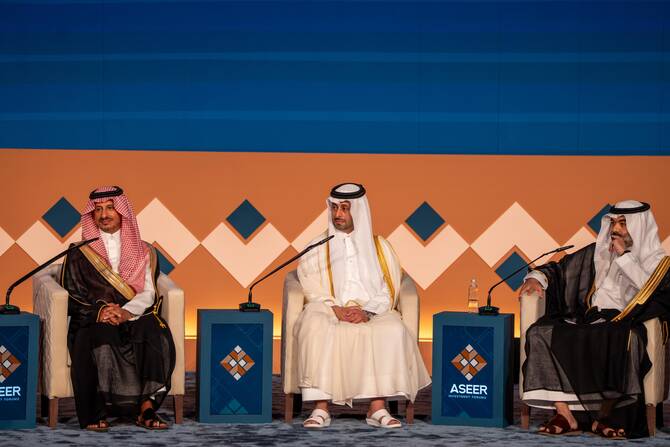
Held under the theme “Asir Thrives… Invest Now,” the second edition of the forum opened on May 27 at King Khalid University in Al-Fara’a, Abha. Organized by the Aseer Development Authority, the event drew over 1,500 participants, including ministers, business leaders, and regional experts.
A key development announced at the forum was the launch of “Qimam Al-Sarrah,” a new investment arm intended to streamline land development and simplify regulatory processes to facilitate investor access.
Ministerial participation included Saudi Tourism Minister Ahmed Al-Khateeb, Qatari Minister of Municipal Affairs Abdullah Al-Atiyah, and Saudi Communications and Information Technology Minister Abdullah Al-Swaha.
During a plenary session, the ministers emphasized the strategic role of digital infrastructure, smart services, and mega-events — including Abha’s bid to host the 2034 FIFA World Cup — in driving economic momentum.
Saudi Commerce Minister Majid Al-Qasabi, addressing the forum virtually, affirmed the region’s transformation.
He stated that Asir is undergoing a qualitative transformation across various levels, positioning it as one of the most promising areas on Saudi Arabia’s investment map — thanks to its human, natural, and economic resources.
Al-Qasabi noted that the Ministry of Commerce is currently reviewing over 110 commercial regulations to enhance the business environment. These include reforms to the Companies Law, Franchise Law, Anti-Concealment Law, and E-Commerce Law, as well as expanding the role of the National Competitiveness Center.
Al-Qasabi added: “We succeeded in launching an extensive corrective campaign, allowing business owners to voluntarily adjust their status. This contributed to a significant drop in concealment cases and a notable increase in compliance.”
As of April 2025, the Kingdom has more than 1.7 million commercial registrations, including 90,000 in Asir — representing 5.3 percent of the national total.
According to Al-Qasabi, between 2018 and 2025, joint-stock companies in Saudi Arabia grew by 76 percent, from 2,300 to 4,000. Limited liability companies surged by 138 percent to 386,000, while sole proprietorships rose 32 percent to reach 1.2 million.
Al-Qasabi also revealed that Saudi Arabia aims to finalize 20 free trade agreements by 2030.
Capital Market Authority Chairman Mohammed El-Kuwaiz addressed efforts to mobilize regional investment through financial markets, including accessible financing mechanisms and regulatory support.
Tourism, a key pillar of the Asir strategy, featured prominently throughout the forum. The Saudi tourism minister emphasized the region’s competitive edge.
“The region’s rich natural and cultural assets are key drivers of tourism investment, which is essential for sustainable development and community empowerment,” Al-Khateeb said.
Figures released on the Ministry of Tourism’s X account during the event showed tourism momentum accelerating. Domestic tourism rose 11 percent year-on-year in the first quarter of 2025 to 1.4 million Saudi visitors. International tourism surged 42 percent to 68,900 visitors.
Tourism-related employment also climbed, with 47,700 jobs recorded — a 2.5 percent increase since late 2024.
The Saudization rate stood at 16.2 percent, with gender participation balanced. In Ministry-supervised sectors, 2,600 jobs were recorded, with a 29 percent Saudization rate and near-equal gender representation.
The concurrent exhibition showcased key regional projects and institutional stakeholders, highlighting growing public-private collaboration in the Asir region.
The forum concluded with a reaffirmation of Asir’s role as a cornerstone of Saudi Arabia’s diversification strategy — one that aims to balance economic opportunity with cultural preservation and long-term sustainability.