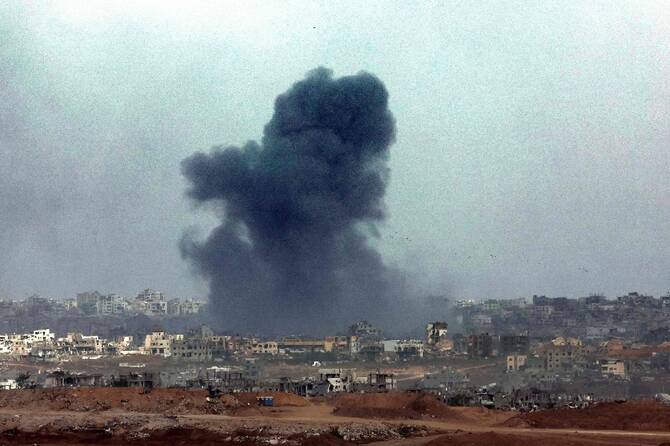
BERLIN: German Chancellor Friedrich Merz delivered his most severe rebuke of Israel to date on Tuesday, criticizing massive air strikes on Gaza as no longer justified by the need to fight Hamas and “no longer comprehensible.”
The message, delivered from a press conference in Finland, reflects a broader shift in public opinion but also a greater willingness from top-ranking German politicians to criticize Israel’s conduct since the October 7, 2023 attacks by Hamas.
There was similar criticism from Merz’s foreign minister Johann Wadephul and calls among his junior coalition partner, the Social Democrats, to halt arms exports to Israel or else risk German complicity in war crimes.
While not a complete rupture, the shift in tone is significant in a country whose leadership follows a policy of special responsibility for Israel, known as the Staatsraeson, due to the legacy of the Nazi Holocaust.
Germany, along with the United States, has been one of Israel’s staunchest supporters, but Merz’s words come as the European Union is reviewing its Israel policy and Britain, France and Canada also threatened “concrete actions” over Gaza.
“The massive military strikes by the Israelis in the Gaza Strip no longer reveal any logic to me. How they serve the goal of confronting terror. ... In this respect, I view this very, very critically,” Merz said in Turku, Finland.
“I am also not among those who said it first ... But it seemed and seems to me that the time has come when I must say publicly, (that) what is currently happening is no longer comprehensible.”
The comments are particularly striking given that Merz won elections in February promising to host Israeli Prime Minister Benjamin Netanyahu on German soil in defiance of an arrest warrant by the International Criminal Court (ICC).
Merz also has hanging in the chancellery a picture of Zikim beach, where Hamas fighters arrived on boats during their rampage in 2023 that killed around 1,200 people.
The Chancellor plans to speak to Netanyahu this week, as attacks on Gaza killed dozens in recent days and its population of 2 million is at risk of famine. He did not reply to a question about German weapons exports to Israel, and a government official told a briefing that this was a matter for a security council presided over by Merz.
Israel’s ambassador to Berlin, Ron Prosor, acknowledged German concerns on Tuesday but made no commitments.
“When Friedrich Merz raises this criticism of Israel, we listen very carefully because he is a friend,” Prosor told the ZDF broadcaster.
PRESSURE FROM BELOW?
Merz’s comments come on top of a groundswell of opposition to Israel’s actions. A survey by Civey, published in the Tagesspiegel newspaper this week, showed 51 percent of Germans opposed weapons exports to Israel.
More broadly, while 60 percent of Israelis have a positive or very positive opinion of Germany, only 36 percent of people in Germany view Israel positively, and 38 percent view it negatively, a survey by the Bertelsmann Foundation found in May.
This represents a notable change from the last survey in 2021, when 46 percent of Germans had a positive opinion of Israel. Only a quarter of Germans recognize a special responsibility toward the state of Israel, while 64 percent of Israelis believe Germany has a special obligation.
In another striking rebuke of Israel, Germany’s commissioner for antisemitism Felix Klein this week called for a discussion about Berlin’s stance on Israel, saying German support after the Holocaust could not justify everything Israel was doing.
Israeli historian Moshe Zimmermann said popular opinion in Germany toward Israel has reacted the same way as in other countries.
“The difference is in the political elites — the political elite is still under the influence of the lessons of WWII in a very one-dimensional way: ‘Jews were our victims during WWII, so we have to take sides with the Jews wherever they are and whatever they do,’” he said.
“You can feel it in the reaction of the new foreign minister, Wadephul, and indirectly the fact that Merz didn’t repeat his promise to invite Netanyahu. This is an unprecedented situation where the pressure from below is forcing the political class to reconsider.”


![]()

Germany shifts tone on Israel over ‘incomprehensible’ Gaza carnage
Short Url
https://arab.news/22vaq
Germany shifts tone on Israel over ‘incomprehensible’ Gaza carnage
- German Chancellor Friedrich Merz says the Israeli military strikes on Gaza "no longer reveal any logic to me"
- 51 percent of Germans oppose weapons exports to Israel according to a published survey


Latest updates


Recommended


© 2026 SAUDI RESEARCH & PUBLISHING COMPANY, All Rights Reserved And subject to Terms of Use Agreement.