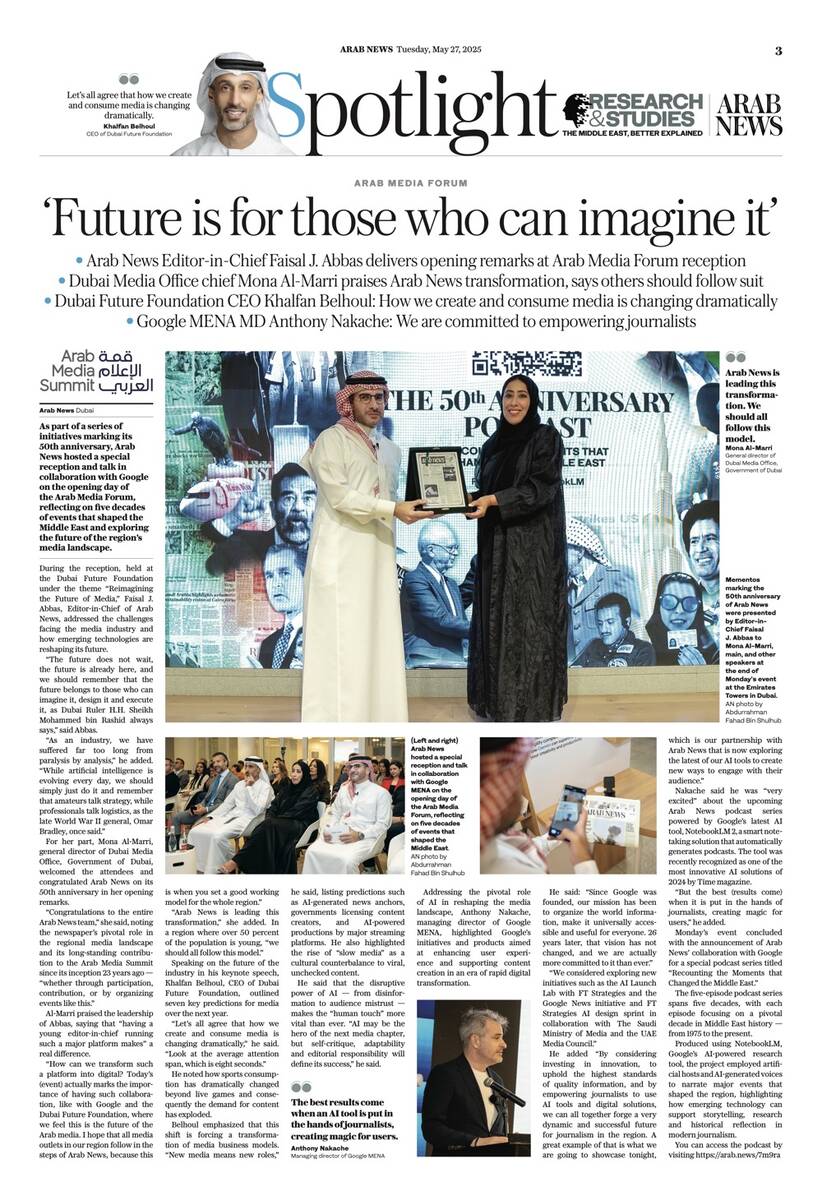

DUBAI: As part of a series of initiatives marking its 50th anniversary, Arab News hosted a special reception and talk in collaboration with Google on the opening day of the Arab Media Forum, reflecting on five decades of events that shaped the Middle East and exploring the future of the region’s media landscape.
During the reception, held at the Dubai Future Foundation under the theme “Reimagining the Future of Media,” Faisal J. Abbas, Editor-in-Chief of Arab News, addressed the challenges facing the media industry and how emerging technologies are reshaping its future.
“The future does not wait, the future is already here, and we should remember that the future belongs to those who can imagine it, design it and execute it, as Dubai Ruler H.H. Sheikh Mohammed bin Rashid always says,” said Abbas.
“As an industry, we have suffered far too long from paralysis by analysis,” he added. “While artificial intelligence is evolving every day, we should simply just do it and remember that amateurs talk strategy, while professionals talk logistics, as the late World War II general, Omar Bradley, once said.”

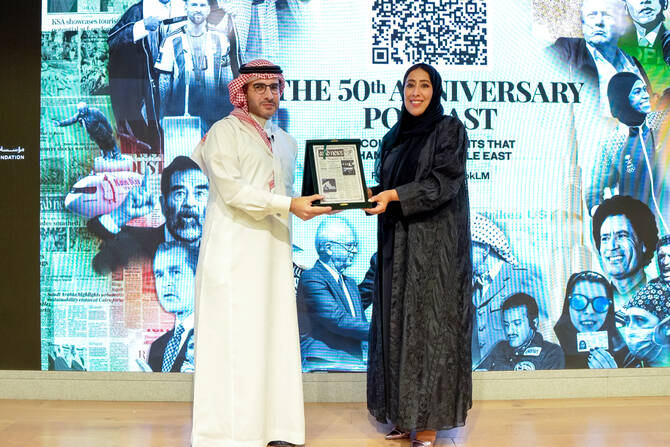
Faisal J. Abbas presents a memento marking the 50th anniversary of Arab News to Khalfan Belhoul. (AN photo/Abdurrahman Fahad Bin Shulhub)
For her part, Mona Al-Marri, director-general of Dubai Media Office, Government of Dubai, welcomed the attendees and congratulated Arab News on its 50th anniversary in her opening remarks.
“Congratulations to the entire Arab News team,” she said, noting the newspaper’s pivotal role in the regional media landscape and its long-standing contribution to the Arab Media Summit since its inception 23 years ago — “whether through participation, contribution, or by organizing events like this.”
Al-Marri praised the leadership of Abbas, saying that “having a young editor-in-chief running such a major platform makes” a real difference.
Let’s all agree that how we create and consume media is changing dramatically.
Khalfan Belhoul, CEO of Dubai Future Foundation
“How can we transform such a platform into digital? Today’s (event) actually marks the importance of having such collaboration, like with Google and the Dubai Future Foundation, where we feel this is the future of the Arab media. I hope that all media outlets in our region follow in the steps of Arab News, because this is when you set a good working model for the whole region.”
“Arab News is leading this transformation,” she added. In a region where over 50 percent of the population is young, “we should all follow this model.”

Al-Marri praised the leadership of Abbas, saying that “having a young editor-in-chief running such a major platform makes” a real difference. (AN photo/Abdurrahman Fahad Bin Shulhub)
Speaking on the future of the industry in his keynote speech, Khalfan Belhoul, CEO of the Dubai Future Foundation, outlined seven key predictions for media over the next year.
“Let’s all agree that how we create and consume media is changing dramatically,” he said during his address at the Dubai Future Foundation Auditorium in Emirates Towers. “Look at the average attention span, which is eight seconds.”
He noted how sports consumption has dramatically changed beyond live games and consequently the demand for content has exploded. “For me, sport is all about pre-game, game, post-game interviews and conversations. And we need to adapt to that.”
Belhoul emphasized that this shift is forcing a transformation of media business models. “New media means new roles,” he said, listing predictions such as AI-generated news anchors, governments licensing content creators, and AI-powered productions by major streaming platforms. He also highlighted the rise of “slow media” as a cultural counterbalance to viral, unchecked content.
He said that the disruptive power of AI — from disinformation to audience mistrust — makes the “human touch” more vital than ever. “AI may be the hero of the next media chapter, but self-critique, adaptability and editorial responsibility will define its success,” he said.
Now in its 24th edition, the three-day Arab Media Forum in Dubai brings together senior government officials, media executives, thought leaders, and influential content creators from the Arab region and beyond. It is now held under a bigger event called the Arab Media Summit, which includes various other forums and award ceremonies.

Faisal J. Abbas, Editor-in-Chief of Arab News, addressed the challenges facing the media industry and how emerging technologies are reshaping its future. (AN photo/Abdurrahman Fahad Bin Shulhub)
The summit runs until May 28 and focuses on fostering collaboration among media platforms, senior officials, and governments to create a positive impact on shaping vital sectors of everyday life in the region.
In light of this connection, the summit features an impressive lineup of prominent personalities including Nawaf Salam, the prime minister of Lebanon, and Asaad Al-Shaibani, Syria’s foreign minister, among others.
A panel discussion featuring information ministers from several Arab countries explores the future of public media and strategies to strengthen collaboration with the private sector.
The best results come when an AI tool is put in the hands of journalists, creating magic for users.
Anthony Nakache, Managing director of Google MENA
Ghassan Salameh, Lebanon’s minister of culture, will share insights on the media’s role in shaping a path toward regional stability, while prominent media figure Piers Morgan is set to address the summit audience in a key session.
Addressing the pivotal role of AI in reshaping the media landscape, Anthony Nakache, Managing Director for Google in the Middle East & North Africa, highlighted Google’s initiatives and AI-powered products aimed at enhancing journalism and supporting content creation in an era of rapid digital transformation.
He said: “Since Google was founded, our mission has been to organize the world's information and make it universally accessible for everyone. Twenty six later, this mission has not changed and we are more committed to it than ever, with AI being at the core of it.”

Anthony Nakache, Managing Director of Google in MENA, highlighted Google’s initiatives and AI-powered products aimed at enhancing journalism and supporting content creation. (AN photo/Abdurrahman Fahad Bin Shulhub)
“We launched new initiatives such as the AI Launchpad with FT Strategies and the Google News initiative and FT Strategies AI design sprint in collaboration with The Saudi Ministry of Media and the UAE Media Council.”
He added: “By continuing to invest in innovation, to uphold the highest standards of quality information, and by empowering journalists to use AI tools and digital solutions, we can together forge a very dynamic and successful future for journalism in the region. A great example of that is what we are going to showcase tonight, which is our collaboration with Arab News that is now experimenting with the latest of our AI tools to create new ways to engage with their audience.”
Nakache said he was “very excited” about the upcoming Arab News podcast series powered by NotebookLM, Google’s AI-powered research tool to help users find, summarize, generate Audio Overviews, and gain insights faster from their information. The tool was recently recognized as one of the most innovative AI solutions of 2024 by Time magazine.
“But the best (results come) when it is put in the hands of journalists, creating magic for users,” he added.

The reception, held at the Dubai Future Foundation, was themed “Reimagining the Future of Media.” (AN photo/Abdurrahman Fahad Bin Shulhub)
Monday evening concluded with the announcement of Arab News’ collaboration with Google for a special podcast series titled “Recounting the Moments that Changed the Middle East.”
The five-episode podcast series spans five decades, with each episode focusing on a pivotal decade in Middle East history — from 1975 to the present.
Produced using NotebookLM, Google’s AI-powered research tool, the project employed artificial hosts and AI-generated voices to narrate major events that shaped the region, highlighting how emerging technology can support storytelling, research and historical reflection in modern journalism.
You can access the podcast by visiting https://arab.news/7m9ra