

Saudi ministers announce full Hajj readiness with 1.07 million pilgrims already in Kingdom

1 / 4
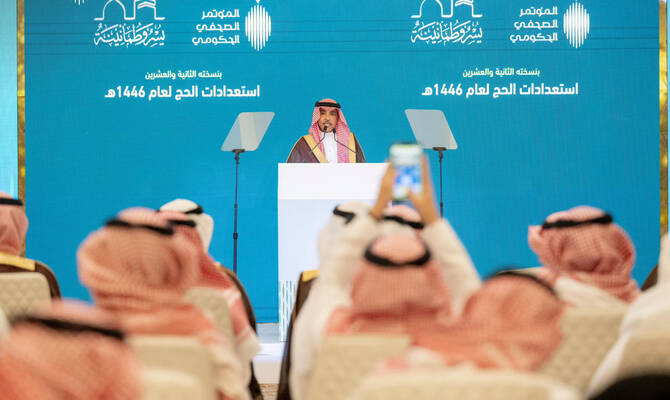
Minister of Hajj Dr. Tawfiq Al-Rabiah announces 1.4M+ Nusuk cards issued and 30+ new digital services launched for Hajj 1446 — with over 120 guidance points on the ground. (Supplied/@media_ksa)
2 / 4
Minister of Media Salman Al-Dosari: “We’ve launched awareness campaigns in 50 languages and hosted global media from 25+ countries to share the true spirit of Hajj.” (Supplied/@media_ksa)
3 / 4
Transport Minister Saleh Al-Jasser presents the 1446H Hajj mobility plan, including smart trains, drones for crowd monitoring, and expanded cooled roads for safer pilgrim movement. (Supplied/@media_ksa)
4 / 4
Health Minister Fahad Al-Jalajel: “50,000+ medical services delivered, 140 surgeries performed, and no epidemic cases recorded among pilgrims so far.” (Supplied/@media_ksa)
Short Url
Updated 27 May 2025
Follow

Saudi ministers announce full Hajj readiness with 1.07 million pilgrims already in Kingdom

  • ‘Our goal is a safe, efficient pilgrimage for all,’ Hajj and Umrah minister says
  • Health, media, transport ministers outline preparations for seamless experience

RIYADH: Saudi Arabia reaffirmed its full readiness to serve pilgrims during Hajj 1446H, with more than 1.07 million pilgrims already in the Kingdom and advanced digital systems deployed across sectors to ensure a safe and seamless experience for them.

At a joint press conference on Monday, ministers from Hajj and Umrah, Health, Transport and Media outlined the strategic and operational plans for the pilgrimage season, which align with Vision 2030’s goals for service excellence.

Minister of Hajj and Umrah Tawfiq Al-Rabiah said that more than 1.4 million Nusuk smart cards had been issued and more than 30 new digital services launched via the Nusuk app this year. The digital platform supports the entire pilgrim journey, from arrival to departure, including permits, mobility, guidance and real-time updates.

Al-Rabiah said that pilgrim camp allocations in Mina and Arafat were now fully integrated with crowd flow systems.

“We began preparing for this season immediately after the last one ended,” he said. “From digital permits to onsite inspections, our goal is a safe, efficient pilgrimage for all.”

As part of the operational strategy, the ministry has conducted more than 37,000 inspections of service providers this month, identifying 3,400 violations and resolving them immediately.

To assist pilgrims on the ground, more than 120 guidance points have been established, including the “Ask Me” service and more than 400 electric carts for the elderly and people with disabilities.

Minister of Health Fahad Al-Jalajel said that more than 50,000 healthcare services had been delivered, with no epidemic cases detected so far.

A 60 percent increase in clinical capacity has been implemented this year, supported by three field hospitals, 71 emergency points, 900 ambulances and 11 air ambulances. Since the start of the season, the ministry has performed 140 surgeries, 65 heart catheterizations and six open-heart operations.

“Our focus is prevention first, followed by rapid response,” Al-Jalajel said. “We are committed to protecting every pilgrim from harm.”

Minister of Transport Saleh Al-Jasser announced the integration of smart monitoring systems, including the use of drones to monitor crowd movement and sensor-enabled roads to reduce heat by up to 12 degrees Celsius.

The Mashair Train will carry up to 72,000 pilgrims per hour, while Haramain High-Speed Railway is offering 2 million seats, up by 400,000 from last year. Additionally, rubberized and cooled road technologies have been expanded by 30 percent to improve comfort and reduce heat exposure.

Minister of Media Salman Al-Dosari said that the Kingdom had launched Hajj awareness campaigns in 50 languages and was now hosting international broadcasters from more than 25 countries. More than 10,000 Wi-Fi access points have also been activated in the holy sites to keep pilgrims connected.

Al-Dosari emphasized the role of AI this year in managing crowd flow and optimizing decision making in real time through data analysis, all handled by trained digital teams.

“Serving pilgrims is a duty we inherit and honor,” he said. “Every detail matters and this year, every tool of technology and collaboration is in place to ensure a successful Hajj.


Nobel Prize winner discusses art of writing at Ithra

Updated 06 December 2025
Follow

Nobel Prize winner discusses art of writing at Ithra

  • Jon Fosse offers insights into storytelling at the 10th iRead celebration

DHAHRAN: Nobel Prize-winning Norwegian author and playwright Jon Fosse drew a full house to Ithra on Friday, as he discussed art, writing, and the human experience during a session entitled “Nobel Minds” at the 10th edition of the institution’s iRead program.

Fosse, who won the 2023 Nobel Prize in Literature, appeared on stage with moderator Tariq Khawaji, Ithra’s cultural consultant.

Jon Fosse, who won the 2023 Nobel Prize in Literature, appeared on stage with moderator Tariq Khawaji, Ithra’s cultural consultant. (Supplied)

Outside, the landmark Ithra building, designed by Norwegian firm Snohetta, was lit in purple to mark the celebration. 

Fosse, whose work includes more than 70 novels, plays, poems, essays, and children’s books, and has been translated into more than 50 languages, including Arabic, is known for his minimalist, introspective style. His unconventional syntax and pared-down prose have significantly influenced postdramatic theater and contemporary experimental fiction. 

HIGHLIGHTS

• The landmark Ithra building, designed by Norwegian firm Snohetta, was lit in purple to mark the 10th anniversary of the institution’s iRead program.

• During the ‘Nobel Minds’ session, Jon Fosse discussed his writing process, sources of inspiration, and how writers might develop their own signature styles.

• Tariq Khawaji told Arab News that bringing Fosse to Saudi Arabia was especially meaningful as Arabic translations of his work remain relatively new to many readers. 

Khawaji told Arab News that bringing Fosse to Saudi Arabia was especially meaningful as Arabic translations of his work remain relatively new to many readers. 

Jon Fosse, who won the 2023 Nobel Prize in Literature, appeared on stage with moderator Tariq Khawaji, Ithra’s cultural consultant. (Supplied)

At a book signing following the session, he noted that Fosse’s pared-back lyrical language is a boon to both translators and new audiences. 

“I think one of Fosse’s strengths is his extremely simple language, he always uses the simplest phrasing and avoids inflated vocabulary or difficult expressions. This is why translators often find his writing both lyrical and clear,” Khawaji said. 

If I’m writing well, I have to bring something new to the book for me, and hopefully also for other people; something that didn’t exist before.

Jon Fosse, Norwegian Nobel laureate

“I think he speaks to the world through the problem of the individual — this tendency toward the quiet, the stripped-down. And I believe the Norwegian landscape, especially the western region, plays a very strong role in shaping him. His characters often feel like they come from a place with vast silence and depth. Even outside the session, you could sense many layers in how he spoke — something almost carved by that landscape,” he continued.

On the topic of artificial intelligence, Fosse said that while it can mimic a writer’s voice, it cannot replicate the essence behind it. (Supplied)

After noting Fosse’s 18 major awards, Khawaji added: “I think his Arabic readership is still small — though his plays have been translated and performed. I believe introducing him to the Arab world will increase his readership significantly, and I think the reception will change. Readers will discover a unique, unfamiliar voice. It was important to have him here.”

During his hour-long English-language conversation with Khawaji before the book signing, Fosse discussed his writing process, sources of inspiration, and how writers might develop their own signature styles.

“I think you can say all literature, in a certain sense, comes from literature. So the more you read — and the better literature you read — the cleverer you most likely will be,” he said.

“If I’m writing well, I have to bring something new to the book for me, and hopefully also for other people; something that didn’t exist before. And to get to that, you have to leave yourself (somehow). If you don’t leave yourself, you know exactly what you knew before,” he added.

On the topic of artificial intelligence, Fosse said that while it can mimic a writer’s voice, it cannot replicate the essence behind it.

“I’ve done it myself. I asked the computer to write something (in my style) and it was like a kind of parody, but still there were some very interesting sides to it. And there were some great metaphors that happened that I couldn’t have figured out myself,” he said. 

“Perhaps it is a childish idea but I think that art has so much to do with this universal individuality of the artist. It cannot possibly be replaced by a machine,” Fosse concluded.