

Pakistan says border control ‘sovereign right’ as UNHCR flags at-risk Afghans amid expulsions

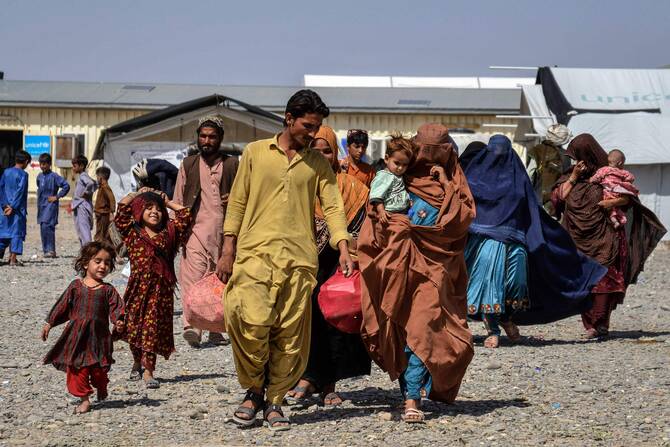
Afghan refugees carrying their belongings arrive from Pakistan at a registration center in Takhta Pul district of Kandahar province on April 13, 2025. (AFP/File)
Short Url
Updated 26 May 2025
Follow

Pakistan says border control ‘sovereign right’ as UNHCR flags at-risk Afghans amid expulsions

  • Afghan journalists, activists, minorities, artists, ex-government workers among 110,000 declared at “high-risk”
  • Foreign office says over 44,000 Afghans approved for relocation to Western nations remain in Pakistan 

ISLAMABAD: Pakistan’s foreign office said on Monday the country had a “sovereign right” to secure and regulate its borders, as the United Nations High Commissioner for Refugees (UNHCR) identified around 110,000 Afghans who faced the risk of persecution at home if deported. 

Facing economic and security crises, Pakistan launched a repatriation drive targeting “illegal” foreigners in November 2023, with approximately 1.3 million Afghan refugees, both undocumented and those with Afghan Citizen Card holders, deported since. 

Pakistan has vowed to continue with the deportations until all “illegal” foreigners have been expelled. As of October 2023, there were over 4 million Afghans, registered and illegals, residing in Pakistan.

According to the latest UNHCR Resettlement Factsheet, some 110,000 refugees and asylum-seekers have high-risk profiles with increased international protection needs and vulnerabilities that could qualify them for resettlement in a third country. The agency has said all returns should be voluntary, dignified, and sustainable.

Speaking to Arab News on Monday, foreign office spokesperson Shafqat Ali Khan said the illegal foreign repatriation plan (IFRP) was consistent with both Pakistan’s obligations under international law and its domestic legal framework. 

“The right to secure and regulate our borders is a sovereign right and an internationally recognized practice, which is by no means unique to Pakistan,” he said, adding that IFRP was neither an “indiscriminate nor an arbitrary measure,” and that Afghans would always be welcome to visit Pakistan through a proper visa regime, whether for business, tourism, or education.

Khan said Pakistan had urged all concerned nations to expedite the repatriation process for Afghans awaiting resettlement in third countries.

“On Afghan nationals awaiting evacuation to a third country, we are in touch with those countries and urged them to expedite the process of evacuation,” the FO spokesman said. 

“We are engaged with relevant UN bodies for the protection of people in vulnerable situations, and our legal safeguards and remedies remain functional and effective to address any complaints.”

UNHCR Pakistan spokesperson Qaiser Khan Afridi said approximately 600,000 Afghans had entered Pakistan following the Taliban’s takeover of Kabul and the withdrawal of US and allied forces in August 2021, with about 490,000 seeking asylum through UNHCR due to the absence of a national refugee law.

“We conducted a verification exercise a year ago and ... around 110,000 have high-risk profiles and qualify for resettlement in a third country,” Afridi told Arab News.

He said these were people who could not return to Afghanistan due to “vulnerabilities and safety concerns.”

“There are journalists, human rights activists, religious minorities, ethnic minorities, musicians, singers, or some people who have worked in previous governments, or they are female only families,” the UNHCR official added.

“We spoke with the Pakistani government, urging them not to send these people back to Afghanistan as their lives are at risk,” Afridi said, adding that the UN agency had also requested that the Pakistan government establish a mechanism to allow these individuals to live in the country temporarily.

According to the foreign office, over 44,000 Afghans approved for relocation to Western countries were still in Pakistan, awaiting resettlement.

The resettlement program has been active since the 1980s, with over 20,000 vulnerable refugees sent to third countries since.


Pakistan says military operation concluded in Balochistan, 216 militants killed 

Updated 8 sec ago
Follow

Pakistan says military operation concluded in Balochistan, 216 militants killed 

  • Separatist BLA militant group claimed responsibility for coordinated attacks across Balochistan last week 
  • Military says 36 civilians, 22 law enforcement and security forces personnel have been killed in attacks 

PESHAWAR: Pakistani forces have concluded a security operation in the southwestern Balochistan province and killed 216 militants after a series of coordinated attacks by separatist militants last week, the military’s media wing said on Thursday. 

Separatist militant group Baloch Liberation Army (BLA) claimed responsibility for a series of attacks in Balochistan last Friday and Saturday in multiple districts across the province, one of the deadliest flare-ups in the area in recent years. 

Pakistan military’s media wing, the Inter-Services Public Relations (ISPR), said security forces launched operations in Panjgur and Harnai district’s outskirts on Jan. 29 based on intelligence confirming the presence of “terrorist elements,” killing 41 militants. 

It said the military launched a broader series of intelligence-based operations in multiple areas of the province after that to dismantle “terrorist sleeper cells,” referring to it as “Operation Radd-ul-Fitna-1.”

“As a result of these well-coordinated engagements and subsequent clearance operations, 216 terrorists have been sent to hell, significantly degrading the leadership, command-and-control structures and operational capabilities of terrorist networks,” the ISPR said in a statement.

The military said 36 civilians, including women and children, were killed by militants while 22 security forces and law enforcement personnel also lost their lives. 

The ISPR said a substantial cache of foreign-origin weapons, ammunition, explosives and equipment were also recovered during the counteroffensive operations. 

“Preliminary analysis indicates systematic external facilitation and logistical support to these extremist proxies,” the statement said. 

The military said Pakistan’s armed forces remain steadfast in their resolve to combat “terrorism,” vowing that counterterror operations will continue until militants are completely eliminated. 

“Operation Radd-ul-Fitna-1 stands as a testament to Pakistan’s and particularly Balochistan’s proud peoples’ unwavering commitment to always prefer peace over violence, unity over division and development over violence,” the ISPR said. 

Pakistan’s government has accused India of being behind the militant attacks in Balochistan, charges that New Delhi has rejected as “baseless.”

Balochistan, Pakistan’s largest province by land area, has long faced a separatist insurgency that has intensified in recent years. Militants frequently target security forces, government officials, infrastructure projects, foreigners and non-local workers.

The province holds vast reserves of minerals and hydrocarbons and is central to the multibillion-dollar China-Pakistan Economic Corridor (CPEC), a flagship component of China’s Belt and Road Initiative.

Separatist groups such as the BLA accuse Islamabad of exploiting Balochistan’s natural resources while denying locals a fair share. Pakistan’s civilian and military leadership reject the claim and say they are investing in the province’s development.