

At Istanbul meeting, Pakistan and Turkiye call for ‘unimpeded’ aid for Gaza

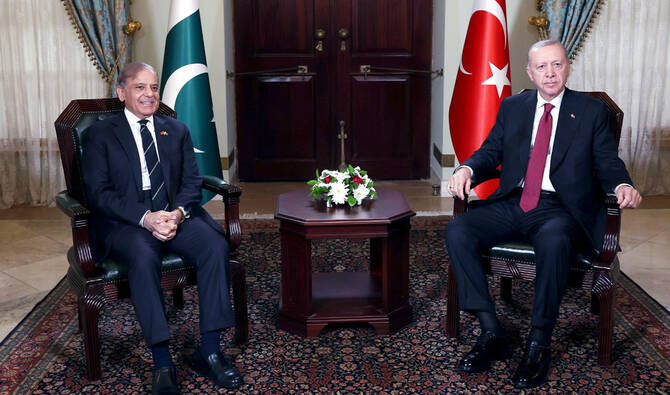
In this handout photo released by Government of Pakistan on May 25, 2025, Pakistan's Prime Minister, Shehbaz Sharif (left) meets President of Turkiye, Recep Tayyip Erdoğan, in Istanbul, Turkey.
Short Url
Updated 26 May 2025
Follow

At Istanbul meeting, Pakistan and Turkiye call for ‘unimpeded’ aid for Gaza

  • Pakistani and Turkish top leaders discuss regional and international developments, call for ‘immediate ceasefire’ in Gaza
  • Israel’s military offensive has killed 53,900 Palestinians since October 2023, according to Gaza health authorities

ISLAMABAD: Turkish President Tayyip Erdogan and Pakistan’s Prime Minister Shehbaz Sharif met in Istanbul on Sunday and called for an “immediate ceasefire” in Gaza and access to “unimpeded humanitarian aid” for the people of the besieged enclave.

Fresh Israeli military strikes killed at least 30 Palestinians across the Gaza Strip on Sunday. Israel launched its latest air and ground war in Gaza after a cross-border attack by the Hamas group on October 7, 2023, which killed 1,200 people by Israeli tallies, with 251 hostages abducted into Gaza. The war has killed more than 53,900 Palestinians since, according to Gaza health authorities, and devastated the coastal strip. 

The entire 2.1 million population of Gaza is facing prolonged food shortages, with nearly half a million people in a catastrophic situation of hunger, acute malnutrition, starvation, illness and death, according to the World Health Organization. Food security groups say more than 93 percent of children in Gaza, about 930,000, are at risk of famine. Using satellite data, the United Nations estimated in February that 69 percent of the structures in Gaza have been damaged or destroyed.

“Prime Minister Sharif and President Erdoğan discussed pressing regional and international developments,” Sharif’s office said in a statement after the two leaders held delegation-level talks in Istanbul.

“They also expressed deep concern over the grave humanitarian situation in Gaza, urgently calling for an immediate ceasefire and unimpeded humanitarian access to the affected Palestinian population.”

With most of Gaza’s two million population squeezed into an ever narrowing zone on the coast and in the area around the southern city of Khan Younis by Israel’s military operation, international pressure to get aid in quickly has ratcheted up.

Israel’s initial blockade on Gaza, immediately following the October 7 attacks, prevented the entry of humanitarian aid for several weeks. As the war progressed, aid has been allowed in limited quantities.

Israel has recently announced that a new aid system, sponsored by the United States and run by private contractors, will soon begin operations from four distribution centers in the south of Gaza, but many details of how the system will work remain unclear. The UN has already said it will not work with the new system, which it says will leave aid distribution conditional on Israel’s political and military aims.

Israel says its forces will only provide security for the centers and will not distribute aid themselves.

Even as the aid has begun to slowly trickle in, the Israeli military has continued its intensified ground and air operation launched last week, which Prime Minister Benjamin Netanyahu said would end with Israel taking full control of the Gaza Strip.


Pakistan offers Turkmenistan its Arabian Sea ports for wider access to ‘South Asia and beyond’

Updated 11 December 2025
Follow

Pakistan offers Turkmenistan its Arabian Sea ports for wider access to ‘South Asia and beyond’

  • PM Sharif meets Turkmen president in Ashgabat, calls for deeper trade and energy cooperation
  • Islamabad cites Karachi and Gwadar as key to boosting regional connectivity, including TAPI links

ISLAMABAD: Pakistan on Thursday urged Turkmenistan to expand trade and connectivity through Karachi and Gwadar, saying its Arabian Sea ports offer Turkmen businesses and exporters a direct route to South Asian and global markets, Prime Minister Shehbaz Sharif’s office said after high-level talks in Ashgabat.

Pakistan and Turkmenistan have long discussed regional transport corridors and energy cooperation, including the Turkmenistan–Afghanistan–Pakistan–India (TAPI) gas pipeline, a proposed multibillion-dollar project that would carry Turkmen natural gas south through Afghanistan into Pakistan and India. Islamabad has also pushed to link the landlocked Central Asian states to the sea by offering transit access through its deep-water ports, which sit at the crossroads of the Middle East, Central Asia and South Asia.

On Thursday, Pakistan's Sharif met Serdar Berdimuhamedov, the president of Turkmenistan, in Ashgabat as both countries look to revive momentum in bilateral engagement after years of regional instability. Pakistan has supported Turkmen neutrality policies at the United Nations, while Ashgabat has backed Pakistan during crises, including helping evacuate Pakistani nationals caught in Iran during the Iran–Israel conflict earlier this year.

“The Prime Minister reaffirmed Pakistan’s desire to enhance connectivity with Turkmenistan through land and sea routes and said that Karachi and Gwadar ports were ideally located to be utilized by the Turkmen side to enhance their outreach to South Asia and beyond,” Sharif’s office said in a statement.

Sharif reiterated his intention to deepen trade and economic ties with Turkmenistan, saying enhanced transport links and energy cooperation could anchor long-term regional integration. He invited President Berdimuhamedow and Turkmenistan’s national leader, Gurbanguly Berdimuhamedow, on official visits to Pakistan next year.

Sharif is on a two-day visit to Turkmenistan for the International Forum on Peace and Trust, accompanied by Deputy Prime Minister and Foreign Minister Ishaq Dar, Energy Minister Awais Leghari, Information Minister Attaullah Tarar and senior officials.

Turkmenistan’s president thanked Sharif for attending the UN-backed peace forum and said Ashgabat was keen to expand cooperation across multiple sectors, according to the statement.

