British king to visit Ottawa amid Trump-Canada tension

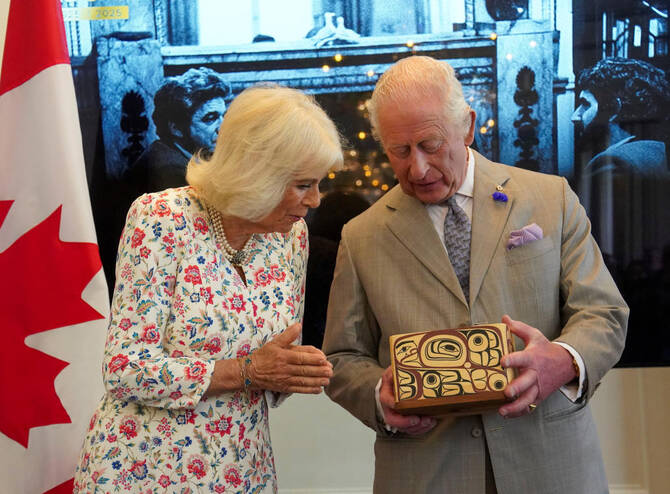
Britain’s King Charles and Queen Camilla visit Canada House to mark 100 years since it opened in London, Britain on May 20, 2025. (Reuters)
Short Url
Updated 23 May 2025
Follow

British king to visit Ottawa amid Trump-Canada tension

  • The 76-year-old monarch is also Canada’s head of state as part of the Commonwealth
  • Queen Camilla will accompany him on the 24-hour visit to the capital Ottawa

LONDON: Britain’s King Charles III will travel to Canada early next week for a brief but “impactful” visit, at a time when President Donald Trump is floating the idea of making his northern neighbor the 51st US state.

The 76-year-old monarch, who is also Canada’s head of state as part of the Commonwealth, has never publicly commented on the ambitions of the US president, a noted admirer of the royal family.

Despite battling cancer for over a year, Charles accepted an invitation from Canada’s newly appointed Prime Minister Mark Carney to deliver the “speech from the throne” at the reopening of parliament on May 27, outlining the new center-left government’s priorities.

Queen Camilla will accompany him on the 24-hour visit to the capital Ottawa.

“The King and Queen are very much looking forward to the program, mindful that it is a short visit but hopefully an impactful one,” a Buckingham Palace spokesperson said as the couple’s May 26-27 itinerary was released this week.

The throne speech is expected to draw close scrutiny, especially on sovereignty and trade, amid Trump’s renewed rhetoric about annexing the country of 41 million and his recent imposition of higher tariffs.

Charles “will outline our government’s plan to build Canada strong,” Carney said at a press conference on Wednesday.

Earlier he said: “This is a historic honor which matches the weight of our times.”

Traditionally, the speech is read by the governor general, the monarch’s representative in Canada.

The last British sovereign to deliver the speech in Canada was Queen Elizabeth II in 1977.

Carney, who became prime minister in late April, made defending Canada’s sovereignty central to his campaign.

During a May 6 meeting at the White House, he told Trump that Canada “is not for sale.”

“It won’t be for sale, ever,” he said, responding to the US president’s talk of the “tremendous benefits” of a “wonderful marriage.”

This will be Charles’s 20th visit to Canada, but his first since becoming king in September 2022. It is Camilla’s sixth visit and her first as queen.

The visit will begin Monday afternoon with a community event at the city’s Lansdowne Park celebrating Canada’s diversity and cultural heritage through music and crafts.

The king will also meet with Carney and Governor General Mary Simon.

At Rideau Hall, the official residence of the governor general, the king will plant a tree before a short reception with the lieutenant governors of Canada’s 10 provinces and the territorial commissioners.

On May 27, the king and queen will ride in a carriage pulled by 28 horses to the Senate for the throne speech, scheduled around 1500 GMT, with full military honors.

The visit will conclude with a wreath-laying at the Tomb of the Unknown Soldier.

A Canadian doctor has been assigned to the king, who is undergoing weekly treatment for an unspecified cancer.


A month on, flood-struck Aceh still reels from worst disaster since 2004 tsunami

Men wait to receive privately donated aid in in eastern Aceh regency of Aceh Tamiang, on Dec. 14, 2025. (AFP)
Updated 13 sec ago
Follow

A month on, flood-struck Aceh still reels from worst disaster since 2004 tsunami

  • Aceh accounts for almost half of death toll in Sumatra floods that struck in November
  • Over 450,000 remain displaced as of Friday, as governor extended state of emergency

JAKARTA: Four weeks since floodwaters and torrents of mud swept across Aceh province, villages are still overwhelmed with debris while communities remain inundated, forced to rely on each other to speed up recovery efforts.

The deadly floods and landslides, triggered by extreme weather linked to Cyclone Senyar, hit the provinces of North Sumatra, West Sumatra and Aceh in late November.

Aceh, the westernmost province of Indonesia, was the worst-hit. Accounting for almost half of the 1,137 death toll, a month later more than 450,000 people are still unable to return to their homes, as many struggle to access clean water, food, electricity and medical supplies.

“We saw how people resorted to using polluted river water for their needs,” Ira Hadiati, Aceh coordinator for the Medical Emergency Rescue Committee, or MER-C, told Arab News on Friday.

Many evacuation shelters were also lacking toilets and washing facilities, while household waste was “piling up on people’s lawns,” she added.

In many regions, people’s basic needs “were still unmet,” said Annisa Zulkarnain, a volunteer with Aceh-based youth empowerment organization Svara.

“Residents end up helping each other and that’s still nowhere near enough, and even with volunteers there are still some limitations,” she told Arab News. 

Volunteers and aid workers in Aceh have grown frustrated with the central government’s response, which many have criticized as slow and ineffective.

And Jakarta continues to ignore persistent calls to declare the Sumatra floods a national disaster, which would unlock emergency funds and help streamline relief efforts.

“It seems like there’s a gap between the people and the government, where the government is saying that funds and resources have been mobilized … but the fact on the ground shows that even to fix the bridges, it’s been ordinary people working together,” Zulkarnain said.

After spending the past two weeks visiting some of the worst-affected areas, she said that the government “really need to speed up” their recovery efforts.

Aceh Gov. Muzakir Manaf extended the province’s state of emergency for another two weeks starting Friday, while several district governments have declared themselves incapable of managing the disasters.

Entire villages were wiped out by the disastrous floods, which have also damaged more than 115,000 houses across Aceh, along with 141 health facilities, 49 bridges, and over 1,300 schools.

The widespread damage to roads and infrastructure continue to isolate many communities, with residents traveling for hours on foot or with motorbikes in search of basic supplies.

“Even today, some areas are still inundated by thick mud and there are remote locations still cut off because the bridges collapsed. For access, off-road vehicles are still required or we would use small wooden boats to cross rivers,” Al Fadhil, director of Geutanyoe Foundation, told Arab News.

“From our perspective, disaster management this time around is much worse compared to how it was when the 2004 tsunami happened.”

When the Indian Ocean earthquake and tsunami struck in 2004, Aceh was the hardest-hit of all, with the disasters killing almost 170,000 people in the province.

But MER-C’s Hadiati said that the impact of the November floods and landslides is “more extensive and far worse than the tsunami,” as 18 Acehnese cities and regencies have been affected — about twice more than in the 2004 disaster.

As Friday marks 21 years since the cataclysmic tsunami, Fadhil said the current disaster management was “disorganized,” and lacked leadership and coordination from the central government, factors that played a crucial role after 2004. 

“The provincial and district governments in Aceh, they’ve now done all they could with what they have,” he said.

“But their efforts stand against the fact that there’s no entry of foreign aid, no outside support, and a central government insisting they are capable.”