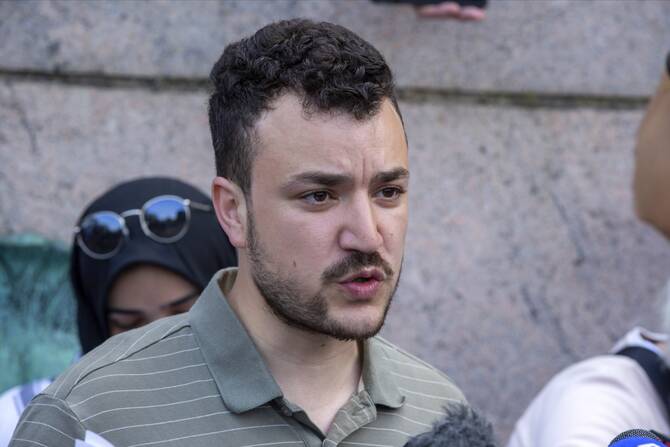
NEW YORK: Detained Palestinian activist Mahmoud Khalil was allowed to hold his one-month-old son for the first time Thursday after a federal judge blocked the Trump administration’s efforts to keep the father and infant separated by a plexiglass barrier.
The visit came ahead of a scheduled immigration hearing for Khalil, a legal permanent resident and Columbia University graduate who has been detained in a Louisiana jail since March 8.
Khalil was the first person arrested under President Donald Trump’s promised crackdown on pro-Palestinian protesters and is one of the few who has remained in custody as his case winds its way through both immigration and federal court.
Federal authorities have not accused Khalil of a crime, but they have sought to deport him on the basis that his prominent role in protests against Israel’s war in Gaza may have undermined US foreign policy interests.
His request to attend his son’s April 21 birth was denied last month by US Immigration and Customs Enforcement.
The question of whether Khalil would be permitted to hold his newborn child or forced to meet him through a barrier had sparked days of legal fighting, triggering claims by Khalil’s attorneys that he is being subject to political retaliation by the government.
On Wednesday night, a federal judge in New Jersey, Michael Farbiarz, intervened, allowing the meeting to go forward Thursday morning, according to Khalil’s attorneys.
The judge’s order came after federal officials said this week they would oppose his attorney’s effort to secure what’s known as a “contact visit” between Khalil, his wife, Noor Abdalla, and their son Deen.
Instead, they said Khalil could be allowed a “non-contact” visit, meaning he would be separated from his wife and son by a plastic divider and not allowed to touch them.
“Granting Khalil this relief of family visitation would effectively grant him a privilege that no other detainee receives,” Justice Department officials wrote in a court filing on Wednesday. “Allowing Dr. Abdalla and a newborn to attend a legal meeting would turn a legal visitation into a family one.”
Brian Acuna, acting director of the ICE field office in New Orleans, said in an accompanying affidavit that it would be “unsafe to allow Mr. Khalil’s wife and newborn child into a secured part of the facility.”
In their own legal filings, Khalil’s attorneys described the government’s refusal to grant the visit as “further evidence of the retaliatory motive behind Mr. Khalil’s arrest and faraway detention,” adding that his wife and son were “the farthest thing from a security risk.”
They noted that Abdalla had traveled nearly 1,500 miles (2,400 kilometers) to the remote detention center in hopes of introducing their son to his father.
“This is not just heartless,” Abdalla said of the government’s position. “It is deliberate violence, the calculated cruelty of a government that tears families apart without remorse. And I cannot ignore the echoes of this pain in the stories of Palestinian families, torn apart by Israeli military prisons and bombs, denied dignity, denied life.”
Farbiarz is currently considering Khalil’s petition for release as he appeals a Louisiana immigration judge’s ruling that he can be deported from the country.
On Thursday, Khalil appeared before that immigration judge, Jamee Comans, as his attorneys presented testimony about the risks he would face if he were to be deported to Syria, where he grew up in a refugee camp, or Algeria, where he maintains citizenship through a distant relative.
His attorneys submitted testimony from Columbia University faculty and students attesting to Khalil’s character.
In one declaration, Joseph Howley, a classics professor at Columbia, said he had first introduced Khalil to a university administrator to serve as a spokesperson on behalf of campus protesters, describing him as a “upstanding, principled, and well-respected member of our community.’
“I have never known Mahmoud to espouse any anti-Jewish sentiments or prejudices, and have heard him forcefully reject antisemitism on multiple occasions,” Howley wrote.
No ruling regarding the appeal was made on Thursday. Comans gave lawyers in the case until 5 p.m. June 2 to submit written closing arguments.
Columbia’s interim president, Claire Shipman, acknowledged Mahmoud’s absence from Wednesday’s commencement ceremony and said many students were “mourning” that he couldn’t be present. Her speech drew loud boos from some graduates, along with chants of “free Mahmoud.”


![]()

Mahmoud Khalil permitted to hold newborn son for the 1st time despite government objections
Short Url
https://arab.news/jf6fc
Mahmoud Khalil permitted to hold newborn son for the 1st time despite government objections
- Khalil was the first person arrested under President Donald Trump’s promised crackdown on pro-Palestinian protesters


Latest updates


© 2026 SAUDI RESEARCH & PUBLISHING COMPANY, All Rights Reserved And subject to Terms of Use Agreement.