

Pakistan seeks World Bank’s technical help to fast track $20 billion development framework

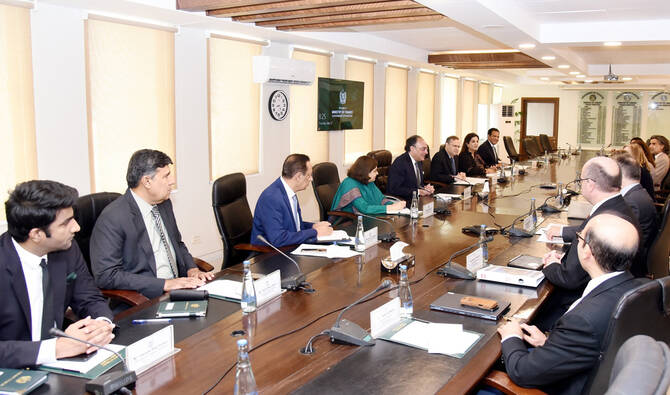
Pakistan Finance Minister Muhammad Aurangzeb (5L) speaks during a meeting with the visiting World Bank delegation at the Finance Division in Islamabad on May 22, 2025. (Photo courtesy: Handout/Finance Ministry)
Short Url
Updated 22 May 2025
Follow

Pakistan seeks World Bank’s technical help to fast track $20 billion development framework

  • The Country Partnership Framework was approved by the World Bank’s executive directors in January
  • It aims to support Pakistan’s development by promoting private sector-led growth, climate resilience

KARACHI: Pakistan on Thursday sought the World Bank’s technical assistance to fast track the implementation of the Country Partnership Framework (CPF) discussed between the two sides earlier this year, according to an official statement circulated by the finance ministry.

The World Bank’s Board of Executive Directors endorsed the framework in January, aiming to support Pakistan’s long-term development by building human capital, promoting private sector-led growth and enhancing climate resilience through up to $20 billion in pledged lending over the next decade.

A World Bank delegation led by Managing Director for Operations Anna Bjerde met with Finance Minister Muhammad Aurangzeb in Islamabad during the day to review the Bank’s financing portfolio and strengthen bilateral cooperation.

“We are focused on ensuring that climate resilience and sustainable development remain at the heart of our economic planning,” Aurangzeb said, according to the statement. “The CPF represents an important opportunity, and we aim to implement it with full coordination across key ministries and stakeholders.”

The finance ministry said Aurangzeb requested the visiting delegation “to provide technical leadership and assistance to streamline processes and ensure a prioritized and focused rollout of the CPF.”

Bjerde praised Pakistan for continuing with difficult economic reforms under challenging circumstances and for aligning its growth with environmental sustainability.

She also reiterated the Bank’s support for initiatives in areas such as taxation, energy and social protection, while emphasizing girls’ education and women’s empowerment as critical to human capital and economic resilience.

Later in the day, the delegation also met Prime Minister Shehbaz Sharif.

According to a separate statement circulated by Sharif’s office, the prime minister welcomed the delegation and thanked the World Bank for playing a key role in the country’s development.

“We are grateful to the World Bank for the Country Partnership Framework, under which development investments exceeding $20 billion will be made in Pakistan,” he said.

Bjerde, in turn, commended Pakistan’s macroeconomic performance and recent stabilization efforts, describing the CPF as a “model” for other countries.

The meeting was also attended by federal ministers, advisers, parliamentarians and senior government officials along with World Bank Country Director Najy Benhassine.

Pakistani lawmaker says parliamentary committee to review high smartphone taxes next month

Updated 7 sec ago
Follow

Pakistani lawmaker says parliamentary committee to review high smartphone taxes next month

  • MNA Qasim Gilani calls high import taxes on smartphones 'excessive' after lobbying against them
  • FBR official says taxes have increased local assembly, with 95% handsets now made in Pakistan

ISLAMABAD: A Pakistani lawmaker campaigning to reduce heavy taxes on iPhones and other smart devices said on Tuesday the government has assured that a parliamentary committee will take up the issue next month and work toward a resolution.
Qasim Gilani, a National Assembly member and son of ex-premier and current Senate Chairman Syed Yousuf Raza Gilani, has been lobbying across party lines to ease what he called “unjust and unaffordable” taxes on imported smartphones.
He said that modern devices, especially high-end phones used for work and digital income, are not a luxury item but a necessity for Pakistan’s youth and information technology sector.
Gilani said he had planned to move a resolution against the Pakistan Telecommunication Authority's (PTA) mobile registration tax in the National Assembly but held back after the government urged him to wait for an upcoming committee meeting.
“I have postponed the resolution against unjust PTA tax, which affects millions of Pakistanis, including overseas nationals,” he told Arab News. “The government assured me the issue will be resolved through a parliamentary committee where the FBR [Federal Board of Revenue] chairman will be present.”
The FBR is a government agency responsible for imposing taxes for revenue collection.
Gilani said the National Assembly's Finance Committee will take up the issue on Dec. 3 in the presence of relevant officials, adding he has already secured support from across the political spectrum, including Pakistan Peoples Party Chairman Bilawal Bhutto-Zardari and members of other parties.
He said he was also seeking a meeting with Prime Minister Shehbaz Sharif to build consensus that smartphone taxes should be reduced.
Elaborating his case, the lawmaker said the current tax structure on smartphones was excessive, citing his own experience.

“I paid half a million rupees in tax on just two phones, almost as much as I paid for my car registration," he said. "This is excessive.”
Gilani said he had taken up the matter with IT Minister Shaza Fatima Khawaja and others, all of whom agreed the tax was problematic.
Pakistan’s mobile phone taxes are applied according to the device’s price and whether it is registered on a passport or a computerized national identity card (CNIC).
The amount that needs to be paid on a device registered on a CNIC is much higher.
The FBR website shows low-cost phones carry fixed charges ranging from Rs430 ($1.5) to Rs9,580 ($34). However, devices priced above $200 are taxed more heavily through a combination of a fixed amount plus a 17% sales tax.
A device priced above $500 requires a consumer to pay Rs27,600 ($98) plus 17% sales tax if registered on a passport, or Rs37,007 ($131) plus 17% sales tax if registered on a CNIC.
Overall, the system heavily penalizes expensive smartphones, making high-end devices significantly costlier in Pakistan.
According to Azhar Abbasi, an Apple reseller based in Islamabad, the current PTA tax on the iPhone 17 Pro Max is Rs213,631 ($756) on CNIC.
Asked about the situation, a senior FBR official told Arab News on condition of anonymity that these taxes on smartphones have led to increased local manufacturing.
“More than 95 percent of the 34 million handsets sold in Pakistan are now assembled locally, including Samsung models," he said. "Only 700,000 imported handsets came into the country last year, and just 10 percent of those were iPhones.”
The official acknowledged public frustration mainly arises from taxes on high-end phones, which represent only a small segment of the market, and added the government was working on reforms.