

Lebanon pushes for local elections despite Israeli attacks

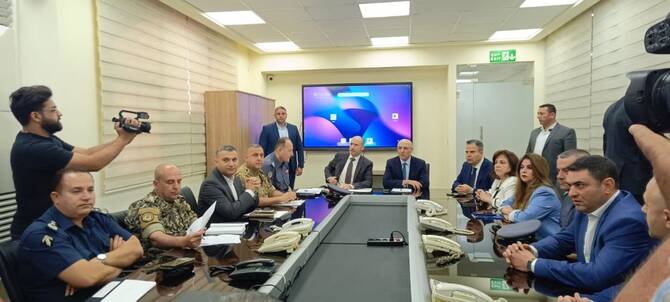
Interior Minister Ahmad Hajjar, in Sidon, on Tuesday, affirmed that “the government is mindful of the potential for Israeli violations and assaults during the municipal elections.” (Supplied)
Short Url
Updated 20 May 2025
Follow

Lebanon pushes for local elections despite Israeli attacks

  • Interior minister underlines commitment to ensure elections are conducted with integrity and safety
  • Elections in the South and Nabatieh governorates, scheduled for their fourth phase this coming Saturday, will be held during ongoing Israeli incursions south and north of the Litani River

BEIRUT: The Lebanese government still faces one final — and perhaps the most security sensitive — electoral challenge: the elections in the South and Nabatieh governorates.

These elections, scheduled for their fourth phase this coming Saturday, will be held during ongoing Israeli incursions south and north of the Litani River.

Interior Minister Ahmad Hajjar, in the southern city of Sidon on Tuesday, affirmed that “the government is mindful of the potential for Israeli violations and assaults during the municipal elections scheduled for Saturday. However, the decision remains clear and resolute regarding the continuation of the electoral process regardless of the circumstances.”

The minister emphasized to Mansour Daou, the governor of South Lebanon, and representatives of the security, military, and judicial agencies in the South, “the state’s commitment to ensuring that the elections are conducted with integrity and safety,” underscoring their significance as part of the reconstruction process for the people of the South.

In the lead-up to the elections, an Israeli military drone targeted a motorcycle on the road between Mansouri and Majdalzoun in the Tyre district, resulting in reports from the Ministry of Health indicating that “nine individuals were injured, including two children, with three of the injured in critical condition.”

Another Israeli drone launched a bomb at fishermen off the coast of Ras Al-Naqoura.

Attention in the south is focused on two issues: observing the extent to which people will participate in the elections, particularly those whose homes were destroyed and displaced to other villages; and monitoring Hezbollah’s ability to maintain its popularity in the south, where the devastation and rubble are still visible to the public. To date, no reconstruction has occurred in any facilities either north or south of the Litani River, because Israel has turned the border area into a devastated and desolate zone, maintaining its occupation of five strategic hills and daily thwarting any attempts to establish readymade rooms for logistical purposes to assist the affected population.

The latest data from the Lebanese Ministry of Health, as of May 12, indicates that since the ceasefire between Israel and Hezbollah took effect on Nov. 27, “Israel has killed 156 individuals and injured 376 others, with a total of 3,138 air and maritime violations recorded.”

According to the Israeli army, “by the end of April, around 140 Hezbollah members had been eliminated, with the vast majority of assassinations (more than 50 percent) taking place south of the Litani River. Assassinations north of the Litani River and in the Bekaa region accounted for 48 percent of the operations; 33.3 percent north of the Litani River and 14.7 percent in the Bekaa.”

The Israeli army claimed that “the majority of the assassinated members belonged to Hezbollah’s Aziz, Nasr and Badr units.” In a new study, the Israeli Alma Center stated: “Those individuals were involved in the rehabilitation of infrastructure on the ground.” 


US military launches strikes in Syria against Daesh fighters after American deaths

Updated 20 December 2025
Follow

US military launches strikes in Syria against Daesh fighters after American deaths

  • “This is not the beginning of a war — it is a declaration of vengeance,” Defense Secretary Pete Hegseth says
  • President Trump earlier pledged “very serious retaliation” but stressed that Syria was fighting alongside US troops

WASHINGTON: The Trump administration launched military strikes Friday in Syria to “eliminate” Daesh group fighters and weapons sites in retaliation for an ambush attack that killed two US troops and an American interpreter almost a week ago.
A US official described it as “a large-scale” strike that hit 70 targets in areas across central Syria that had Daesh (also known as Islamic State or IS) infrastructure and weapons. Another US official, who also spoke on condition of anonymity to discuss sensitive operations, said more strikes should be expected.
The attack was conducted using F-15 Eagle jets, A-10 Thunderbolt ground attack aircraft and AH-64 Apache helicopters, the officials said. F-16 fighter jets from Jordan and HIMARS rocket artillery also were used, one official said.
“This is not the beginning of a war — it is a declaration of vengeance. The United States of America, under President Trump’s leadership, will never hesitate and never relent to defend our people,” Defense Secretary Pete Hegseth said on social media.


President Donald Trump had pledged “very serious retaliation” after the shooting in the Syrian desert, for which he blamed Daesh. The troops were among hundreds of US troops deployed in eastern Syria as part of a coalition fighting the terrorist group.
Trump in a social media post said the strikes were targeting Daesh “strongholds.” He reiterated his support for Syrian President Ahmad Al-Sharaa, who he said was “fully in support” of the US effort to target the militant group.
Trump also offered an all-caps threat, warning the group against attacking US personnel again.
“All terrorists who are evil enough to attack Americans are hereby warned — YOU WILL BE HIT HARDER THAN YOU HAVE EVER BEEN HIT BEFORE IF YOU, IN ANY WAY, ATTACK OR THREATEN THE USA.,” the president added.
The attack was a major test for the warming ties between the United States and Syria since the ouster of autocratic leader Bashar Assad a year ago. Trump has stressed that Syria was fighting alongside US troops and said Al-Sharaa was “extremely angry and disturbed by this attack,” which came as the US military is expanding its cooperation with Syrian security forces.
Syria’s foreign ministry in a statement on X following the launch of US strikes said that last week’s attack “underscores the urgent necessity of strengthening international cooperation to combat terrorism in all its forms” and that Syria is committed “to fighting Daesh and ensuring that it has no safe havens on Syrian territory and will continue to intensify military operations against it wherever it poses a threat.”


Daesh has not claimed responsibility for the attack on the US service members, but the group has claimed responsibility for two attacks on Syrian security forces since, one of which killed four Syrian soldiers in Idlib province. The group in its statements described Al-Sharaa’s government and army as “apostates.” While Al-Sharaa once led a group affiliated with Al-Qaeda, he has had a long-running enmity with Daesh.
Syrian state television reported that the US strikes hit targets in rural areas of Deir ez-Zor and Raqqa provinces and in the Jabal Al-Amour area near Palmyra. It said they targeted “weapons storage sites and headquarters used by Daesh as launching points for its operations in the region.”

Trump this week met privately with the families of the slain Americans at Dover Air Force Base in Delaware before he joined top military officials and other dignitaries on the tarmac for the dignified transfer, a solemn and largely silent ritual honoring US service members killed in action.

President Donald Trump, from left, Defense Secretary Pete Hegseth and Chairman of the Joint Chiefs Air Force Gen. Dan Caine attend a casualty return ceremony at Dover Air Force Base, Delaware, on Dec. 17, 2025,of soldiers who were killed in an attack in Syria last week. (AP)

The guardsmen killed in Syria last Saturday were Sgt. Edgar Brian Torres-Tovar, 25, of Des Moines, and Sgt. William Nathaniel Howard, 29, of Marshalltown, according to the US Army. Ayad Mansoor Sakat, of Macomb, Michigan, a US civilian working as an interpreter, was also killed.
The shooting nearly a week ago near the historic city of Palmyra also wounded three other US troops as well as members of Syria’s security forces, and the gunman was killed. The assailant had joined Syria’s internal security forces as a base security guard two months ago and recently was reassigned because of suspicions that he might be affiliated with Daesh, Interior Ministry spokesperson Nour Al-Din Al-Baba has said.
The man stormed a meeting between US and Syrian security officials who were having lunch together and opened fire after clashing with Syrian guards.
When asked for further information, the Pentagon referred AP to Hegseth’s social media post.