

Europe lifts all remaining sanctions on Syria

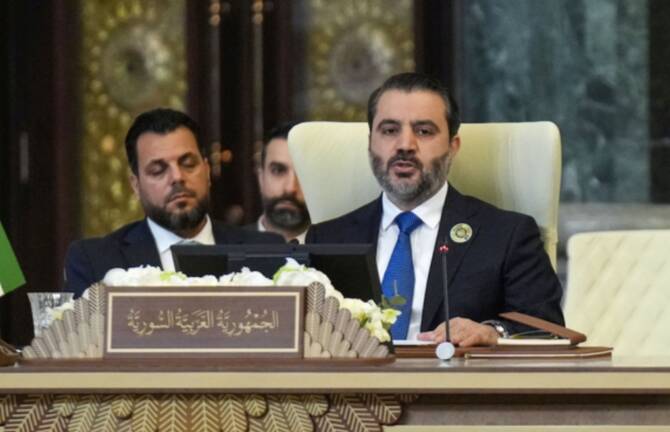
Asaad al-Shaibani, Syria's foreign minister said on Tuesday that the lifting of sanctions on his country shows an "international will" to support his country. (WAM/File)
Short Url
Updated 20 May 2025
Follow

Europe lifts all remaining sanctions on Syria

  • Lifting sanctions expresses the regional and international will to support Syria, said Al-Shaibani

BRUSSELS: EU foreign ministers agreed on Tuesday to lift the bloc’s last remaining economic sanctions on the new administration in Syria.

“We want to help the Syrian people rebuild a new, inclusive and peaceful Syria,” foreign policy chief Kaja Kallas said. “The EU has always stood by Syrians throughout the past 14 years, and will keep doing so.”

Europe had already eased some sanctions related to energy, transport and reconstruction, as well as associated financial transactions, but many member states felt those measures were insufficient to support Syria’s political transition and economic recovery.

US President Donald Trump ordered the end of American sanctions on Syria during a visit to Riyadh this month. Syria’s Foreign Minister Asaad Al-Shaibani said the moves showed “regional and international will to support Syria.”

He said: “The Syrian people today have a very important and historic opportunity to rebuild their country. The plan today is to benefit from the lifting of sanctions. Anyone who wants to invest in Syria, the doors are open; anyone who wants to cooperate with Syria, there are no sanctions.”

Al-Shaibani spoke on a visit to Jordan, where the two countries signed a new cooperation agreement on energy, water, industry, trade, transport and health. Syria was “in a new phase, and Syria’s success requires giving it a chance to succeed,” Jordanian Foreign Minister Ayman Safadi said.


Hoping for better year ahead, Gazans bid farewell to ‘nightmare’

Updated 20 sec ago
Follow

Hoping for better year ahead, Gazans bid farewell to ‘nightmare’

  • Humanitarian agencies have warned that shortages of food, clean water and medical supplies persist, while winter conditions are worsening life in overcrowded camps

GAZA CITY: As 2025 draws to a close, Palestinians in Gaza are marking the new year not with celebration, but with exhaustion, grief and a fragile hope that their “endless nightmare” might finally end.

For residents of the battered territory, daily life is a struggle for survival.

Much of Gaza’s infrastructure lies in ruins, electricity remains scarce and hundreds of thousands of people live in makeshift tents after being repeatedly displaced by the two years of fighting that began with Hamas’s attack on Israel in October 2023.

“We in the Gaza Strip are living in an endless nightmare,” said Hanaa Abu Amra, a displaced woman in her thirties living in Gaza City. “We hope that this nightmare will end in 2026 ... The least we can ask for is a normal life — to see electricity restored, the streets return to normal and to walk without tents lining the roads,” she said.

Across Gaza, a territory of more than 2 million people, scenes of hardship are commonplace.

The outgoing year brought relentless loss and fear, said Shireen Al-Kayali.

“We bid farewell to 2025 with deep sorrow and grief,” she said.

“We lost a lot of people and our possessions. We lived a difficult and harsh life, displaced from one city to another, under bombardment and in terror.”

Her experience reflects that of countless Gazans who have been forced to flee repeatedly, often with little warning, taking with them only what they could carry.

Entire families have been uprooted, livelihoods destroyed, and communities fragmented as the war dragged on for two years.

Despite the devastation, some residents cling to the belief that the new year might bring an end to the fighting and a chance to rebuild.

For many Gazans, hope has become an act of resilience, particularly after the truce that came into effect on October 10 and has largely halted the fighting.

“We still hope for a better life in the new year, and I call on the free world to help our oppressed people so we can regain our lives,” said Khaled Abdel Majid, 50, who lives in a tent in Jabalia camp.

Faten Al-Hindawi hoped the truce would finally end the war.

“We will bid farewell to 2025, leaving behind its pain, and we hope that 2026 will be a year of hope, prayer, determination and success stories.”