PARIS: Breaking with tradition at the Tour de France is stirring controversy.
Since race organizers announced plans last week to climb the iconic Montmartre hill in Paris during the final stage in July, the cycling world has been abuzz. Could the climb actually decide the Tour winner? Or disrupt the final sprint by injecting tactical uncertainty into what is usually a celebratory day?
Well, that remains to be seen. But one thing seems certain: The stage will be a spectacle.
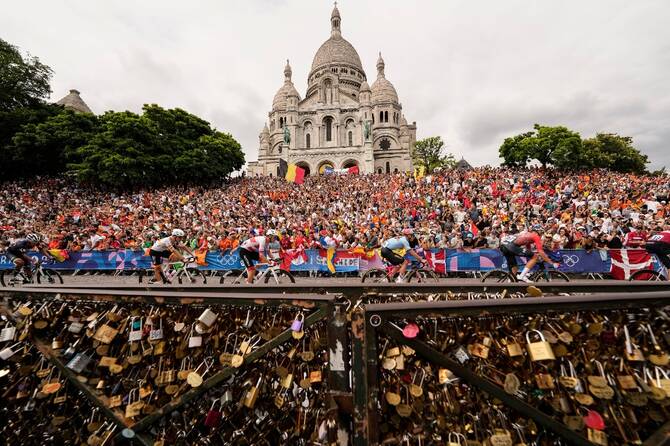
At last year’s Olympics, massive crowds lined the streets of Montmartre — the area in the northern part of Paris that is popular among artists and offers grand vistas of the city — to cheer on riders.
Inspired by the frenetic atmosphere and willing to build on the momentum, Tour organizers said this month that riders competing in cycling’s biggest race this summer would climb the Montmartre hill and pass beneath the Sacré-Coeur basilica before “battling it out on a stage that may break from the traditions established over the past 50 years in the heart of the capital.”
Traditionally, the Tour final stage is largely processional until a sprint decides the day’s winner on the Champs-Élysées. Last year’s final stage was held outside Paris for the first time since 1905 because of a clash with the Olympics, moving instead to Nice. The world famous avenue is back on the program this year for the conclusion of the 3,320-kilometer (2,060-mile) race.
The inclusion of the steep Montmartre climb could dramatically change the dynamics of the stage. If the hill features just a few kilometers from the finish line, or is climbed several times, pure sprinters will likely be dropped before they can compete for the stage win. And if the general classification remains tight ahead of the final stage, the yellow jersey itself could be decided in Paris.
Riders not happy
Full details of the route will be presented at a news conference on Wednesday. With a peloton roughly twice as big as it was at the Olympics, organizers are working with Paris authorities and the Prefecture of police to ensure the security of the race on the narrow and cobbled streets of the area. But some top riders have already expressed their lack of enthusiasm about the addition.
“Montmartre was nice to do in the Olympics, it seemed good, a lot of people, a really good atmosphere,” two-time Tour champion Jonas Vingegaard told reporters this week. “But when they came to the Montmartre, there was only 15 riders left in the bunch. And when we do the Tour de France, there will be 150 guys fighting for positions on a very narrow climb. It could end up being more stress than they want to have.”
Even Remco Evenepoel, who won the Olympic men’s road race in Paris last year and the gold medal in the time trial, is also opposed to the idea.
“There will be enough battle for positioning in the first week of the Tour,” he told sports media Sporza. “With Montmartre added, that would mean we have to do the same on the last day. We will be tired enough by then.”
Evenepoel also lamented the fact that sprinters would be robbed of a rare chance to claim a prestigious win on the world famous avenue.
“They get a big chance every year to sprint for a stage win on the Champs-Elysées,” he said. “That chance is then taken away from them. In my opinion, Montmartre is an unnecessary obstacle.”
Marc Madiot, who manages the Groupama-FDJ team, said bad weather on the final day could make the stage more treacherous.
“Imagine a slight rain in Paris; it’s not going to be easy for the riders,” he told RMC Radio. “Do we want a show? Do we want to visit Paris? Do we want to commemorate the Olympics? If we expect a real race, we could be disappointed. And if we do get a real race, we put everything that has happened in the last three weeks in jeopardy.”
The Tour starts from the northern city of Lille on July 5, and the women’s race kicks off on July 26 from the Brittany town of Vannes.

Tour de France’s new Montmartre climb could be a game changer. It sparks controversy
Short Url
https://arab.news/6tbzg
Tour de France’s new Montmartre climb could be a game changer. It sparks controversy
Sabalenka says ‘Battle of the Sexes’ pays off after ruthless win
- Aryna Sabalenka said her much-maligned exhibition match against Nick Kyrgios had paid dividends as she demolished Cristina Bucsa on Tuesday to launch her Australian Open preparations
BRISBANE: Aryna Sabalenka said her much-maligned exhibition match against Nick Kyrgios had paid dividends as she demolished Cristina Bucsa on Tuesday to launch her Australian Open preparations.
The world number one took just 48 minutes to dispose of the Spaniard 6-0, 6-1 in the second round of the season-opening Brisbane International.
The ease of the win against the world number 50 will send a warning to the Belarusian’s rivals ahead of the Australian Open starting January 18.
She raced through the first set in just 22 minutes and took only 26 minutes to claim the second against an opponent who had no answer to the power of the 27-year-old.
Sabalenka said the fact that she played so well in her first match of the season showed that the December 28 exhibition in Dubai against the mercurial but controversial Kyrgios was worthwhile.
“I mean, when you play against a guy, the intensity is completely different,” she said.
“Especially when there is Nick, who is drop-shotting every other shot, so you move a lot, so there was a great fitness for me.
“And today I was, like, whew, let’s move around, you know.
“That exhibition, it was fun. It was a great challenge,” she added.
“I think we brought so many eyes on tennis. It wasn’t about proving something to anyone, it was able to show that tennis can be really huge.”
Sabalenka will now play either Jelena Ostapenko or Sorana Cirstea in the third round and remains on track to meet Madison Keys in the quarter-finals in a rematch of last year’s Australian Open final, won by the American.
Keys reached the Brisbane third round with a 6-4, 6-3 win over fellow American McCartney Kessler.
Like Sabalenka, Keys had a bye into the second round and said she had found it tough to find her rhythm early on.
“I think it’s sometimes a little bit harder when the person you’re playing has already played a match, and then you’re kind of trying to still knock off a bit of the rust,” she said.
“I felt like it took a little bit just to find my rhythm, but I feel like once I did it, I kind of settled in a little bit better.”
There were two major upsets in the men’s draw with second-seeded Spaniard Alejandro Davidovich Fokina and Canada’s fifth seed, Denis Shapovalov both losing.
American Brandon Nakashima downed Davidovich Fokina 7-6 (7/4), 6-4 while Belgian qualifier Raphael Collignon beat Shapovalov 6-4, 6-2.
The world number one took just 48 minutes to dispose of the Spaniard 6-0, 6-1 in the second round of the season-opening Brisbane International.
The ease of the win against the world number 50 will send a warning to the Belarusian’s rivals ahead of the Australian Open starting January 18.
She raced through the first set in just 22 minutes and took only 26 minutes to claim the second against an opponent who had no answer to the power of the 27-year-old.
Sabalenka said the fact that she played so well in her first match of the season showed that the December 28 exhibition in Dubai against the mercurial but controversial Kyrgios was worthwhile.
“I mean, when you play against a guy, the intensity is completely different,” she said.
“Especially when there is Nick, who is drop-shotting every other shot, so you move a lot, so there was a great fitness for me.
“And today I was, like, whew, let’s move around, you know.
“That exhibition, it was fun. It was a great challenge,” she added.
“I think we brought so many eyes on tennis. It wasn’t about proving something to anyone, it was able to show that tennis can be really huge.”
Sabalenka will now play either Jelena Ostapenko or Sorana Cirstea in the third round and remains on track to meet Madison Keys in the quarter-finals in a rematch of last year’s Australian Open final, won by the American.
Keys reached the Brisbane third round with a 6-4, 6-3 win over fellow American McCartney Kessler.
Like Sabalenka, Keys had a bye into the second round and said she had found it tough to find her rhythm early on.
“I think it’s sometimes a little bit harder when the person you’re playing has already played a match, and then you’re kind of trying to still knock off a bit of the rust,” she said.
“I felt like it took a little bit just to find my rhythm, but I feel like once I did it, I kind of settled in a little bit better.”
There were two major upsets in the men’s draw with second-seeded Spaniard Alejandro Davidovich Fokina and Canada’s fifth seed, Denis Shapovalov both losing.
American Brandon Nakashima downed Davidovich Fokina 7-6 (7/4), 6-4 while Belgian qualifier Raphael Collignon beat Shapovalov 6-4, 6-2.
© 2026 SAUDI RESEARCH & PUBLISHING COMPANY, All Rights Reserved And subject to Terms of Use Agreement.