

Pakistan eyes mining deals with global firms at upcoming Future Minerals Forum in Riyadh

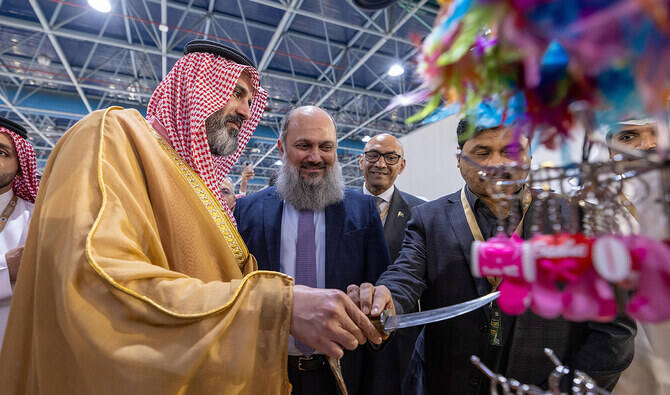
Pakistan's Federal Minister for Commerce Jam Kamal Khan (second from left) inaugurates ‘Made in Pakistan’ expo in Jeddah, Saudi Arabia, on February 5, 2025. (Pakistan commerce ministry)
Short Url
Updated 06 January 2026
Follow

Pakistan eyes mining deals with global firms at upcoming Future Minerals Forum in Riyadh

  • Forum will be attended by around 20,000 representatives from governments, businesses and associations from over 160 countries
  • Official says Pakistani companies will be showcasing the nation’s mineral potential at the three-day event starting on Jan. 13

KARACHI: Pakistan expects to sign agreements with various international mining companies at the upcoming Future Minerals Forum (FMF) summit in the Saudi capital of Riyadh next week, officials at the state-run Pakistan Petroleum Limited (PPL) exploration firm said on Monday.

The FMF will be attended by around 20,000 representatives from governments, businesses, multilateral and non-governmental organizations, academic institutions and trade associations from more than 160 countries, according to the organizers. Last year, over 3,500 business meetings took place at the forum, during which 126 MoUs and agreements had been signed.

At least 13 public and private companies from Pakistan’s mines and mineral sector will participate in the three-day annual event at the King Abdulaziz International Conference Center in Riyadh on Jan. 13, with the PPL being the lead organizer from Pakistan.

Other Pakistani firms participating in the event include Mari Minerals and Mari Energies, Oil & Gas Development Company Limited (OGDCL), Pakistan Mineral Development Corporation (PMDC), Frontier Works Organization (FWO), Balochistan Mineral Resources Limited (BMRL), Pakistan Minerals Private Limited (PMPL), Government Holdings (Private) Limited, Balochistan Mineral Exploration Company (BMEC), Saindak Metals Limited, Globacore Minerals Limited, Bolan Mining Enterprises and Biafo Industries Limited, according to documents seen by Arab News.

“There are certain MoUs in pipeline with different international mining companies likely to be signed during FMF,” Ajaz Ahmed Khan, a general manager at PPL’s shared services department, told Arab News.

In recent years, Saudi Arabia has positioned itself as a leader in the global minerals and energy sectors and accelerated investments in green technologies, sustainable mining practices, and international collaborations that are shaping the future of the mines and mineral industry.

Pakistani companies will be showcasing the nation’s mineral potential at the Saudi event, according to Khan.

“We are focusing to promote our Pakistan Mineral Investment Forum (PMIF) planned in April in Pakistan, where all major countries and international companies have been invited,” the PPL official said.

Pakistan’s government plans to organize PMIF 2026 in Islamabad to attract foreign investment in the mines and minerals sector. The South Asian country lies in the middle of the mineral-rich geological zone, called the ‘Tethyan Belt,’ where one of the world’s largest copper-gold mines is currently under development at Reko Diq, which is expected to start production by 2028.

“Many other similar initiatives and blocks are currently under exploration or in various stages of development, which make Pakistan a crucial partner in this energy transition,” Petroleum Minister Ali Pervaiz Malik said in a video message, noting that Pakistan last year benchmarked its fiscal and regulatory environment with the best mining jurisdictions in the world to seek patient capital and formalize its mining sector.

At the FMF, Islamabad will set up a dedicated pavilion, titled ‘Pakistan – The Mineral Marvel,’ aimed at showcasing the vast potential and promise of Pakistan’s rich geological landscape to the global mineral community, according to documents seen by Arab News.

Malik will lead a delegation, comprising officials and business leaders from Pakistani mineral companies, at the forum. The South Asian nation will hold a 90-minute Country Showcase Session at the FMF that will feature the petroleum minister, chief executives of Pakistani companies, foreign investors and international experts.


Bangladesh treads carefully as it explores closer defense ties with Pakistan

Updated 13 sec ago
Follow

Bangladesh treads carefully as it explores closer defense ties with Pakistan

  • Air force chiefs of Pakistan and Bangladesh discussed potential defense pact last week
  • Dhaka says plan to procure fighter jets still in early stages, discussions ongoing with several countries

DHAKA: Bangladesh appears to be moving with caution as Dhaka and Islamabad forge closer ties and explore a potential defense deal, experts said on Friday. 

Following decades of acrimonious ties, relations between Bangladesh and Pakistan have been growing since a student-led uprising ousted former Prime Minister Sheikh Hasina in 2024. 

Talks on a potential defense deal covering the sale of Pakistan’s JF-17 fighter jets to Dhaka emerged after Bangladesh’s Air Chief Marshal Hasan Mahmood Khan visit to Rawalpindi last week, where he met with his Pakistani counterpart Air Chief Marshal Zaheer Ahmed Baber Sidhu and Field Marshal Syed Asim Munir, Pakistan’s chief of defense forces. 

Bangladesh’s military media wing, the Inter-Services Public Relations, said the procurement of fighter jets for the Bangladesh Air Force is “in the very rudimentary level,” and currently “under an evaluation process.” 

“The evaluation process will determine which country’s offer proves befitting for us. The Air Chief’s visit to Pakistan is part of the evaluation process … earlier he visited China, Italy (too),” ISPR Director Lt. Col. Sami Ud Dowla Chowdhury told Arab News. 

“Discussions are underway with different countries. Nothing concrete has come yet.” 

Talks between the high-ranking military officials are the latest development in Bangladesh-Pakistan ties, which have included resumption of direct trade for the first time since the 1971 war and the expected launch of a regular route from Dhaka to Karachi at the end of this month, following over a decade of suspension. 

Though efforts to expand relations can be seen from both sides, the current interim government of Bangladesh led by economist and Nobel Prize laureate Muhammad Yunus has been “showing some kind of pragmatism,” said Prof. Delwar Hossain of Dhaka University’s international relations department. 

“Bangladesh is stepping very cautiously in comparison with the advancement from the Pakistan side. Bangladesh is trying to make a balanced approach,” he told Arab News. 

“The present government is always saying that the development of a relationship with Pakistan doesn’t necessarily mean that Bangladesh is moving toward a particular camp. Rather, Bangladesh is interested in having a balanced relationship with all the great powers.” 

Trade and economy are “naturally” more preferable areas of cooperation for Dhaka, Hossain said, adding that “we need more time to determine” how far military cooperation will be expanded. 

Ishfaq Ilahi Choudhury, a defense expert and retired air officer of Bangladesh Air Force, said that Bangladesh is “very much in need of advanced aircraft” because its military has not procured new fighter jets in at least two decades. 

“Air frigate fighters are badly needed for the Bangladesh Air Force. We had some F-7 produced by China, but they stopped producing these fighters nowadays. Here, Pakistan can be a source for our fighter jets, but it involves … geopolitics,” he told Arab News, alluding to how Dhaka’s defense ties with Pakistan may be perceived by its archrival neighbor India. 

Pakistan’s JF-17 fighter jets, a multi-role combat aircraft jointly developed with China, has drawn international interest following its success last May, when Pakistani and Indian forces engaged in their worst fighting since 1999. 

Islamabad said it shot down several Indian fighter jets during the aerial combat, a claim Indian officials later acknowledged after initially denying any losses, but without specifying the number of jets downed. 

“We shouldn’t also forget that both India and Pakistan are at each other’s foot. Here, our friendship with Pakistan shouldn’t go at the cost of our friendship with India,” Choudhury said. 

“With this (potential) defense purchase deal with Pakistan, we have to remain very cautious so that it proves sustainable in the long term.”